

Published by AgamiSoft | Reading time: ~14 minutes
|
Featured Snippet / AEO Answer: Model Context Protocol (MCP) is an open standard that defines how AI agents connect to external tools, databases, enterprise applications, and data sources through a unified interface. Instead of building a custom integration for every AI-to-tool combination, organizations build one MCP server per resource and any MCP-compatible AI client can use it. MCP reduces integration complexity, enables runtime tool discovery, and provides the session context that AI agents need for multi-step workflows.
|
|
Quick Answer / TL;DR: Model Context Protocol is the open standard that solved the M×N AI integration problem where M AI models each required a custom connector to each of N enterprise tools, producing an unmaintainable grid of bespoke integrations. MCP reduces that to M+N: one MCP client per AI model, one MCP server per tool. Launched by Anthropic in November 2024, donated to the Linux Foundation in December 2025, and supported by OpenAI, Google, Microsoft, AWS, Bloomberg, and Cloudflare, MCP is now the de facto standard for AI-to-tool integration in enterprise environments.
|
Model Context Protocol (MCP): The Enterprise Integration Standard Your AI Architecture Needs
Why Model Context Protocol Has Become Enterprise Infrastructure in 2026
The problem MCP solves was not abstract it was consuming 60–70% of AI engineering time in organizations actively deploying AI agents (Agilesoftlabs, 2026). Every AI integration required custom code: a unique authentication flow, a bespoke data serialization layer, a custom error handler, and documentation the AI model could use to understand what the endpoint does. Multiply that by the number of AI models your organization was deploying and the number of enterprise systems each model needed to reach, and the integration backlog became the primary constraint on AI deployment velocity.
Model Context Protocol eliminated that constraint by providing a single, standardized interface for the agent-to-tool relationship. The structural simplification is measurable: the M×N custom integration grid (every AI model requires a custom connector to every tool) becomes M+N (every AI model needs one MCP client, every tool needs one MCP server, and any client can reach any server). For an organization deploying 10 AI models across 20 enterprise tools, that is the difference between 200 custom integrations and 30 standardized components.
The adoption trajectory that followed was unusual for an enterprise technology standard. MCP launched on November 25, 2024. By April 2025, MCP server downloads reached 8 million growing from 100,000 in the launch month (Guptadeepak.com, December 2025). By March 2026, monthly SDK downloads stood at 97 million, a 970x increase in 18 months (Anthropic ecosystem update, December 2025; Knak, 2026). The speed of adoption reflects the severity of the problem it solved, not marketing momentum engineering teams that were spending half their time on integration boilerplate adopted MCP because it demonstrably eliminated that cost.
Industry consensus arrived alongside adoption. In December 2025, Anthropic donated MCP to the Linux Foundation's newly formed Agentic AI Foundation (AAIF), with OpenAI, Block, AWS, Google, Microsoft, Cloudflare, and Bloomberg as founding or platinum members (Anthropic, December 2025). OpenAI deprecated its proprietary Assistants API in favor of MCP, with a mid-2026 sunset. That deprecation decision is the clearest signal in the market: the primary commercial alternative to MCP concluded it was better to adopt the open standard than to maintain a competing proprietary one.
By early 2026, 80% of Fortune 500 companies were deploying active AI agents in production workflows, with 28% having implemented MCP servers directly (Synvestable, 2026). The July 2026 MCP specification release candidate delivered the largest protocol revision since launch, including a stateless protocol core, an Extensions framework, a Tasks extension for long-running workflows, and formalized authorization aligned with OAuth and OpenID Connect (MCP Blog, May 2026). MCP now has the technical foundation its lead maintainer described as one the project "expects it to grow on for a long time."
What Is the Model Context Protocol, Exactly?
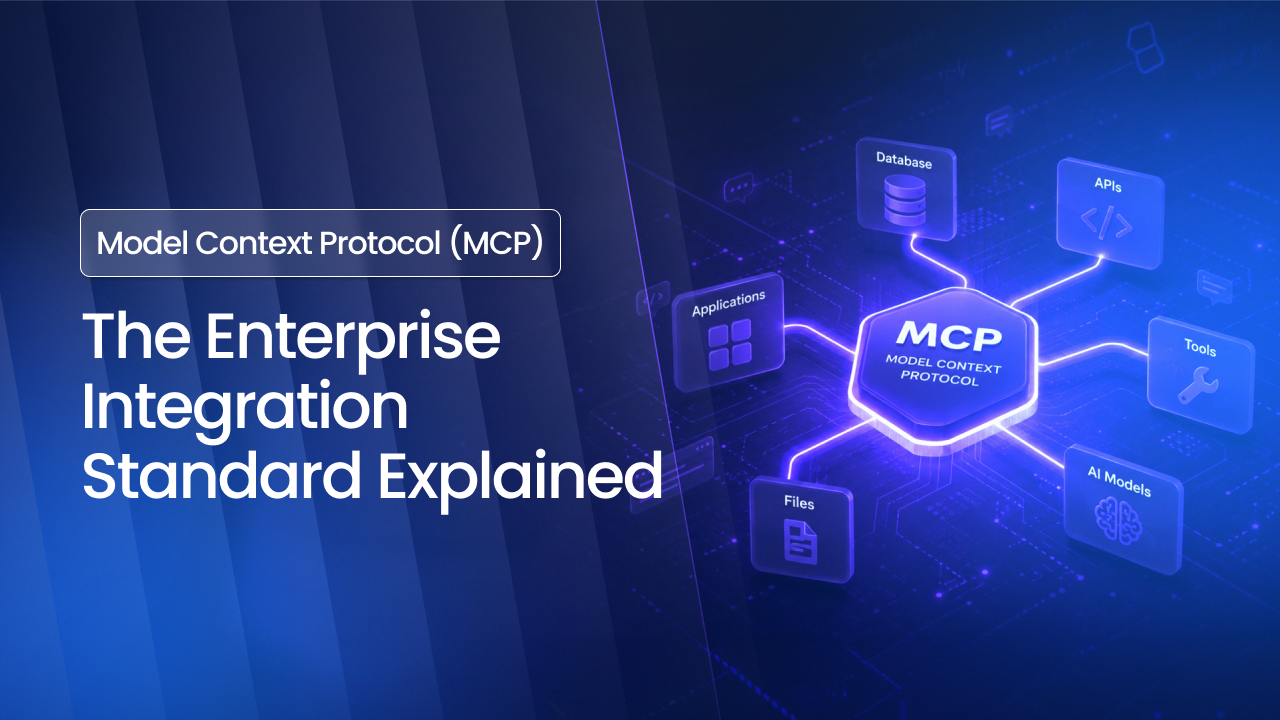
Model Context Protocol (MCP) is an open standard, defined by the Anthropic-originated specification and now governed by the Linux Foundation's Agentic AI Foundation, that standardizes how AI applications connect to external tools, data sources, and enterprise systems. It defines the interface the protocol, the data format, the discovery mechanism, and the session semantics that allows an AI agent to use a tool without the developer writing custom integration code for that specific agent-tool combination.
The architecture has three defined components:
MCP Host The AI application that coordinates interactions. The host contains the AI model (the LLM) and one or more MCP clients. In enterprise deployments, the host might be Claude Desktop, a custom enterprise AI assistant, an AI coding agent, or an agentic workflow platform. The host is responsible for presenting the user's goal to the AI model and coordinating the tool calls the model decides to make.
MCP Client The component within the MCP host that manages the connection to a specific MCP server. Each client maintains an isolated, one-to-one connection with one server. The client formats the AI model's tool call requests, manages session state, and processes server responses. A host can contain multiple clients simultaneously, allowing an AI agent to use tools from multiple MCP servers in a single workflow.
MCP Server A lightweight service that exposes a specific set of tools, data resources, or capabilities to any MCP-compatible client. The server advertises what it can do through structured tool names, parameter schemas, and natural-language descriptions so the AI model can reason about which tool is appropriate for a given task without the developer hard-coding the logic. One MCP server is built once for each enterprise system; every subsequent AI integration that needs that system uses the existing server rather than building a new connector.
The three capabilities MCP servers expose:
-
Tools Functions the AI agent can call to take actions: querying a database, posting to Slack, creating a Jira ticket, calling an internal REST API. Tools are the primary MCP primitive for most enterprise use cases.
-
Resources Structured data the AI can read: files, database records, API responses, documents. Resources provide context to the AI without the agent actively calling a function.
-
Prompts Pre-defined prompt templates that MCP servers can expose to clients, enabling organizations to standardize how AI models interact with specific systems or workflows.
The communication protocol underneath MCP:
MCP uses JSON-RPC 2.0 as its message format a lightweight, language-agnostic remote procedure call protocol that serializes requests and responses as JSON. This choice makes MCP compatible with any programming language and any infrastructure that can process JSON over a network connection. The transport layer has two modes: stdio for local inter-process communication (the default for desktop AI clients like Claude Desktop and Cursor), and Streamable HTTP introduced in the November 2025 specification update and replacing the deprecated SSE transport for remote server deployments that need to run behind load balancers and enterprise API gateways.
MCP vs A2A (Agent-to-Agent Protocol):
A2A the Agent-to-Agent protocol, released by Google in April 2025 and donated to the Linux Foundation AAIF in June 2025 is the complementary protocol for multi-agent systems. MCP handles the agent-to-tool relationship: how one agent accesses the tools and data it needs to complete its work. A2A handles the agent-to-agent relationship: how one agent delegates subtasks to another specialized agent. In a sophisticated agentic workflow, both operate simultaneously. An orchestrator agent uses A2A to delegate a data analysis subtask to a specialist agent, and that specialist agent uses MCP to access the database tool it needs for the analysis. The two protocols compose; they do not compete.
The Numbers: MCP's Adoption Scale and Enterprise Impact
The adoption data for MCP is some of the most rapid in recent enterprise technology history, and the specificity of the numbers matters for architecture decisions: a protocol with 97 million monthly downloads, backing from every major AI platform, and Linux Foundation governance is infrastructure, not a bet on a single vendor.
Adoption scale:
-
Monthly SDK downloads: from 100,000 at launch (November 2024) to 97 million by March 2026 a 970x increase in 18 months (Anthropic; Knak, 2026)
-
MCP server downloads grew from ~100,000 in November 2024 to over 8 million by April 2025 (Guptadeepak.com, 2025)
-
Over 5,800+ MCP servers and 300+ MCP clients now available in the ecosystem (Guptadeepak.com, 2025)
-
28% of Fortune 500 companies run MCP servers in production (Synvestable, 2026)
-
Major enterprise deployments at Block, Bloomberg, Amazon, and hundreds of Fortune 500 companies (Guptadeepak.com, 2025)
Industry validation:
-
December 2025: Anthropic donates MCP to the Linux Foundation AAIF; OpenAI, AWS, Google, Microsoft, Cloudflare, and Bloomberg join as co-founders or platinum members (Anthropic, December 2025)
-
OpenAI deprecates its Assistants API in favor of MCP, mid-2026 sunset (Atlan, 2026)
-
Gartner forecasts 40% of enterprise applications will feature task-specific AI agents by end of 2026, up from less than 5% in 2025 the agentic AI adoption wave that drives MCP demand (Gartner, August 2025)
-
Over 200 MCP server implementations covering major SaaS and developer platforms as of March 2026, including GitHub, Slack, Google Drive, PostgreSQL, Notion, Jira, and Salesforce (DEV Community, 2026)
The business impact of MCP adoption:
Before MCP, engineering teams spent 60–70% of AI project time on integration work rather than AI capability development (Agilesoftlabs, 2026). MCP's elimination of the M×N custom integration problem reclaims that engineering time and redirects it to the product functionality that actually differentiates. The business case is not a reduction in API costs or infrastructure spend it is engineering velocity: more working AI capability per engineer-month, because integration boilerplate is replaced by a single protocol that handles the connection layer once for each enterprise system.
How to Implement Model Context Protocol in Your Enterprise: A 6-Step Framework
This framework reflects the implementation sequence used by enterprise teams deploying MCP in production in 2026. It is ordered by technical dependency each step creates the prerequisite for the next.
Step 1: Map your AI agent use cases to their tool requirements.
Before writing any MCP code, produce a tool inventory: for each AI agent workflow your team plans to deploy, list every external system the agent needs to access. Group by system type: databases, SaaS APIs (Slack, Jira, Salesforce), internal REST APIs, file systems, and data stores. This inventory is the input to your MCP server build list. One MCP server per system; that server serves every current and future AI integration that needs that system.
Step 2: Prioritize your MCP server build order.
Build MCP servers in order of integration demand the systems that appear most frequently across multiple AI agent workflows generate the highest return per build. Most enterprise teams start with three to five high-demand systems: the CRM (Salesforce, HubSpot), the project management platform (Jira, Linear), the internal knowledge base, a key database, and Slack or Teams. Each completed server immediately reduces the integration cost for every subsequent AI deployment that needs it.
Step 3: Choose your transport mode based on deployment architecture.
For local development and desktop AI client integrations (Claude Desktop, Cursor, VS Code with Copilot), use stdio transport it requires no network configuration and is the fastest path to a working integration. For production deployments accessed over a network enterprise AI assistants, multi-user agent platforms, cloud-deployed workflows use Streamable HTTP transport. Streamable HTTP enables the MCP server to run as a remote service behind a load balancer and API gateway, with OAuth 2.1 authentication. The MCP 2026 specification release candidate (published May 2026, final specification scheduled July 28, 2026) delivers a stateless protocol core that eliminates the session affinity constraint on Streamable HTTP deployments, enabling true horizontal scaling on standard HTTP infrastructure.
Step 4: Implement authentication and access controls before production deployment.
MCP remote server deployments use OAuth 2.1 as the authentication standard, with MCP servers classified as OAuth Resource Servers that advertise their authorization server location through .well-known endpoints (DEV Community, 2026). For enterprise deployments, integrate your existing SSO provider (Okta, Azure AD, Google Identity) with the OAuth 2.1 flow so that MCP tool calls carry user identity and can be scoped to per-user permissions. Apply least-privilege access at the server level: each MCP server should have access only to the specific systems and data its tools require. An MCP server for Slack should not have read access to the HR database, even if both are theoretically reachable from the same network.
Step 5: Implement observability and audit logging.
The November 2025 MCP specification added formal server identity verification and structured audit trails enterprise capabilities specifically designed to address the governance concerns that slowed adoption through most of 2025 (NeuralCoreTech, April 2026). In production, every MCP tool call should generate a structured log entry recording: the calling agent identity, the tool called, the parameters passed, the response received, the timestamp, and the outcome (success, error, or exception). This log is your audit trail for governance, compliance review, and post-incident analysis. Without it, you cannot answer the question "what did the AI agent do and why" a question regulators and security teams will ask. Integrate MCP server logs with your existing SIEM or observability platform (Datadog, Splunk, Azure Monitor) before go-live.
Step 6: Monitor for security threats specific to MCP deployments.
Three threat vectors are specific to MCP deployments and require active monitoring:
-
Prompt injection via tool responses Malicious content in data the agent reads (a web page, an email, a document returned by an MCP tool) can embed instructions that hijack the agent's subsequent behavior. Sanitize all MCP tool responses before they enter the agent's context, particularly responses from tools that read external or user-generated content.
-
Tool poisoning Modification of MCP server tool descriptions to change the semantics of a tool in ways that manipulate agent behavior. Pin tool descriptions at the client level in high-security deployments, and monitor for unexpected changes to tool schemas.
-
Overprivileged servers MCP servers with broader access than their tools require create unnecessary blast radius if the server is compromised. Audit every MCP server's effective permissions quarterly, using the principle of least privilege as the standard.
An Endor Labs analysis of 2,614 MCP implementations found 82% use file system operations prone to path traversal and 67% use APIs related to code injection (Endor Labs, 2026). These are not rare configurations they are the dominant implementation patterns in the current ecosystem. Security review before production deployment is not optional.
Tools, Platforms, and Ecosystem Resources for MCP in 2026
The MCP ecosystem has matured from experimental to enterprise-grade. These are the tools and platforms your implementation team needs.
Official specification and SDKs:
-
modelcontextprotocol.io The canonical specification source, architecture documentation, and transport changelog. The specification repository on GitHub tracks every Spec Enhancement Proposal (SEP) and Working Group decision. Required reading before any enterprise MCP implementation.
-
Anthropic MCP SDKs (Python and TypeScript) The reference SDKs for building MCP servers and clients. Python SDK is the primary choice for data-heavy enterprise backends; TypeScript SDK is the primary choice for web-based AI applications. Both are Tier 1 SDKs under the 2026 specification release candidate, with committed support windows under the new deprecation policy.
MCP server discovery:
-
Smithery MCP Registry The primary public registry for discovering pre-built MCP server implementations. Search by system name, category, or capability. Covers GitHub, Slack, Google Drive, PostgreSQL, MongoDB, Notion, Jira, Salesforce, Stripe, AWS services, and hundreds of other enterprise systems.
-
Cursor Directory / Claude Desktop MCP servers Community-maintained directories of MCP servers vetted by developer communities. Useful for identifying production-tested implementations before building from scratch.
Enterprise AI clients with native MCP support:
-
Claude Desktop / Claude Code Anthropic's reference MCP clients; the fastest path to testing a new MCP server implementation before deploying it in a production agent workflow
-
Microsoft Copilot / Azure AI Foundry Full MCP support for organizations standardized on Microsoft enterprise infrastructure; the deployment path for Copilot-powered enterprise AI assistants
-
Cursor / VS Code GitHub Copilot Developer-facing MCP clients for AI-assisted engineering workflows; relevant for engineering productivity use cases
-
OpenAI Responses API The migration target for existing OpenAI enterprise integrations following the Assistants API mid-2026 deprecation; full MCP client support
Security tooling:
-
Endor Labs MCP security scanner Automated vulnerability analysis for MCP server implementations, covering path traversal, injection risks, and permission scope. Run against every MCP server before production deployment.
-
AWS API Gateway / Apigee / Azure API Management API gateway infrastructure providing rate limiting, authentication enforcement, and traffic monitoring for MCP servers deployed at enterprise scale. Every production Streamable HTTP MCP server should sit behind an API gateway.
Observability and monitoring:
-
Datadog / Splunk / Azure Monitor Integrate structured MCP audit logs into your existing SIEM. Configure alerts for anomalous tool call patterns (unusually high call volume, unexpected tool combinations, calls to sensitive tools outside business hours).
What Goes Wrong: The 5 Most Expensive MCP Implementation Mistakes
1. Building MCP servers before establishing a security model.
The instinct to build first and secure later produces MCP servers in production with path traversal vulnerabilities, overprivileged access, and no audit logging the same configuration found in 82% of analyzed MCP implementations (Endor Labs, 2026). The CVE-2025-53967 (Figma's MCP server allowed remote code execution through command injection) and the Cursor/Supabase token exfiltration incident are the documented consequences. The correct sequence: define the security model first. Before any MCP server goes to staging, document its required permissions, implement input validation at the server boundary, and configure structured audit logging. Security is not a deployment step it is a design constraint.
2. Building MCP servers without checking the public registry first.
Over 200 production MCP server implementations exist for major enterprise platforms as of March 2026 (DEV Community, 2026), covering GitHub, Slack, Salesforce, Jira, PostgreSQL, Google Drive, Notion, and hundreds of others. Organizations that build custom MCP servers for systems with existing, production-tested public implementations are duplicating work without adding value. Check the Smithery registry before writing a single line of MCP server code. If a production-tested implementation exists for your target system, fork it, customize it for your access control requirements, and move on to the next server in your build list.
3. Deploying with SSE transport instead of Streamable HTTP.
SSE (Server-Sent Events) transport was deprecated in the MCP specification in June 2025. Organizations that deployed MCP servers using SSE transport in 2025 now face a migration to Streamable HTTP. The migration is not complex both share the HTTP transport layer but it requires re-testing all connected MCP clients and updating deployment configurations. Any MCP server being built or deployed in 2026 should use Streamable HTTP from day one. If your team's implementation reference materials predate June 2025, verify which transport they describe before using them as the basis for a new deployment.
4. Conflating MCP and A2A, and building the wrong protocol for the problem.
MCP connects one agent to its tools. A2A connects one agent to another agent for task delegation and coordination. An architecture that uses MCP to coordinate between agents or attempts to build multi-agent delegation logic inside an MCP server is using the wrong protocol for the job. The diagnostic question is simple: is the thing on the other end of the connection a tool or data source that the agent will use directly? Use MCP. Is it another AI agent with its own reasoning capability that will handle a subtask? Use A2A. Both protocols can and should coexist in sophisticated agentic architectures the mistake is using one to do the job of both.
5. Treating MCP as a finished standard rather than an evolving one.
The July 2026 specification release candidate (final publication July 28, 2026) is described by MCP's lead maintainer as the largest revision since launch (MCP Blog, May 2026). It introduces a stateless protocol core, an Extensions framework, the Tasks extension for long-running workflows, and formalized authorization aligned with OAuth and OpenID Connect. Organizations that built production MCP deployments in 2025 against the November 2024 specification need to review their implementations against the 2026 release candidate. The formal deprecation policy introduced in the 2026 release candidate establishes the lifecycle management framework that allows the protocol to evolve without breaking existing deployments but that protection applies only to implementations that track the specification actively. Subscribe to the MCP specification changelog and review releases within your enterprise architecture governance cadence.
FAQ
What is Model Context Protocol?
Model Context Protocol (MCP) is an open standard, launched by Anthropic in November 2024 and governed by the Linux Foundation's Agentic AI Foundation since December 2025, that defines how AI agents connect to external tools, data sources, and enterprise applications. It uses a client-server architecture built on JSON-RPC 2.0: an MCP client within an AI application connects to an MCP server that exposes tools, resources, and prompts. Any MCP client can connect to any MCP server, replacing the M×N custom integration grid with a composable M+N standard that reduces integration complexity while enabling runtime tool discovery and multi-step workflow context management.
Why is MCP important for enterprise AI?
MCP is important because it solves the integration bottleneck that was consuming 60–70% of enterprise AI engineering time before the standard existed. Without MCP, every combination of AI model and enterprise tool required a custom connector unique authentication, unique data serialization, unique documentation for the model to understand the tool's purpose. At enterprise scale, that produced hundreds of bespoke integrations that were expensive to build and expensive to maintain. MCP provides one MCP server per enterprise system and one MCP client per AI application, with any client able to reach any server. It also provides the session context AI agents need for multi-step workflows something stateless REST APIs cannot provide without custom state management code.
How does MCP improve AI integrations?
MCP improves AI integrations through four specific mechanisms. First, runtime tool discovery: MCP servers advertise their capabilities through structured descriptions that AI models can read and reason about, so agents can decide which tool to use for a given task rather than being hard-coded to specific endpoints. Second, session management: MCP maintains context across multi-step agent workflows, enabling agents to execute step 4 of a 10-step task with awareness of what the preceding steps returned. Third, standardized security: OAuth 2.1 authentication, per-tool access scoping, and structured audit trails are part of the protocol specification not optional add-ons. Fourth, ecosystem composability: the 5,800+ publicly available MCP servers mean most common enterprise system integrations are pre-built and production-tested, reducing implementation time from weeks to days.
Conclusion: Model Context Protocol Is the Foundation Your AI Agent Architecture Needs
Model Context Protocol has crossed from experimental protocol to foundational enterprise infrastructure in 18 months a transition driven not by marketing but by the measurable elimination of a real engineering problem. The 97 million monthly downloads, 28% Fortune 500 server adoption, Linux Foundation governance, and OpenAI's Assistants API deprecation are not hype signals. They are the evidence that the enterprise engineering community evaluated MCP against the alternative (continuing to build custom connectors) and chose MCP at a scale that makes it infrastructure.
The July 2026 specification release candidate, scheduled for final publication on July 28, 2026, delivers the stateless protocol core, Extensions framework, and formalized authorization that address the remaining enterprise deployment constraints. The protocol is not frozen in its current form it is actively evolving under a governance structure and deprecation policy designed specifically for long-term enterprise use.
Your next concrete action: produce the tool inventory from Step 1 of the framework above this quarter. Map every AI agent workflow your team is planning or already running against the enterprise systems each workflow needs to access. Identify the three highest-demand systems the ones that appear across multiple workflows. Build or adopt an MCP server for each of those three systems first. The return is immediate: every subsequent AI integration that needs those systems uses the existing MCP server rather than a new custom connector. That is the compounding return on MCP adoption, and it starts accruing from the first server you build.
Related reading: For the implementation support to deploy MCP-native AI architectures in your enterprise stack, see our guides on AI Integration Services and Enterprise AI Solutions to scope the architecture and governance framework your agentic AI roadmap requires.