

Published by AgamiSoft | Reading time: ~14 minutes
|
Featured Snippet / AEO Answer : Human-in-the-Loop AI (HITL) is a system design approach that embeds human review, approval, or intervention at defined decision points within an automated AI workflow ensuring that consequential, ambiguous, or high-risk AI decisions receive human judgment before they affect individuals or organizations. Human oversight remains a core requirement for high-risk AI applications in regulated industries including healthcare, finance, legal services, and public administration, where regulatory frameworks increasingly mandate that automated decisions affecting individuals can be reviewed, explained, and appealed to a human decision-maker.
|
|
Quick Answer / TL;DR : Human-in-the-Loop AI combines automated decision-making with human review at critical stages not because AI is always wrong, but because specific decision types carry consequences, legal obligations, or ethical dimensions that require human accountability regardless of AI accuracy. The organizations deploying AI most effectively in 2026 are not those who automate the most decisions they are those who have precisely defined which decisions belong to AI, which belong to humans, and which require the two working together, and have built the oversight architecture that enforces those boundaries reliably.
|
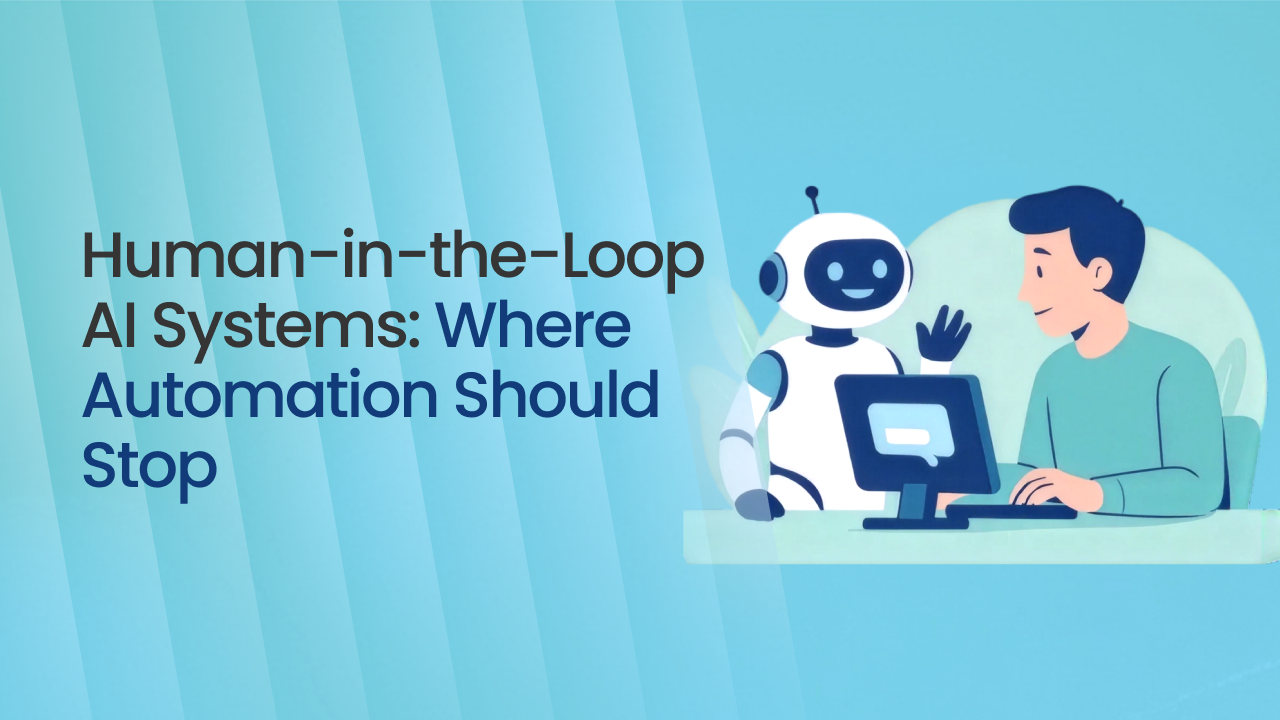
Human in the Loop AI: Where Automation Should Stop and Human Judgment Must Begin
Why Human-in-the-Loop AI Has Become a Regulatory and Governance Imperative in 2026
Fully automated AI decision-making has produced a specific, recurring pattern of failure: AI systems that perform accurately in aggregate produce individual outcomes that are incorrect, unfair, or harmful and without a human review point, those individual failures affect real people without any mechanism for detection, appeal, or correction before the consequences materialize.
The EEOC enforcement action against Amazon's hiring algorithm in the late 2010s demonstrated this pattern in employment. The CFPB's repeated guidance on algorithmic credit decisioning has demonstrated it in finance. The FDA's expanding oversight of AI/ML-based medical device software has demonstrated it in healthcare. In each case, the AI system's aggregate accuracy was not the regulatory concern the absence of meaningful human oversight of individual decisions that affected real people was.
Three forces have made Human-in-the-Loop AI a 2026 operational requirement rather than an ethical aspiration:
The EU AI Act has codified human oversight as a legal obligation for high-risk AI. Article 14 of the EU AI Act explicitly requires that high-risk AI systems be designed to allow for effective human oversight including the ability to understand the AI's capabilities and limitations, monitor operation, interpret outputs, and override or interrupt the system. This is not a vague principle; it is a binding legal requirement for any AI system classified as high-risk under Annex III, affecting AI in employment, credit, education, law enforcement, healthcare, and critical infrastructure across EU markets.
AI systems have been deployed at a scale and in domains where failures have material consequences. An AI content moderation error affecting one user is unfortunate. The same error policy applied to millions of users simultaneously affects millions and without human oversight at the decision level, the detection of the systematic error and the mechanism for remediation is absent. Scale amplifies both the value and the risk of AI automation, making human oversight architecture proportionally more important as AI scale increases.
"Black box" AI decisions have created legal and reputational exposure that human oversight directly addresses. Regulatory pressure for AI explainability including the right to explanation under GDPR Article 22 for automated individual decisions and the EU AI Act's transparency requirements creates a specific legal exposure for fully automated AI decisions that cannot be explained and that affected individuals cannot appeal. Human-in-the-Loop architecture is the organizational structure that satisfies the "right to human review" that multiple regulatory frameworks increasingly guarantee.
What Is Human-in-the-Loop AI, Exactly and How Does It Differ From Human-on-the-Loop?
Human-in-the-Loop AI (HITL) is a system design approach that requires explicit human review, approval, or intervention at defined decision points within an AI workflow before the AI's decision takes effect the human is part of the decision execution path, not just an observer of it.
This is distinct from two related but different oversight models:
Human-on-the-Loop AI (HOTL) is an oversight model where AI makes and executes decisions autonomously, but a human monitors the system and has the ability to intervene when anomalies are detected. The human is not in the decision path they are watching the system and can pull an override if something goes wrong. Human-on-the-loop provides monitoring oversight without requiring human approval for each decision, enabling higher throughput at the cost of earlier intervention capability.
Human-out-of-the-Loop AI (fully autonomous) is AI that makes and executes decisions without any designed human review point appropriate for low-risk, reversible, low-consequence decisions where AI accuracy is sufficiently high and the cost of human review exceeds its benefit.
The three models exist on a spectrum, and the correct choice for any specific AI decision is not a philosophical preference but an architectural design decision driven by five factors:
Factors determining where on the HITL-HOTL-autonomous spectrum a specific AI decision belongs:
-
Consequence severity: how harmful is an incorrect AI decision to the affected individual or organization?
-
Reversibility: can an incorrect AI decision be easily corrected after the fact, or does it create lasting harm?
-
AI accuracy: what is the AI system's error rate on this decision type, and is the error rate acceptable given the consequence severity?
-
Regulatory requirement: does applicable regulation require human review for this decision type regardless of AI accuracy?
-
Explainability obligation: is the organization required to explain this decision to the affected individual in terms they can understand and challenge?
The matrix of these five factors produces a principled answer about where human oversight belongs an answer that is specific to the decision type, not a blanket policy about the AI system.
The Regulatory Landscape and Failure Data Behind HITL Requirements
Regulatory Requirements for Human Oversight by Domain
|
Domain |
Governing Framework |
HITL Requirement |
Scope |
|
High-risk AI (employment, credit, education, law enforcement) |
EU AI Act Article 14 |
Mandatory effective human oversight required |
EU market AI systems in listed categories |
|
Automated individual decisions |
GDPR Article 22 |
Right to human review required |
EU personal data automated decisions |
|
Medical AI/ML devices |
FDA AI/ML SaMD Guidance |
Human factors validation required |
AI diagnostic and treatment software |
|
Credit decisioning (consumer) |
ECOA / FCRA / CFPB AI Guidance |
Adverse action explanation + human override path |
US consumer credit AI |
|
Model risk management (banking) |
SR 11-7 / OCC AI Guidance |
Human validation and monitoring required |
US bank AI models |
|
Algorithmic hiring tools |
NYC Local Law 144, EEOC Guidance |
Bias audit + disclosure required |
Automated employment decision tools |
Sources: EU AI Act Official Text 2024; FDA AI/ML-based SaMD Action Plan 2025; CFPB AI Supervisory Guidance 2025; EEOC AI in Hiring Technical Assistance 2025.
The Cost of HITL Failures When Automation Crossed Its Boundary
-
Amazon's AI recruiting tool, trained on historical hiring data that skewed male, systematically downgraded resumes from women a failure that produced discriminatory outcomes at scale without any human review mechanism to detect or correct individual decisions. The system was ultimately scrapped rather than fixed because the bias was embedded in the training data in ways that couldn't be easily removed (Reuters, widely reported)
-
Healthcare AI diagnostic systems that produce incorrect outputs without a human clinician review point create patient harm risks that FDA's AI/ML SaMD guidance specifically addresses requiring human factors validation that confirms clinicians can effectively interpret and appropriately override AI recommendations in clinical workflows
-
Human oversight remains a core requirement for many high-risk AI applications in regulated industries CFPB enforcement actions against automated credit decisioning without adequate adverse action explanation have resulted in settlements ranging from $1 million to $175 million for individual financial institutions (CFPB enforcement data, 2025)
The Performance Case for HITL
-
Human-AI collaboration on diagnostic tasks consistently outperforms both AI alone and human alone radiologists reviewing AI-flagged mammography images achieve 20% higher cancer detection rates than either AI or human review independently (Lancet Digital Health, 2025)
-
Human review of AI-generated legal documents reduces error rates by 35–45% compared to unreviewed AI outputs on complex transactional documents (Thomson Reuters Legal AI Report, 2025)
-
Customer service AI with human review at defined escalation points achieves 15% higher customer satisfaction than fully autonomous AI customer service, specifically for complex or emotionally sensitive interactions (Salesforce State of Service, 2025)
How to Design a Human-in-the-Loop AI Architecture: A 6-Step Framework
Step 1: Classify Every AI Decision by Consequence, Reversibility, and Regulatory Obligation
The HITL design process starts with decision classification, not technology selection. For every AI decision your system makes:
-
Assess consequence severity: categorize as low (affects operational efficiency only, no individual impact), moderate (affects individuals in limited, correctable ways), high (affects individuals in ways that are significant but correctable), or critical (affects individuals in ways that are irreversible or carry safety implications)
-
Assess reversibility: can the AI decision be corrected after the fact at low cost and without lasting harm? Or does executing the decision create conditions that are difficult or impossible to reverse?
-
Identify regulatory obligation: does applicable law or regulation require human review for this decision type, regardless of AI accuracy? EU AI Act, GDPR Article 22, FDA guidance, ECOA list the specific provision that applies
-
Determine the required oversight model: low consequence, high reversibility, no regulatory requirement → autonomous or human-on-the-loop. High consequence, low reversibility, regulatory requirement → human-in-the-loop with documented approval. Critical consequence → human decision, AI as analytical support only
Step 2: Design the Human Review Interface for Each HITL Decision Point
Human oversight is only as effective as the interface through which humans exercise it a review interface that doesn't surface the right information, makes the review task impractically time-consuming, or creates cognitive overload consistently produces rubber-stamp approvals rather than genuine oversight:
-
Surface AI reasoning alongside AI output: the human reviewer should see not just what the AI decided but the key factors that drove the decision which data inputs had the highest weight, what the AI's confidence level is, what the closest alternative decision was and how much less likely it was
-
Surface dissenting signals: if other data sources or model variants suggest a different conclusion than the primary AI output, make these visible in the review interface the human reviewer's judgment is most valuable when applied to genuine uncertainty, not when confirming high-confidence AI outputs
-
Make the override mechanism prominent and frictionless: a human reviewer who has identified that an AI decision is incorrect must be able to override it easily, document the reason, and trigger the appropriate alternative action a technically available but practically difficult override path is not meaningful human oversight
-
Design for reviewer cognitive load: human review is most effective when the reviewable content is scoped tightly to the genuinely uncertain or high-risk decisions if everything comes through for human review, reviewers develop the same insensitivity that security alert fatigue produces. Route only the decisions that genuinely need human judgment to the human review queue
Step 3: Define and Enforce the Decision Authority Matrix
Documenting HITL requirements without enforcing them through system design produces HITL on paper and full automation in practice:
-
Create a formal decision authority matrix a governance document that lists every AI decision type, its consequence and reversibility classification, the applicable regulatory requirement, and the designated oversight model
-
Enforce the matrix through system architecture, not through policy expectation decisions requiring human approval should be technically incapable of executing without a logged human approval event; policy-based HITL that requires a human to manually intervene to stop an automated execution is not reliable HITL
-
Implement an audit trail for every HITL decision: timestamp, AI output, AI confidence score, reviewer identity, review duration, reviewer decision (approve/override), and if override, the documented reason
-
Define the escalation path for HITL reviews that exceed defined time limits a HITL review point that creates a processing bottleneck because reviewers are unavailable defaults to either holding the decision (affecting the individual) or auto-approving (defeating the HITL purpose). Define which outcome applies and under what conditions
Step 4: Calibrate the HITL Threshold Based on AI Model Performance Data
The volume of decisions requiring human review should be calibrated to AI model performance, not set at a fixed rate:
-
Track AI decision accuracy against ground truth outcomes continuously specifically measuring accuracy by decision sub-type, input data distribution, and edge case categories
-
Adjust HITL routing thresholds based on performance data high-confidence AI decisions on well-represented input types may route to human-on-the-loop monitoring; low-confidence decisions or decisions on underrepresented input types route to human-in-the-loop review
-
Implement confidence score-based routing: decisions where the AI confidence score exceeds a validated threshold proceed with monitoring oversight; decisions below threshold route to human review. Validate confidence scores against actual accuracy AI models can be systematically overconfident, requiring recalibration of the confidence score's practical meaning
-
Review routing threshold calibration quarterly as the AI model is retrained and as the input data distribution changes, the appropriate confidence threshold for autonomous execution should be reassessed
Step 5: Train Human Reviewers on AI Limitations, Not Just AI Outputs
Human reviewers who don't understand what AI models can and cannot do consistently make poor override decisions:
-
Train reviewers on the specific AI model's known failure modes the input types where the model underperforms, the demographic or contextual segments where accuracy is lower, and the confidence score patterns that historically precede incorrect outputs
-
Train reviewers to recognize and resist automation bias the well-documented tendency for humans to accept AI recommendations even when independent review would produce a different conclusion, particularly when the AI output is presented confidently
-
Establish independent reviewer calibration periodically present reviewers with labeled historical cases where the AI was incorrect, assessing whether reviewers would have overridden the incorrect AI output or approved it. Calibration results identify training needs and systemic review quality issues
-
Create escalation paths for reviewers who identify novel failure patterns a reviewer who notices that the AI consistently makes a specific type of error should have a defined path to surface that pattern to the AI development team for model investigation
Step 6: Implement Continuous HITL Performance Monitoring
HITL architecture is not self-maintaining monitoring that confirms human oversight is functioning as intended is required:
-
Review volume monitoring: track the volume of decisions routing to human review versus autonomous processing sudden changes in routing volume signal either AI model performance changes or routing threshold miscalibration
-
Override rate monitoring: track the rate at which human reviewers override AI decisions, by decision type and reviewer. Override rates that are consistently near zero suggest automation bias; override rates that are consistently above 30% suggest the AI model is performing poorly enough to question whether HITL is providing sufficient error correction or whether the AI's role should be reduced
-
Review duration monitoring: track average human review time by decision type reviews completed in under 5 seconds for complex decisions suggest the reviewer is not actually reviewing; reviews taking over 30 minutes suggest the review interface is inadequate or the task is too complex for the time available
-
Post-decision outcome tracking: follow the outcomes of HITL-approved decisions what percentage of decisions that the AI recommended and the human approved turn out to be incorrect in retrospect? This is the ultimate measure of whether HITL is adding value to AI decision quality
Which Tools and Approaches Support Human-in-the-Loop AI Implementation in 2026?
For AI workflow orchestration with HITL checkpoints:
LangGraph (LangChain) provides the most production-ready multi-agent orchestration framework with native support for human-in-the-loop approval interruptions enabling AI workflows to pause at defined decision points, route to a human review queue, and resume with approval. Microsoft Power Automate with AI Builder provides accessible HITL workflow capability for organizations within the Microsoft 365 ecosystem. Temporal provides durable workflow execution with human approval steps for long-running AI processes that may wait hours or days for human review.
For AI decision review interfaces:
Scale AI RLHF and review tools provide review interfaces specifically designed for human AI evaluation appropriate for organizations building feedback-loop training workflows. Labelbox and Humanloop provide human review platforms for AI output evaluation with annotation, feedback collection, and quality metrics.
For HITL compliance in regulated industries:
Credo AI and Fiddler AI provide AI governance platforms with decision audit trails, fairness monitoring, and compliance documentation specifically designed for regulated industry AI programs. IBM OpenScale (Watson OpenScale) provides AI monitoring and human review workflow capability integrated with IBM's broader AI platform.
For explainability at HITL review points:
SHAP (SHapley Additive exPlanations) and LIME (Local Interpretable Model-agnostic Explanations) provide the feature-level explanation generation that surfaces AI reasoning alongside AI output in human review interfaces the technical mechanism that converts "the AI said no" into "the AI said no primarily because of these three factors, which you can evaluate."
Explore our Responsible AI Consulting and AI Governance Services capabilities for CIOs, compliance leaders, and AI product managers designing Human-in-the-Loop AI architecture across regulated and high-risk AI applications.
What Goes Wrong With Human-in-the-Loop AI Programs and How to Prevent Each Failure
Failure 1: Designing HITL as Policy Rather Than Architecture
Organizations that write HITL policies ("human review is required for X decision types") without enforcing those policies through system architecture consistently discover that HITL is bypassed in practice when operational pressure demands throughput. A system that technically requires human approval but allows timeout auto-approval, allows reviewer role assignment to bots, or allows bulk approval without individual decision review is HITL on paper and full automation in practice. Enforce HITL requirements through technical controls that make bypass architecturally impossible, not through policy compliance that operational pressure overrides.
Failure 2: Routing All Decisions to Human Review Without Prioritization
HITL implementations that route everything to human review without AI confidence scoring, consequence classification, or routing logic that prioritizes genuinely uncertain decisions produce reviewer fatigue and automation bias simultaneously. Reviewers who see 500 decisions per day develop the expectation that AI is correct and approve without genuine review, which means the HITL architecture is generating an audit trail of human approvals without generating actual human oversight. Design the HITL queue to contain only the decisions where human judgment adds genuine value.
Failure 3: Not Tracking Whether Human Reviewers Are Actually Reviewing
HITL audit trails that log "approved by [reviewer name]" without capturing review duration, reviewer decision reasoning, or post-outcome accuracy provide compliance documentation without actual oversight evidence. A reviewer who approves 200 decisions in an hour has approved approximately one decision per 18 seconds a rate at which genuine review of complex AI decisions is not possible. Capture review duration and implement minimum review time gates for high-consequence decision types, and use override rate and review duration as indicators of review quality, not just review completion.
Failure 4: Treating HITL as Permanent Rather Than as a Lifecycle Stage
HITL requirements should be calibrated to AI model maturity a newly deployed model with limited validation warrants higher HITL review rates than a mature model with years of validated production performance. Organizations that maintain the same HITL routing rates regardless of AI performance improvement carry unnecessary review overhead on well-validated decisions, while organizations that reduce HITL oversight prematurely before validation justifies it create regulatory and accuracy risk. Tie HITL threshold adjustments to formal model performance review and documented validation evidence, not to operational pressure or budget targets.
Frequently Asked Questions
What Is Human-in-the-Loop AI?
Human-in-the-Loop AI (HITL) is a system design approach that requires explicit human review, approval, or intervention at defined decision points within an automated AI workflow ensuring that the human judgment is embedded in the decision execution path before consequential decisions take effect. Unlike fully autonomous AI (where AI decides and acts without human involvement) or human-on-the-loop AI (where humans monitor but don't participate in each decision), HITL requires a human to actively review and approve specific AI decisions before they execute. It is used when AI decision errors carry significant consequence, when regulatory frameworks require human review, or when the AI's confidence or accuracy on specific input types is insufficient to warrant autonomous execution.
When Should Humans Review AI Decisions?
Humans should review AI decisions when five conditions apply: the decision has significant consequences for the affected individual (employment, credit, health, freedom, or legal status); the decision is difficult or impossible to reverse after execution; applicable regulation explicitly requires human review for the decision type; the AI model's accuracy on the specific input type or demographic is below validated thresholds; or the affected individual has a legal right to human review and explanation. Conversely, full AI automation is appropriate when consequence is low, reversibility is high, AI accuracy is well-validated, no regulatory requirement applies, and human review would add cost without commensurate accuracy improvement. The calibration between these conditions is the core design decision of any AI deployment.
Which Industries Require Human-in-the-Loop AI Systems?
Industries with the most clearly defined HITL requirements include healthcare (FDA AI/ML medical device guidance requiring human factors validation and clinical oversight of diagnostic AI), financial services (SR 11-7 model risk management requiring human validation and CFPB guidance requiring adverse action explanation with human review path for consumer credit decisions), employment (EEOC guidance and NYC Local Law 144 requiring human oversight of automated employment decisions), legal services (where professional responsibility rules require attorney supervision of AI-assisted legal work), and public administration (EU AI Act requiring human oversight for all AI systems used in law enforcement, immigration, and benefits administration). Any industry deploying AI for decisions that affect individual rights, safety, or access to services should treat human oversight design as a core architecture requirement regardless of whether specific regulatory guidance has yet been issued for their domain.
Classify Decisions by Consequence and Reversibility Before Choosing an Oversight Model. Enforce HITL Through Architecture, Not Policy. Calibrate Review Thresholds to AI Performance Data, Not to Fixed Rules.
Human-in-the-Loop AI delivers its safety, governance, and regulatory compliance value when oversight is designed into the system architecture at the decision level not added as a policy layer over an autonomous system, and not applied uniformly to every AI decision regardless of consequence or AI performance.
The CIOs, compliance leaders, and AI product managers building the most effective HITL architectures in 2026 share one design discipline: they classified decisions by consequence and reversibility before selecting technology, and they enforced HITL through technical controls that made bypass impossible producing audit trails that document actual human oversight rather than logged approvals that occurred without genuine review.
Conduct a decision authority matrix audit for your highest-risk AI applications this quarter listing every AI decision type, its consequence classification, its reversibility, and the applicable regulatory requirement. Map each decision type to the correct oversight model: autonomous, human-on-the-loop, or human-in-the-loop. Implement technical enforcement of HITL requirements approval workflows that cannot be bypassed by timeout or bulk action for any decision type classified as high consequence or subject to regulatory human review requirements.
To design Human-in-the-Loop AI architecture that satisfies regulatory requirements, maintains AI performance, and produces auditable evidence of genuine human oversight, explore our Responsible AI Consulting and AI Governance Services capabilities structured for CIOs, compliance leaders, and AI product managers who need oversight delivered as a verifiable architectural property, not a compliance checkbox.