

Published by AgamiSoft | Reading time: ~14 minutes
|
Featured Snippet / AEO Answer : MCP vs API is not a competition it is a layering decision. Traditional REST APIs expose predefined endpoints for software-to-software communication and remain the foundation of enterprise infrastructure. Model Context Protocol (MCP) is an AI orchestration layer that wraps those APIs, enabling AI agents to discover tools at runtime, maintain context across multi-step workflows, and integrate with enterprise systems without custom glue code for each connection.
|
|
Quick Answer / TL;DR: REST : APIs and MCP operate at different layers of enterprise architecture they don't compete, they compose. REST is the infrastructure: stateless, scalable, the foundation of enterprise software. MCP is the orchestration layer your AI agents live in: context-aware, session-capable, and designed for the agentic era where the primary API consumer is no longer a human developer but an autonomous AI system. The question is not which one to use. It is where in the stack each one belongs.
|
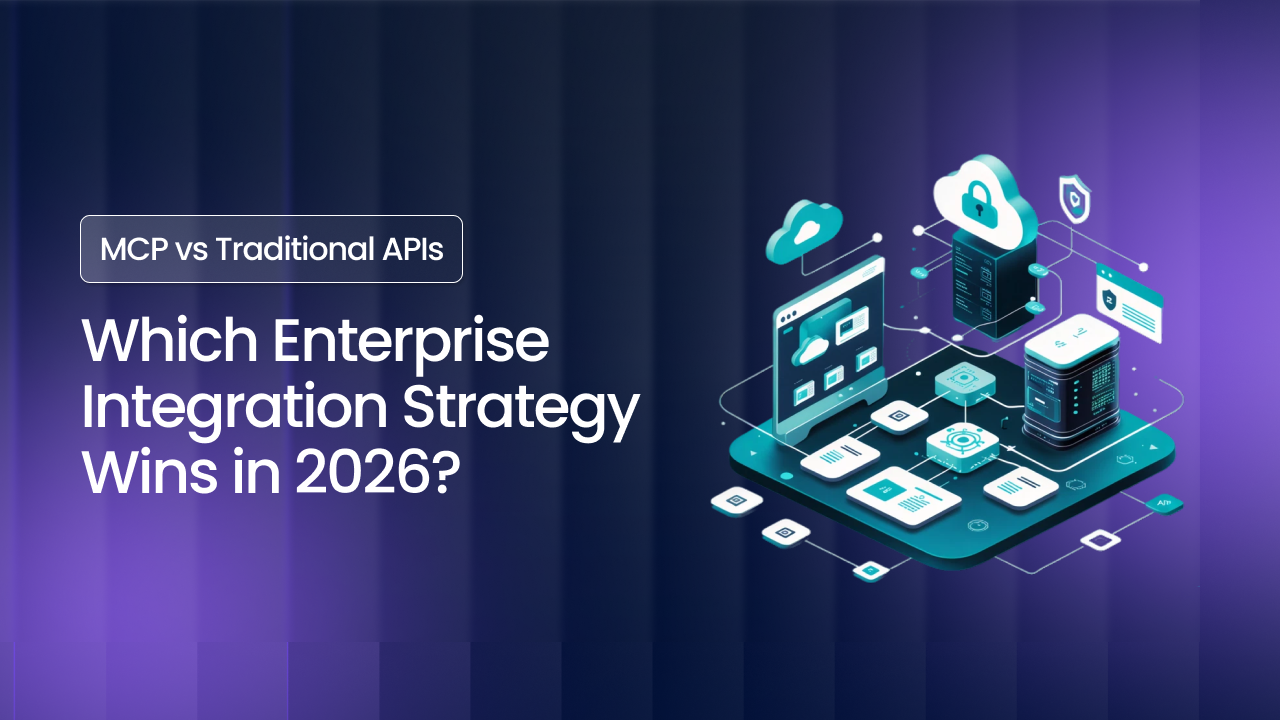
MCP vs API: Which Enterprise Integration Strategy Actually Wins in 2026?
Why the MCP vs API Conversation Has Become Urgent in 2026
The primary consumer of enterprise APIs changed in 2026 and most enterprises' integration architecture has not caught up. For over a decade, API design assumed the caller was a front-end application or a human-authored service: deterministic, predictable, with a developer writing exactly which endpoint to call with exactly which payload. That assumption is no longer valid for the fastest-growing category of API consumers: autonomous AI agents.
Gartner forecasts that 40% of enterprise applications will feature task-specific AI agents by end of 2026, up from less than 5% in 2025 (Gartner, August 2025). These agents operate differently from traditional software callers they receive a natural language goal, reason about which tools to use, decide which data to retrieve, sequence multi-step operations, and adapt based on intermediate results. Traditional REST APIs were not designed for that consumption pattern. They expose fixed endpoints that require a human developer to know in advance exactly what to call. An AI agent operating probabilistically on a natural language objective cannot function reliably against an API surface that provides no self-description, no context maintenance, and no runtime tool discovery.
This is the problem Model Context Protocol (MCP) was designed to solve. Launched by Anthropic in November 2024, MCP grew from 100,000 monthly SDK downloads at launch to 97 million monthly downloads by March 2026 a 970x increase in 18 months (Anthropic ecosystem update, December 2025; Knak, April 2026). In December 2025, Anthropic donated MCP to the Agentic AI Foundation (AAIF) under the Linux Foundation, with OpenAI, AWS, Google, Microsoft, Cloudflare, and Bloomberg joining as founding members (Anthropic, December 2025). OpenAI subsequently deprecated its proprietary Assistants API in favor of MCP, with a mid-2026 sunset (Atlan, 2026).
The practical implication for your architecture team: MCP has crossed from experimental to enterprise-default infrastructure in under 18 months. The MCP vs API decision is no longer a future consideration it is a current architectural decision that your team is either making deliberately or making by default, one integration at a time.
Teams building AI agent integrations without MCP spend 60–70% of AI project time building and maintaining custom integrations rather than improving AI capabilities (Agilesoftlabs, 2026). That is the cost of a pre-MCP integration architecture in a post-MCP world.
What Is MCP and How Does It Differ From Traditional APIs?
Model Context Protocol (MCP) is an open standard that defines how AI applications connect to external tools, data sources, and enterprise systems. It provides a universal protocol for the agent-to-tool relationship the interface between an AI model and the resources it needs to complete tasks so that any MCP-compatible AI client can work with any MCP-compatible server without custom integration code.
REST APIs (Representational State Transfer) are an architectural style built on standard HTTP verbs and resource-based endpoints. They are stateless: every request is independent, carries its own authentication and parameters, and the server processes it without memory of previous requests. REST is the backbone of enterprise software and the dominant pattern for software-to-software communication. 92% of organizational data exchanges currently use REST APIs (BuzzClan, 2026).
The architectural differences between the two are not superficial. They reflect a fundamental difference in what each is designed for:
What REST does well:
-
Stateless, cache-friendly, horizontally scalable communication between known services
-
Deterministic requests from human-authored code that knows exactly which endpoint to call
-
Simple, well-understood patterns supported by every language, framework, and toolchain
-
High throughput microservices where millions of independent requests need consistent, fast handling
What REST cannot do for AI agents:
-
Expose tool capabilities to an agent that doesn't know in advance what tools exist
-
Maintain session context across a multi-step agent workflow without custom state management code
-
Tell an LLM what a tool does in a format the model can reason about
-
Let an agent discover and compose capabilities dynamically based on a goal
What MCP adds:
-
Runtime tool discovery MCP servers expose a list of available tools with structured descriptions the AI model can read and reason about without a developer hard-coding which endpoint to call
-
Session management MCP maintains state across multi-step agent workflows, so the agent can perform step 4 of a ten-step task with awareness of what steps 1–3 returned
-
Unified protocol one MCP client can connect to any MCP server, replacing the M×N custom integration problem (M AI systems × N tools = M×N custom integrations) with an M+N composition (any M can reach any N through the shared protocol)
-
AI-native error handling MCP returns structured errors that AI systems can parse programmatically, enabling agents to recover from failures without human intervention
MCP does not replace REST APIs. The most common production pattern in 2026 is an MCP server that wraps an existing REST API the REST API serves its traditional programmatic consumers unchanged, while the MCP layer makes the same capability accessible to AI agents with the tool metadata and session semantics they need (Lycore, 2026).
The one-line architectural summary: REST is infrastructure. MCP is the operating layer your AI agent lives in.
The Numbers: MCP Adoption in Enterprise in 2026
The adoption trajectory of MCP is unusual in enterprise technology: most protocols take years to achieve broad adoption; MCP achieved it in 18 months. Understanding why that happened helps architects evaluate whether the standard is durable enough to build enterprise architecture around.
Adoption metrics:
-
MCP server downloads: from ~100,000 in November 2024 to 97 million monthly SDK downloads by March 2026 a 970x increase in 18 months (Anthropic/Knak, 2026)
-
Over 5,800+ MCP servers and 300+ MCP clients now available in the public ecosystem (Guptadeepak.com research, December 2025)
-
28% of Fortune 500 companies run MCP servers in production (Andrew.ooo, July 2026)
-
78% of enterprise AI teams report MCP-backed agents in production as of July 2026 (Andrew.ooo, July 2026)
-
Major deployments at Block, Bloomberg, Amazon, and hundreds of Fortune 500 companies (Guptadeepak.com, 2025)
Why adoption was so fast three structural factors:
First, the M×N problem was genuinely painful. Before MCP, every AI integration required custom code: custom authentication flows, custom data serialization, custom error handling, custom documentation for the model to understand what the endpoint does. A team integrating five AI models with ten enterprise tools needed 50 custom integrations. With MCP, they need 15 (five MCP clients plus ten MCP servers). The time and cost reduction was immediate and measurable.
Second, industry consensus arrived unusually fast. Normally, competing AI vendors would each push their own integration standard fragmenting the ecosystem and slowing adoption for every buyer waiting for a winner to emerge. Instead, OpenAI, Google, Microsoft, AWS, and Anthropic all converged on MCP within months of its release. OpenAI's decision to deprecate its Assistants API in favor of MCP removed the last credible alternative for the enterprise market (Atlan, 2026).
Third, governance was formalized before the enterprise adoption wave. The Linux Foundation's Agentic AI Foundation took governance of MCP in December 2025 vendor-neutral, open-standard, no single company controlling the specification. That governance structure is what enterprise procurement and legal teams require before committing to a protocol as core infrastructure.
The honest caveat what MCP does not yet fully solve:
Security is MCP's most significant current limitation. An Endor Labs analysis of 2,614 MCP implementations found 82% use file system operations prone to path traversal and 67% use APIs related to code injection (Endor Labs, 2026). Security researchers filed 30+ CVEs in January and February 2026 alone. The MCPTox benchmark found o1-mini achieved a 72.8% attack success rate against MCP tool poisoning scenarios with more capable models often more susceptible because the attack exploits superior instruction-following (MCPTox, 2025). Enterprise-grade authentication with OAuth 2.1 and SAML/OIDC is on the 2026 roadmap but still in progress (Kai Waehner / NeuralCoreTech, 2026).
The practical guidance: MCP is production-ready for internal enterprise tools and AI assistant use cases where data exposure is controlled. It requires deliberate security controls least-privilege server access, input validation, tool description monitoring before deployment in customer-facing or sensitive-data contexts.
How to Decide: MCP vs API Decision Framework for Enterprise Architects
This framework produces a documented, defensible architecture decision for each integration scenario your team evaluates. It is not a binary MCP vs REST choice it is a layering decision that specifies which protocol belongs at which layer for which consumer.
Step 1: Identify who or what is consuming the integration.
If the consumer is traditional software a front-end application, a microservice, a mobile app, a data pipeline with deterministic logic REST API is the correct choice. It is stateless, scalable, and universally supported. If the consumer is an AI agent a system that receives a natural language goal and dynamically decides which tools to use MCP is the correct integration layer. The fundamental design question is: does the caller know in advance exactly which endpoint to call with exactly which parameters? If yes: REST. If no: MCP.
Step 2: Count the integration surface.
Use MCP when three or more integrations feed a single AI workflow (Atlan, 2026). When an AI agent needs to query a database, call an internal API, read from a file system, and check a calendar, implementing four separate custom REST integrations is four times the maintenance burden. An MCP layer that wraps all four produces one integration pattern the agent can discover and compose at runtime. Below three integrations, the overhead of an MCP server may not justify the architecture investment over a direct REST call.
Step 3: Determine context requirements.
Assess whether the workflow requires state across multiple steps. A single-call operation retrieve a record, return a result is stateless and well-served by REST. A multi-step agent workflow search for relevant records, analyze them, generate a draft, request approval, post the result requires the agent to maintain context across those steps. MCP's session management handles that; REST requires custom state management code for each such workflow.
Step 4: Apply the MCP wrapper pattern to your existing REST APIs.
The most common enterprise adoption path in 2026 is not replacing REST with MCP it is building an MCP server that wraps existing REST endpoints. Your REST API serves its existing consumers unchanged. Your MCP server adds an AI-accessible layer on top, exposing the same capabilities with the tool metadata and session semantics AI agents require. This pattern preserves your existing API investment while making it AI-accessible (Lycore, 2026).
Step 5: Apply security controls before deployment, not after.
Implement least-privilege access at the MCP server level: each MCP server should have access only to the specific systems and data its tools require. Validate all inputs at the server boundary. Monitor tool definitions for unexpected changes tool poisoning (malicious modification of tool descriptions to manipulate agent behavior) is a documented attack vector. Pin tool descriptions in high-risk deployments. Apply rate limiting to prevent runaway agent loops from consuming API quotas or generating unexpected costs.
Step 6: Add Agent-to-Agent (A2A) only when multi-agent coordination is required.
A2A (Agent-to-Agent Protocol, developed by Google) addresses a different layer: how one AI agent delegates tasks to another AI agent. MCP handles tool access (agent-to-tool). A2A handles delegation (agent-to-agent). In 2026, every serious enterprise agent architecture uses REST, MCP, and A2A together as complementary layers not as alternatives (Colrows.com, July 2026). Add A2A to your architecture only when your agent system requires one agent to coordinate the work of other specialized agents. For most current enterprise deployments, MCP alone handles the integration requirements.
Tools, Platforms, and Ecosystem Resources for MCP Implementation
The MCP ecosystem has matured significantly since the November 2024 launch. These are the resources your enterprise architecture team needs.
MCP server infrastructure:
-
Anthropic's official MCP repository The canonical source for the MCP specification, SDK (Python and TypeScript), and reference server implementations. Start here before evaluating any third-party tooling. The specification changelog tracks every version change, including the March 2025 introduction of Streamable HTTP transport (the required mode for production-scale enterprise deployments) and the deprecation of SSE transport in June 2025.
-
5,800+ community MCP servers Publicly available servers covering Slack, Postgres, GitHub, filesystem access, Google Drive, Jira, Salesforce, and hundreds of other enterprise systems. Use BASIS/Smithery registries to discover production-verified servers before building custom implementations.
Enterprise AI platforms with native MCP support:
-
Claude Desktop / Anthropic API Native MCP client; the reference implementation for testing MCP servers before enterprise deployment
-
Microsoft Copilot / Azure AI Foundry Full MCP support as of early 2026; the deployment path for organizations standardized on Microsoft enterprise infrastructure
-
OpenAI GPT-4o / o-series via Responses API Native MCP client support following the Assistants API deprecation; the migration path for existing OpenAI enterprise integrations
-
Cursor / GitHub Copilot Workspace Developer-facing MCP clients; relevant for enterprise teams deploying AI-assisted engineering workflows
Security and governance tooling:
-
Endor Labs MCP security scanner Automated analysis of MCP server implementations for common vulnerabilities including path traversal, injection risks, and excessive privilege scope. Run against any MCP server before production deployment.
-
AWS API Gateway / Apigee API gateway infrastructure that provides the rate limiting, authentication, and access control layer that should sit in front of MCP servers in regulated or high-security enterprise environments.
Architecture reference materials:
-
modelcontextprotocol.io Official specification, architecture overview, and transport documentation. Required reading before any enterprise MCP implementation decision.
-
Linux Foundation AAIF Governance body for MCP; source for the roadmap covering stateless transport (enabling horizontal scaling), enterprise authentication (OAuth 2.1/SAML/OIDC), and audit logging.
What Goes Wrong: The 5 Most Expensive MCP and API Integration Mistakes
1. Treating MCP as a REST replacement rather than a REST complement.
The most common architectural mistake in 2026 is removing existing REST integrations and replacing them with MCP servers. REST and MCP serve different consumers at different layers. An MCP server that wraps a REST API gives you both: the REST endpoint serves its traditional programmatic consumers unchanged, and the MCP layer makes the same capability accessible to AI agents. Replacing rather than wrapping discards a working, proven integration layer without adding capability it just changes the protocol for non-AI consumers who didn't need the change.
2. Deploying MCP without security controls.
82% of current MCP implementations use file system operations prone to path traversal, and 67% use APIs related to code injection (Endor Labs, 2026). These are not theoretical risks they are documented attack vectors with documented CVEs. An MCP server deployed without input validation, least-privilege scoping, and tool description monitoring is an access control risk to every system that server can reach. Security review is not a post-deployment checklist item for MCP it is a prerequisite for any production deployment accessing sensitive data.
3. Building MCP before validating the agent use case.
MCP is infrastructure that serves AI agents. If the AI agent use case is not validated if the business value of the agent workflow isn't clear, if the agent's decision quality hasn't been tested against realistic inputs building MCP infrastructure to support it is over-investing in a deployment that may not scale or may not receive adoption. Validate the agent workflow first, in a prototype that uses direct REST calls even if they require custom glue code. Once the use case is validated, replace the custom glue code with MCP servers.
4. Ignoring the stateful session scaling limitation.
Current MCP Streamable HTTP transport requires session state, which limits horizontal scaling a server handling multiple concurrent agent sessions cannot be load-balanced across instances the way a stateless REST service can. For enterprise deployments with high concurrency requirements (thousands of simultaneous agent sessions), this is a current architectural constraint. The MCP 2026 roadmap includes a stateless transport variant that resolves this, but it is not yet in the stable specification. Design for this constraint now: limit high-concurrency agent workloads to architectures that can tolerate session affinity, and plan to migrate to stateless transport once the specification stabilizes.
5. Conflating MCP and A2A and building the wrong thing.
MCP is agent-to-tool: it connects one agent to the tools and data it needs. A2A is agent-to-agent: it connects one agent to another agent for task coordination and delegation. These are complementary layers that compose together, not alternatives to each other. An enterprise team that builds A2A connections between agents when what they need is MCP tool access has implemented coordination without capability. The diagnostic question: is the thing on the other end of the connection a tool or resource (use MCP) or another AI agent with its own decision-making capability (use A2A)?
FAQ
What is the difference between MCP and APIs?
Traditional REST APIs expose predefined endpoints for software-to-software communication a developer writes code that calls a specific endpoint with specific parameters, and the API returns a structured response. MCP (Model Context Protocol) is an orchestration layer designed for AI agents: it enables an agent to discover available tools at runtime, understand what each tool does from a structured description, maintain context across multi-step workflows, and compose multiple tool calls dynamically based on a goal rather than predetermined logic. REST is infrastructure; MCP is the operating layer AI agents reason within.
Does MCP replace REST APIs?
No. MCP wraps REST APIs rather than replacing them. The standard production pattern in 2026 is building an MCP server that sits in front of existing REST endpoints the REST API continues serving its traditional programmatic consumers unchanged, while the MCP layer adds tool metadata and session semantics for AI agent consumers. REST dominates stateless, high-throughput, and human-authored software integrations. MCP addresses the different requirements of autonomous AI agents. Replacing REST with MCP for non-AI consumers would remove a proven, scalable layer without adding value. The correct architecture uses both.
When should enterprises adopt MCP for AI integration?
Enterprises should adopt MCP when three conditions are met: when an AI agent workflow requires three or more tool integrations that would otherwise need separate custom code; when that workflow involves multi-step operations requiring context to persist across steps; and when the underlying REST APIs or data sources are stable enough to wrap with an MCP server without constant updates. For internal AI assistant use cases, knowledge management tools, and developer productivity agents, MCP is ready for production deployment today. For customer-facing or sensitive-data deployments, implement MCP with deliberate security controls input validation, least-privilege scoping, and tool description monitoring before go-live.
Conclusion: MCP Is Not the Winner of the MCP vs API Debate the Layered Architecture Is
The MCP vs API comparison resolves cleanly once you recognize they are not alternatives competing for the same job they are two layers of the same enterprise architecture, each designed for a different consumer. REST is the proven, stateless infrastructure that enterprise software has been built on for two decades. MCP is the agent-native orchestration layer that makes that infrastructure accessible to AI systems operating on natural language goals rather than deterministic code.
The 78% of enterprise AI teams running MCP-backed agents in production in 2026 did not achieve that adoption by choosing MCP over REST. They achieved it by adding MCP as a layer that wraps their existing REST infrastructure making it AI-accessible without displacing what already works.
Your next concrete action: audit your current AI agent development projects for the M×N integration problem. Count how many custom REST integration adapters your team has written to connect AI models to enterprise systems. Any workflow with three or more custom adapters is the right candidate for MCP refactoring. Build one MCP server per enterprise system, retire the custom glue code, and redirect that engineering time to the agent capabilities that actually differentiate your product.
Related reading: For the implementation support to deploy MCP-native agent architectures in your enterprise stack, see our guides on Enterprise AI Integration Services and AI Agent Development to scope the architecture and execution plan your AI roadmap requires.