

Published by AgamiSoft | Reading time: ~14 minutes
|
Featured Snippet / AEO Answer: AI agent evaluation is the structured process of measuring an autonomous AI agent's accuracy, reasoning quality, tool usage, safety behavior, and business impact before and after production deployment. Effective enterprise evaluation combines automated benchmarking across five dimensions intelligence, performance, reliability, safety, and user experience with human expert review and continuous runtime monitoring, not just pre-deployment testing.
|
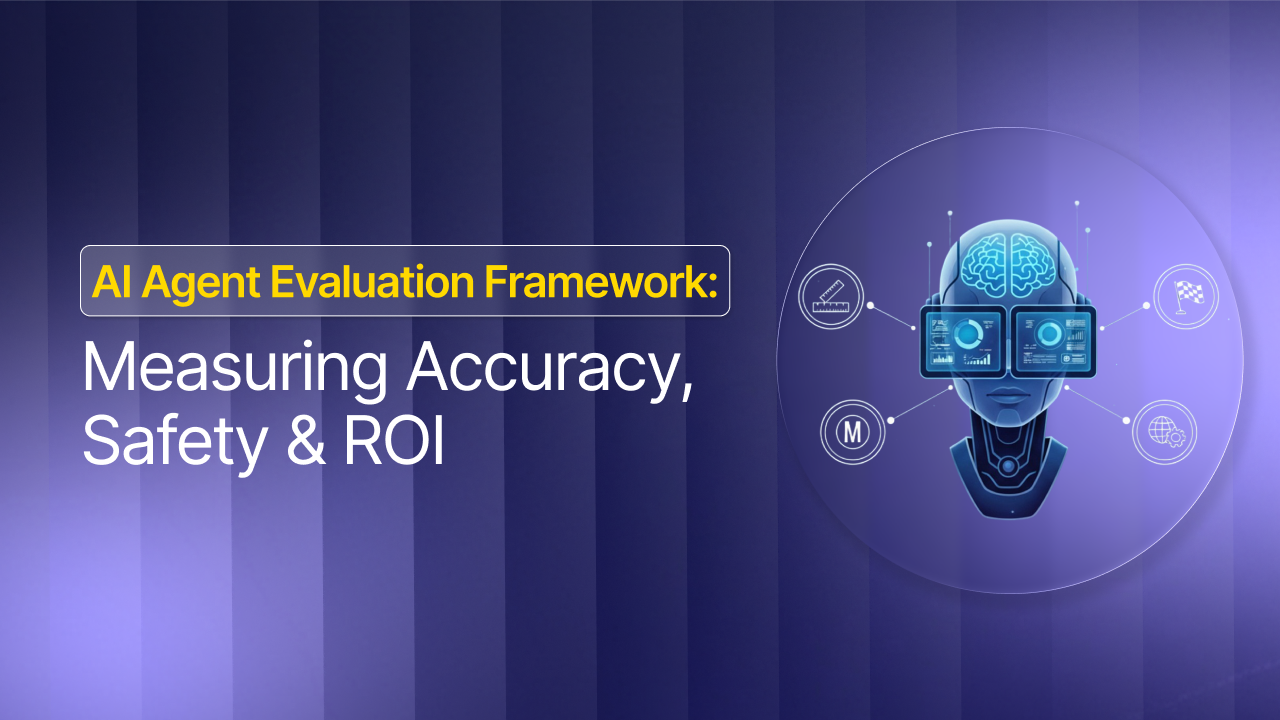
AI Agent Evaluation Framework: How to Measure Accuracy, Safety, and ROI Before You Deploy
|
Quick Answer / TL;DR: 78% of enterprises have AI agent pilots but fewer than 15% have reached production scale (enterprise technology survey, March 2026). The gap is not model quality 60% of production failures trace to data quality, context problems, and governance failures, not model limitations (Algolia, 2026). A structured AI agent evaluation framework is what closes that gap: it gates production deployment on measured performance across accuracy, safety, cost, and business outcomes, not on "the demo looked good."
|
Why AI Agent Evaluation Has Become the Bottleneck Between Pilot and Production in 2026
The pilot-to-production failure rate in enterprise AI has not improved at the pace that model capability has. 60% of organizations are now deploying AI agents (LXT, 2026), yet 39% of AI projects in both 2024 and 2025 fell short of expectations a failure rate that has held stubbornly stable despite two years of model improvement (LXT, 2026). The reason is structural: organizations are investing in model selection and prompt engineering but not in the evaluation infrastructure that determines whether the model is actually doing what the business needs it to do.
The production gap is measured. A March 2026 survey of 650 enterprise technology leaders found that 78% of enterprises have AI agent pilots, but fewer than 15% have reached production scale (Algolia, 2026). The most common explanation offered for why pilots don't scale is "the model wasn't good enough" but the data tells a different story. 60% of AI production failures trace back to data quality problems, context failures, and governance gaps rather than model capability limitations (Algolia, 2026). You do not have a model problem in most cases. You have an evaluation problem: you deployed before you measured whether the agent was operating correctly on your data, in your context, against your specific failure modes.
The regulatory and financial stakes of skipping structured evaluation are now documented. $2.1 billion in regulatory fines related to AI misuse were issued globally in 2025 a 7x increase from 2023 (Medhacloud, 2026). 71% of enterprises are concerned about AI hallucination in customer-facing applications (Gartner, 2026). An AI agent deployed in a customer service or financial services context without a documented evaluation record is not just a technical risk it is a compliance exposure under the EU AI Act's requirements for high-risk AI systems and under sector-specific regulations in every regulated industry.
This is where AI agent evaluation shifts from a best practice to a production prerequisite. The organizations producing measurable AI ROI 5.8x average return within 14 months for production deployments (McKinsey Global AI Survey, 2025) are the ones that built evaluation into their deployment process rather than treating it as optional QA at the end.
What Is AI Agent Evaluation, Exactly?
AI agent evaluation is the systematic process of measuring an autonomous AI agent's performance across multiple dimensions reasoning quality, tool usage, task completion, safety behavior, operational efficiency, and business impact before production deployment and continuously throughout the agent's operational life.
AI agent evaluation differs from traditional software testing in a fundamental and important way. Traditional software tests deterministic outputs: given input A, the correct output is always B, and any deviation is a bug. AI agents make autonomous decisions that vary between runs even with identical inputs they reason, select tools, chain actions, and adapt to intermediate results. The correct output for a given input is not always a single fixed answer; it is a distribution of acceptable outcomes that a trained evaluator can recognize as correct or incorrect. That non-determinism requires a different evaluation methodology: multi-run sampling, probabilistic correctness scoring, and human expert review alongside automated metrics.
The distinction between benchmark testing and production evaluation is equally important. Standard AI benchmarks SWE-bench, WebArena, AgentBench, GAIA, τ-bench test agents in controlled environments with standardized tasks. They are essential for comparing models and establishing capability baselines, but UC Berkeley researchers examining eight prominent benchmarks found they largely fail to capture reliability, cost efficiency, safety behavior, and long-horizon competence in real-world production conditions (Zylos Research, 2026). A model that tops SWE-bench for software engineering tasks can still fail systematically on your specific codebase with your specific toolchain. Benchmark scores measure general capability. Production evaluation measures specific fitness for your use case.
Trajectory accuracy is the evaluation concept that unifies these concerns. Rather than asking only "did the agent complete the task," trajectory accuracy asks "did the agent take the right steps, in the right sequence, with the right tool calls, to reach the correct outcome?" A customer service agent that resolves a ticket by hallucinating a policy and communicating it confidently to a customer has a 100% task completion rate and a 0% trajectory accuracy score on that interaction. Trajectory accuracy is the metric that catches that failure. It is also the metric that most pre-2026 evaluation frameworks did not capture.
The Numbers: Why Evaluation Infrastructure Determines ROI, Not Model Selection
The performance gap between organizations that evaluate systematically and those that don't is large enough to constitute the primary ROI differentiator in enterprise AI deployment.
On the pilot-to-production failure rate:
-
78% of enterprises have AI agent pilots; fewer than 15% have reached production scale (650-enterprise survey, March 2026, Algolia)
-
39% of AI projects in 2024 and 2025 fell short of expectations a rate unchanged despite model improvements (LXT, 2026)
-
60% of production failures trace to data quality, context, and governance not model limitations (Algolia, 2026)
-
Only 29% of executives report seeing significant ROI from generative AI; only 23% from AI agents specifically (Orbilon Tech, 2026)
On what structured evaluation delivers:
-
5.8x average ROI on AI investment within 14 months for organizations that reached production deployment (McKinsey Global AI Survey, 2025)
-
Enterprise conversational AI systems with structured evaluation typically aim for and achieve containment rates of 70–90% (Master of Code, 2026)
-
AI-assisted customer support agents resolve 14% more issues per hour; novice workers see 34% improvement but these gains require evaluation gates that verify the AI is actually helping rather than creating work (Stanford GSB, 2025)
-
Organizations using AI in IT operations report 31% fewer critical incidents when AI systems are continuously monitored the runtime evaluation pattern, not just pre-deployment testing (Medhacloud, 2026)
On safety and governance risk:
-
A customer service agent can achieve 100% tool-call accuracy while still violating policy on edge cases the normal failure mode for agents evaluated only on task completion (Dr. Randal Olson, 2026)
-
Static task-completion scores fail to capture reliability, cost efficiency, safety, and long-horizon competence the specific gaps that produce production failures (Zylos Research, 2026)
-
UC Berkeley researchers examining eight prominent AI agent benchmarks found contradictory safety rankings across the same models on different benchmarks meaning no single benchmark is sufficient for production safety validation (Zylos Research, 2026)
The pattern in the data is consistent: organizations that deploy AI agents without structured evaluation are the 39% that keep missing expectations. Organizations that build evaluation infrastructure before scaling are the ones in the 5.8x ROI group. The evaluation infrastructure is the differentiator not the model.
How to Build an AI Agent Evaluation Framework: A 6-Phase Process
This framework reflects the enterprise evaluation approach used by production AI teams in 2026. The phases are sequenced by dependency: each one generates the data or infrastructure the next requires.
Phase 1: Define the evaluation scope and success criteria before selecting metrics.
Start with the business objective, not the metric. An AI agent deployed for customer support has different success criteria than one deployed for code review or financial analysis. Document, for your specific use case: what does a correct output look like (and who is qualified to judge)? What does an acceptable failure look like (recoverable, low-stakes) versus an unacceptable failure (irreversible, policy-violating, legally consequential)? What is the minimum acceptable performance on each dimension before production deployment? These definitions are inputs to metric selection without them, you will measure what is easy to measure, not what matters for your use case.
Phase 2: Build a labelled evaluation dataset from production-representative inputs.
The quality of your AI agent evaluation is determined entirely by the quality of your evaluation dataset. A test set built from idealized, simple inputs will produce an agent that performs well in testing and poorly in production because production inputs are ambiguous, multi-turn, exception-heavy, and don't follow the clean patterns of a hand-crafted test. Build your evaluation dataset from three sources: real historical interactions from the workflow the agent will replace (if available); adversarial inputs designed by domain experts to probe the agent's specific failure modes; and edge cases drawn from the categories of failure your team has already encountered in other AI deployments. Label each example with the ground truth correct output and the acceptable output range, reviewed by a domain expert. The labeling investment is the highest-leverage activity in evaluation it defines what correct means for your use case.
Phase 3: Score across five evaluation dimensions simultaneously.
Effective AI agent evaluation covers five dimensions in parallel assessing only one or two produces a misleadingly narrow picture of the agent's production fitness:
-
Intelligence and Accuracy Does the agent reach correct conclusions? Metrics: task success rate, intent resolution rate, hallucination rate (verified against ground truth), factual accuracy on domain knowledge, trajectory accuracy (did the reasoning path match expert judgment, not just the final output).
-
Performance and Efficiency Does the agent operate within operational constraints? Metrics: end-to-end latency, token consumption per task, cost per successful completion, API call volume and efficiency.
-
Reliability and Resilience Does the agent behave consistently at scale and under adversarial conditions? Metrics: pass@k (success rate across multiple runs of the same task the most important reliability signal for non-deterministic agents), error recovery rate, behavior under edge case and adversarial inputs.
-
Safety and Governance Does the agent comply with policy constraints and avoid harmful outputs? Metrics: policy compliance rate on sensitive topics, refusal accuracy (does it refuse the right things?), prompt injection resistance, output toxicity and bias scores, audit trail completeness.
-
User Experience Does the agent produce outputs that users find useful? Metrics: response coherence, completeness, helpfulness ratings from human evaluators, escalation rate (the rate at which the agent correctly escalates to a human rather than attempting a task beyond its capability).
The pass@k metric deserves specific attention for production deployment decisions. Unlike a single-run success rate, pass@k measures whether an agent can reliably complete the same task class across k independent attempts typically k=3 to k=10. An agent with a 70% single-run success rate and a pass@10 of 40% is far less production-ready than the single-run number suggests. τ-bench is currently the most rigorous public benchmark for tool-using agents specifically because it uses this pass^k reliability metric (Automation Anywhere, 2026).
Phase 4: Apply the eval-gated promotion model to every deployment decision.
Eval-gated promotion means no agent version moves from development to staging, or from staging to production, without meeting defined performance thresholds on all five dimensions simultaneously. Define the thresholds before you start evaluating not after you see the results. Thresholds set after seeing results are not quality gates; they are rationalizations. The promotion decision should be automatic and documented: version X of the agent met thresholds on all five dimensions on date Y, reviewed by name Z, and promoted to production under change record W. This record is what satisfies EU AI Act Article 9 documentation requirements for high-risk AI systems and what your audit team will request first.
Phase 5: Deploy runtime evaluation alongside the production agent.
Pre-deployment evaluation tells you the agent was fit for production on launch day. Runtime evaluation tells you whether it is still fit for production today. AI agents degrade over time as data distributions shift, tool dependencies change, and new interaction patterns emerge that the training and evaluation datasets didn't cover. Runtime evaluation requires: continuous sampling of production interactions with automated quality scoring; alerting when metrics drift below defined thresholds; periodic re-evaluation against the full labelled dataset; and a feedback loop that routes failed production interactions back into the evaluation dataset as new test cases. The organizations reporting 31% fewer critical incidents from AI in IT operations (Medhacloud, 2026) are the ones running runtime evaluation, not just pre-deployment testing.
Phase 6: Establish the human review layer for high-stakes and ambiguous cases.
Automated evaluation scores measure what automated metrics can measure. They do not catch every failure mode that matters in production particularly the ones that are contextually wrong without being algorithmically wrong. A research agent that correctly retrieves and synthesizes information but draws a conclusion that a domain expert would immediately identify as flawed passes automated scoring and fails expert review. Build a structured human review cadence into your evaluation process: weekly domain expert review of a random sample from production interactions, monthly review of all cases where the agent was flagged for low confidence or escalation, and immediate review of any interaction that generated a user complaint or compliance flag. The human review layer is what catches the "100% tool-call accuracy, policy violation on edge cases" failure pattern described by Dr. Randal Olson (2026).
Tools and Platforms for AI Agent Evaluation in 2026
These are the platforms actively used by enterprise AI teams for evaluation, benchmarking, and runtime monitoring. Match the tool to the evaluation phase it addresses.
For automated benchmarking and eval-gated deployment:
-
Braintrust Connects AI agent versioning directly to quality measurement. Every agent update is evaluated against a labelled dataset before it can be promoted. Runs continuous eval in CI/CD pipelines and surfaces regression against prior versions. The clearest implementation of eval-gated promotion in a commercial platform. Supports automated LLM-as-judge scoring for open-ended response evaluation.
-
LangSmith (LangChain) Trace-based evaluation platform that logs every agent step tool calls, intermediate reasoning, input/output at each node and scores trajectory accuracy against labelled ground truth. Strongest for teams running LangChain or LangGraph agent architectures. Provides the step-level tracing that surfaces the difference between "task completed" and "task completed correctly via the right path."
-
Truesight (Randalolson.com, 2026) Positioned specifically for the gap between "how your agent ran" (solved by most platforms) and "whether it worked" (solved by fewer). Focuses on contextual correctness evaluation in domains where the right answer is defined by people, not by automated metrics.
For safety and adversarial evaluation:
-
Giskard Open-source AI testing platform focused on vulnerability detection: hallucination, prompt injection, bias, toxicity, and policy compliance. Generates adversarial test cases automatically against your specific agent and data. Strong for Phase 3 (safety dimension) evaluation and for regulated industries requiring documented safety testing.
-
PromptFoo Open-source LLM evaluation and red-teaming tool. Runs automated adversarial attacks against your agent configuration and scores guardrail effectiveness. Used for prompt injection resistance testing and safety behavior validation before deployment.
For runtime monitoring and continuous evaluation:
-
Arize AI / Fiddler AI Production model monitoring platforms that detect output distribution shift, accuracy degradation, and anomalous behavior patterns in live AI systems. The production implementation of Phase 5 (runtime evaluation). Integrates with your alerting infrastructure to trigger HITL review when quality metrics fall below thresholds.
-
Datadog LLM Observability For generative AI and LLM-based agents specifically. Monitors token consumption, latency, output quality scores, and error rates in production. Configurable threshold alerting that feeds back into the eval-gated cycle.
Industry benchmark suites for capability validation:
-
τ-bench The most rigorous public benchmark for tool-using agents, using the pass^k reliability metric that exposes agents that perform well on single runs but fail under repeated testing. Required baseline for any agent that will use external tools in production.
-
SWE-bench Software engineering agent benchmark. For development productivity agents, SWE-bench verified scores against your specific codebase type provide the most relevant capability signal.
-
GAIA (General AI Assistant) Multi-modal, multi-step reasoning benchmark that tests agents on real-world tasks requiring tool use, web navigation, and factual reasoning. Strong for knowledge-intensive agent applications.
What Goes Wrong: The 5 Most Expensive AI Agent Evaluation Mistakes
1. Evaluating only on task completion rate.
Task completion rate measures whether the agent finished the task. It does not measure whether the agent finished it correctly, safely, via the right reasoning path, or within acceptable cost and latency bounds. A customer service agent that closes 95% of tickets by hallucinating policy information has an excellent task completion rate and a catastrophic safety record. Evaluate trajectory accuracy alongside task completion the path to the answer matters as much as the answer itself.
2. Using benchmark scores as a proxy for production fitness.
SWE-bench, WebArena, and AgentBench scores are useful for model comparison. They are not sufficient for production deployment decisions. UC Berkeley researchers found contradictory safety rankings across the same models on different benchmarks, and static task-completion scores consistently fail to capture reliability at scale (Zylos Research, 2026). Your production evaluation must be conducted against your data, your toolchain, and your specific failure modes not against a standardized benchmark that was designed for general capability assessment.
3. Setting evaluation thresholds after seeing the results.
This is the most common evaluation process failure and the one that most reliably produces the 39% of AI projects that fall short of expectations. If your team evaluates an agent, observes a 72% task success rate, and then decides that 70% is the acceptable threshold, you have not conducted an evaluation you have conducted a rationalization. Thresholds must be defined before evaluation begins, based on the business consequences of failure at different performance levels. That pre-definition is what makes the evaluation meaningful and what makes the deployment decision defensible.
4. Treating pre-deployment evaluation as sufficient.
An agent that passes pre-deployment evaluation is fit for production on launch day. It is not certified fit for production forever. Data distributions shift, tool dependencies update, user behavior evolves, and new interaction patterns emerge that your launch-day evaluation dataset didn't cover. Without runtime monitoring and periodic re-evaluation, you will not know when the agent degrades you will find out when a user complaint or a compliance incident makes the degradation visible. Build the runtime evaluation layer before launch, not after the first incident.
5. Skipping domain expert review in favor of fully automated scoring.
Automated metrics measure what automated metrics can measure. They do not catch policy violations that are contextually wrong without being linguistically wrong, domain knowledge errors that require subject matter expertise to identify, or subtle reasoning failures that produce plausible-sounding but incorrect conclusions. An agent that passes automated scoring and fails domain expert review is the "100% tool-call accuracy, policy violation on edge cases" failure pattern described by Dr. Randal Olson (2026). It is also the most common pattern in deployments that generate compliance incidents. Budget for structured domain expert review in your evaluation process not as a replacement for automated scoring, but as the layer that catches what automation cannot.
FAQ
How should AI agents be evaluated?
AI agents should be evaluated across five dimensions simultaneously: intelligence and accuracy (task success rate, hallucination rate, trajectory accuracy), performance and efficiency (latency, token cost, API efficiency), reliability and resilience (pass@k across multiple runs, error recovery, adversarial robustness), safety and governance (policy compliance, prompt injection resistance, audit trail completeness), and user experience (coherence, helpfulness, appropriate escalation rate). Evaluation must combine automated scoring with domain expert review, use a labelled dataset built from production-representative inputs, and gate deployment on defined performance thresholds set before evaluation not after results are visible.
Which metrics matter most for AI agent performance?
The three metrics that most reliably predict production success are trajectory accuracy (did the agent use the right reasoning path, not just reach an output), pass@k reliability (does the agent succeed consistently across multiple runs of the same task, not just occasionally), and hallucination rate verified against ground truth (not just fluency). Task completion rate is the most commonly reported metric and the least predictive of production outcomes an agent can complete tasks incorrectly, at unacceptable cost, or via policy violations while maintaining a high completion rate. For regulated industries, policy compliance rate and audit trail completeness are non-negotiable additions to this core set.
How do organizations measure AI ROI?
Organizations measure AI ROI at two levels: operational metrics and business outcome metrics. Operational metrics include cost per successful task completion (total inference cost divided by tasks correctly completed), time-to-resolution improvement versus the baseline process, error rate reduction versus the pre-AI process, and escalation rate (the share of tasks the AI handles without human intervention). Business outcome metrics include revenue attributable to AI-handled interactions, cost savings from reduced human labor on automated tasks, and compliance incident reduction. The McKinsey benchmark for production AI deployments is 5.8x ROI within 14 months but this requires connecting operational metrics to business outcomes through a documented measurement model, not inferring ROI from productivity surveys.
Conclusion: Evaluation Infrastructure Is the Investment That Makes Every Other AI Investment Pay Off
The 5.8x ROI that production AI deployments deliver and the 39% of projects that consistently fall short of expectations are not two populations of companies with different model choices. They are one population of companies divided by whether they built evaluation infrastructure before scaling deployment.
The path from pilot to production does not run through a better model. It runs through a structured AI agent evaluation framework that defines success criteria before testing, measures performance across all five dimensions simultaneously, gates deployment on pre-defined thresholds, and maintains runtime monitoring after launch. That infrastructure is what converts the 78% of enterprises with AI pilots into the 15% with production-scale deployments and what converts pilot ROI into the compounding return that McKinsey documents at 14 months post-deployment.
Your immediate next step: identify the single AI agent in your portfolio closest to production deployment and run Phase 3 of the framework above against it this quarter. Score it across all five dimensions against a labelled evaluation dataset built from production-representative inputs. Set your deployment thresholds before you see the results. If the agent meets them, deploy with runtime monitoring in place. If it doesn't, you have a documented gap analysis that tells your team exactly what to fix which is worth more than any model comparison chart.
Related reading: For the consulting support to build an enterprise AI evaluation program, see our guides on AI Consulting Services and Enterprise AI Governance to scope the evaluation infrastructure and governance framework your AI deployment program requires.