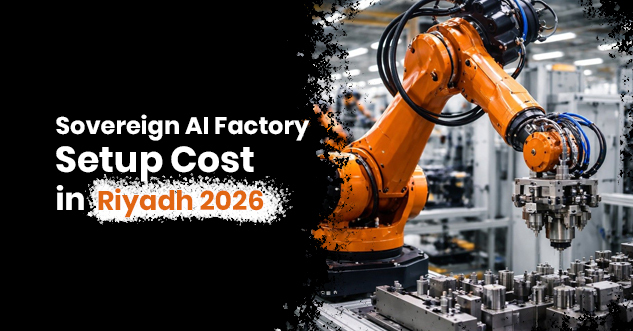


Saudi Vision 2030, the Humain Initiative, and the $100 Million+ Infrastructure Build That Will Define GCC AI Leadership
Reading time: ~14 minutes
|
TLDR ; A Sovereign AI Factory setup in Riyadh in 2026 ranges from $10 million for an initial compute cluster to over $100 million for national-scale infrastructure. These projects are driven by Saudi Vision 2030's mandate for local control over AI models and data, achieving full sovereignty under the SDAIA Personal Data Protection Law (PDPL). The Humain initiative targets 1.9GW of data centre capacity, positioning Saudi Arabia not merely as an AI adopter but as a global AI compute provider. The GCC region's structural energy advantage $0.025/kWh average industrial electricity cost versus $0.12/kWh in the EU makes large-scale AI inference economically viable at margins unavailable in Western markets. |
Why GCC Operates Under Different Structural Conditions for AI Infrastructure
The prevailing Western model of AI adoption treats compute infrastructure as a cost to be minimised rented from hyperscalers at marginal rates, scaled elastically, and measured in cost-per-token. This model works when energy is expensive and compute is a commodity. The GCC region inverts both assumptions: energy is structurally cheap (Saudi Arabia produces electricity at $0.025/kWh for industrial consumers), land is available at scale, and the political economy actively incentivises building compute infrastructure as a national strategic asset.
The consequence is that Saudi Arabia is not simply an AI adopter it is positioning itself as a provider of global AI compute infrastructure. The Humain initiative (Human AI Initiative), launched under the Public Investment Fund in 2025, targets 1.9GW of data centre capacity in the Kingdom by 2030 equivalent to more than 200 hyperscale data centres. At the energy cost advantage the Kingdom enjoys over European and US markets, Saudi-hosted AI inference will be cost-competitive with the most efficient hyperscaler regions in the world.
|
VISION 2030 AI INFRASTRUCTURE STAT Saudi Arabia's Public Investment Fund committed $40 billion to AI infrastructure in 2025 through the Humain initiative. The programme targets 500MW of GPU cluster capacity operational by the end of 2026, with full 1.9GW deployment by 2030. At the Kingdom's industrial electricity rate of $0.025/kWh, the running cost of this infrastructure is approximately $190 million per year compared to $900 million for equivalent capacity in a Western European market. |
Sovereign AI Factory: What the Setup Actually Costs
Tier 1: Department-Level Compute Cluster ($10M–$25M)
A Tier 1 Sovereign AI Factory is appropriate for a government ministry, semi-government authority, or large enterprise that requires dedicated AI compute for internal applications processing citizen data, financial records, or sensitive operational data under PDPL compliance. This tier provides GPU compute capacity for model fine-tuning, inference, and data processing, without dependence on foreign cloud providers.
|
Component |
Specification |
Cost Range |
|
GPU compute cluster |
64–128x H100 SXM5 or equivalent |
$4.5M–$12M |
|
High-performance networking (InfiniBand) |
400Gb/s HDR InfiniBand fabric |
$800K–$1.8M |
|
Storage infrastructure (NVMe + NAS) |
2PB usable high-speed storage |
$600K–$1.4M |
|
Data centre facility (colocation) |
Al Murjanah or KACST facility, Riyadh |
$400K–$900K/year |
|
MLOps platform (Kubeflow / Ray) |
Containerised training + inference stack |
$300K–$700K |
|
PDPL compliance & data governance |
Data classification, audit trails, access controls |
$400K–$900K |
|
Arabic LLM fine-tuning (JAIS or Allam) |
Domain-specific adaptation on sovereign hardware |
$500K–$1.5M |
|
TOTAL TIER 1 |
Department-scale sovereign AI |
$10M–$25M |
Tier 2: Enterprise / Semi-Government AI Platform ($25M–$75M)
A Tier 2 Sovereign AI Factory serves a national authority, large semi-government entity, or multi-ministry shared infrastructure programme. This tier provides multi-tenant AI infrastructure capable of hosting multiple Arabic-language models, processing large-scale citizen datasets, and supporting real-time AI applications across government services.
|
Component |
Specification |
Cost Range |
|
GPU compute cluster |
256–512x H100 / GH200 Grace Hopper |
$18M–$45M |
|
Dedicated data centre build |
5–15MW purpose-built facility, Riyadh |
$8M–$22M |
|
Sovereign networking (dark fibre) |
Dedicated cross-connect to KSA internet exchange |
$1.2M–$3M |
|
Arabic NLP & vertical AI platform |
Medical Arabic NLP + financial Arabic LLM stack |
$2M–$6M |
|
PDPL compliance + CITC certification |
Full regulatory approval programme |
$800K–$2M |
|
Security operations centre (SOC) |
24/7 sovereign SOC for AI infrastructure |
$1.5M–$4M/year |
|
TOTAL TIER 2 |
Enterprise sovereign AI platform |
$25M–$75M |
Tier 3: National-Scale AI Infrastructure ($75M–$100M+)
Tier 3 represents the Humain-scale deployment: national AI infrastructure designed to serve the Kingdom's entire public sector, export compute capacity to regional partners, and host the Arabic-language foundation models that underpin Saudi Arabia's AI sovereignty. These projects are PIF-backed, SDAIA-governed, and aligned with the 2030 target of 1.9GW total data centre capacity.
|
HUMAIN INITIATIVE SCALE The Humain initiative's first phase 500MW of GPU capacity by end of 2026 represents approximately 6.2 million H100-equivalent GPU hours per day of compute availability. At Saudi Arabia's industrial electricity rate, operating this infrastructure costs $3.1 million per day versus $14.9 million per day for equivalent capacity in a Western European market. The structural energy advantage is the foundational economics of Saudi AI sovereignty. |
The Vertical AI Opportunity: Arabic-Language Medical and Financial Systems
The strategic value of Sovereign AI infrastructure extends beyond data residency compliance. The deeper opportunity is Vertical AI: domain-specific AI systems trained on Arabic-language data in sectors where global English-language models perform poorly and where the stakes of model error are highest healthcare and financial services.
Arabic Medical AI: The Under-Served Opportunity
Arabic-language medical AI is one of the least-developed verticals in the global AI landscape. The JAIS and Allam foundation models developed by the Mohammed bin Zayed University of Artificial Intelligence and the Saudi Authority for Data and AI respectively provide sovereign Arabic LLM capacity, but domain-specific medical fine-tuning on Saudi patient data is only possible with sovereign infrastructure that keeps that data within KSA borders.
• Clinical decision support in Arabic: diagnosis assistance for Saudi physicians using ICD-10-AM coded Arabic clinical notes
• Arabic radiology report generation: NLP extraction from Arabic-language imaging reports for Saudi national health data
• CCHI-compliant medical AI: Saudi Commission for Health Specialties compliance for AI-assisted clinical documentation
• Arabic patient communication AI: automated patient-facing communications in Hejazi, Najdi, and Gulf Arabic dialects
Arabic Financial AI: Compliance-First Automation
• SAMA-compliant financial AI: models trained on Saudi regulatory frameworks for AML, KYC, and credit risk assessment
• Shariah-compliant product recommendation: Islamic finance product recommendation AI trained on Saudi banking data
• Arabic financial NLP: automated extraction from Arabic-language financial statements, contracts, and regulatory filings
• Vision 2030 economic diversification analytics: AI systems tracking Saudi private sector growth against Vision 2030 KPIs
PDPL Compliance: The Non-Negotiable Requirement for Sovereign AI
The Saudi Personal Data Protection Law (PDPL), enforced by SDAIA since September 2023, creates specific requirements for AI systems processing Saudi citizen data. Article 29 prohibits the transfer of sensitive personal data outside Saudi Arabia without explicit consent and regulatory approval a requirement that rules out public cloud AI processing for most government and healthcare applications.
|
PDPL Requirement |
Implication for AI Systems |
Sovereign Factory Solution |
|
Article 29: Data localisation for sensitive data |
AI training and inference must occur within KSA |
On-premise GPU cluster within Saudi data centre |
|
Article 17: Purpose limitation |
AI models must be trained only on data collected for defined purposes |
Data governance layer with purpose tagging and training data lineage |
|
Article 19: Automated decision transparency |
AI decisions affecting individuals must be explainable |
Explainability layer with Arabic-language decision rationale output |
|
Article 34: Data breach notification |
72-hour breach notification to SDAIA |
Sovereign SOC with automated breach detection and regulatory reporting |
AgamiSoft's Sovereign AI Advisory Services for GCC Clients
AgamiSoft provides end-to-end advisory and implementation services for GCC sovereign AI infrastructure projects, from initial feasibility assessment through to production deployment. Our team includes SDAIA-certified data governance specialists, Arabic NLP engineers with JAIS and Allam fine-tuning experience, and infrastructure architects with KSA data centre deployment credentials.
|
AgamiSoft is accepting Sovereign AI advisory engagements for GCC clients in Q2 2026. Our services cover feasibility assessment, PDPL compliance architecture, Arabic LLM fine-tuning programme design, and procurement support for GPU infrastructure sourcing. Initial feasibility study from $85,000. Full programme advisory from $350,000. KSA presence with SDAIA compliance expertise. |