
Supply Chain Security 2026
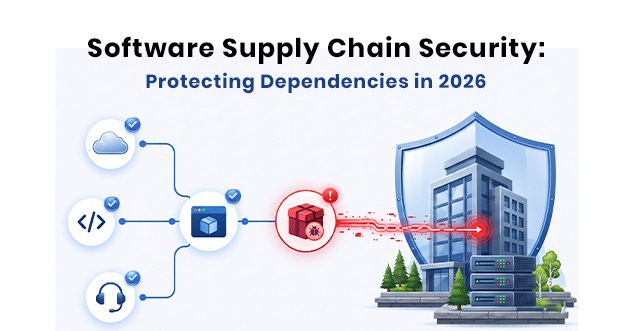
Supply Chain Security 2026
Published by AgamiSoft | Reading time: ~14 minutes
|
TLDR ; Software supply chain security is the discipline of protecting the third-party components, tools, and infrastructure that software depends on open-source libraries, commercial packages, CI/CD pipeline tools, build systems, and developer environments from being compromised and used as attack vectors into your production software. Modern applications rely heavily on third-party libraries, making dependency management a critical security function: the average application imports 40–80 direct dependencies, each potentially importing dozens of their own. The organizations with the strongest software supply chain security in 2026 are not those that eliminate third-party dependencies they are those with continuous visibility into what they depend on and automated detection of when those dependencies change or become compromised. |
Why Software Supply Chain Security Has Become a Top Engineering Priority in 2026
Supply chain attacks against software have delivered some of the most consequential security incidents of the past five years and the attack surface has grown, not shrunk, as software dependency counts have increased. The SolarWinds compromise (2020) demonstrated that an attacker who compromises a widely-used software build system can reach thousands of organizations through a single malicious update. The Log4Shell vulnerability (2021) demonstrated that a single library embedded deep in an application's transitive dependency tree can expose virtually every enterprise application simultaneously. The XZ Utils backdoor (2024) demonstrated that a sophisticated state-level attacker can spend years building trust within an open-source project before inserting a targeted backdoor into a widely-deployed compression library.
Each of these incidents shared a common characteristic: the attack vector was not the target organization's own code. It was a component the organization trusted implicitly because it came from an established source and that implicit trust is precisely what software supply chain security programs are designed to replace with explicit, verified trust.
Three 2026-specific developments have elevated software supply chain security from a security team concern to an engineering-wide operational priority:
Executive Order 14028 and SSDF compliance have become procurement requirements. The US Cybersecurity and Infrastructure Security Agency's Secure Software Development Framework (SSDF), mandated for software vendors selling to the US federal government by EO 14028, requires documented secure development practices including SBOM generation, dependency vulnerability management, and build environment security. This requirement has cascaded from federal procurement into enterprise software procurement more broadly software buyers increasingly requiring SBOM provision and SSDF alignment from commercial software vendors.
SLSA has established a widely-adopted supply chain security maturity model. The Supply-chain Levels for Software Artifacts (SLSA) framework, developed by Google and now governed by the OpenSSF, provides a four-level maturity model for software supply chain security that has been adopted by major software producers as both an internal target and a vendor communication standard. SLSA Level 2 (tamper-resistant build provenance) and Level 3 (hardened build environment) have become the practical targets for software engineering teams in 2026.
AI-generated and AI-assisted code has introduced new supply chain surface area. Code generated by GitHub Copilot, Amazon CodeWhisperer, and similar AI coding tools can introduce dependencies, import patterns, or code structures that developers don't recognize or review with the same scrutiny as code they wrote themselves. AI-suggested dependencies may be outdated, malicious (in cases of hallucinated package names that a malicious actor has registered), or insecure creating a new software supply chain risk surface that pre-AI security frameworks don't address.
What Is Software Supply Chain Security, Exactly and What Attack Vectors Does It Cover?
Software supply chain security is the practice of verifying and protecting every component that enters your software's build process from the libraries your code imports to the tools your CI/CD pipeline uses to build, test, and deploy that code ensuring that adversaries cannot insert malicious code, vulnerabilities, or backdoors through trusted third-party channels.
A complete software supply chain includes more components than most engineering teams consciously track:
The dependency supply chain:
-
Direct dependencies: libraries and packages your code explicitly imports (npm packages, Python pip packages, Java Maven artifacts, Go modules)
-
Transitive dependencies: libraries imported by your direct dependencies typically 5–20x the count of direct dependencies, largely invisible to development teams without tooling
-
Pinned vs floating versions: whether your dependency declarations specify exact versions (reproducible but requiring manual update) or version ranges (automatic updates with less control over what changes)
The build supply chain:
-
CI/CD pipeline tools (GitHub Actions, GitLab CI, Jenkins, CircleCI) and the actions/plugins they use each CI workflow step that runs third-party code is a supply chain component
-
Build tools (compilers, bundlers, linters, test frameworks) and their own dependency trees
-
Container base images the operating system and runtime layers in Docker images that form the foundation of containerized applications
The developer environment supply chain:
-
IDE plugins and extensions that have code execution access within developer environments
-
Developer tools installed via package managers (npm global packages, pip global installs, homebrew formulae)
-
AI coding assistants and their suggested code patterns, imports, and dependencies
Software supply chain attack vectors documented in the wild include:
-
Dependency confusion attacks: registering a malicious public package with the same name as an internal private package, exploiting package manager resolution behavior to install the malicious public version
-
Typosquatting: registering packages with names similar to popular legitimate packages (e.g., "request" vs "reqeuest") that developers install accidentally
-
Account takeover of package maintainers: compromising an open-source maintainer's credentials to publish a malicious update to an otherwise legitimate, trusted package
-
Build system compromise: inserting malicious code into the build pipeline rather than the source code, so the delivered binary contains malware that no code review would detect
-
Malicious commit to open-source project: the XZ Utils model patient, long-term project contribution followed by a targeted malicious commit
SBOM Software Bill of Materials is the inventory document listing every component in a software product, their versions, their licenses, and their relationship to each other. SBOM is the foundational artifact that software supply chain security programs generate and consume: you cannot assess or manage risk in components you haven't inventoried.
The Numbers Behind Software Supply Chain Risk in 2026
Dependency Volume and Vulnerability Data
|
Metric |
Current State |
Source |
|
Average direct dependencies per application |
40–80 packages |
Synk Open Source Security Report 2025 |
|
Average transitive dependencies per application |
300–800 packages |
Snyk, 2025 |
|
% of CVEs in open-source components vs custom code |
84% in dependencies, 16% in proprietary code |
Veracode State of Software Security 2025 |
|
Average time from CVE publication to exploit in the wild |
Under 24 hours (high-severity) |
Mandiant M-Trends 2025 |
|
% of applications with a known vulnerable dependency in production |
68% |
Snyk, 2025 |
Sources: Snyk Open Source Security Report 2025; Veracode State of Software Security 2025; Sonatype Software Supply Chain State of the Union 2025.
Supply Chain Attack Frequency and Impact
-
Software supply chain attacks increased 742% between 2019 and 2025, measured by publicly documented incidents (Sonatype, 2025)
-
The average time to detect a supply chain compromise in production is 287 days longer than direct attacks because malicious code entering through a trusted dependency is less likely to trigger security monitoring tuned for unauthorized external access (IBM Cost of a Data Breach Report, 2025)
-
Malicious packages detected in public npm, PyPI, and Maven registries grew 125% year-over-year in 2025, with an increasing proportion showing sophisticated evasion techniques rather than unsophisticated typosquatting (Sonatype, 2025)
Regulatory and Procurement Pressure
-
Software vendors selling to US federal agencies must provide SBOM for all software deliveries under EO 14028 implementation guidance, effective for new contracts (CISA, 2025)
-
41% of enterprise software buyers now require SBOM provision from commercial software vendors in contract terms, up from 8% in 2022 (Gartner, 2025)
-
SLSA Level 2 compliance is required by the Linux Foundation's OpenSSF for projects in its security critical software program a standard increasingly referenced in enterprise open-source procurement requirements
How to Build a Software Supply Chain Security Program: A 6-Step Framework
Step 1: Generate and Maintain a Complete SBOM for Every Application
An SBOM Software Bill of Materials is the foundational artifact of software supply chain security. You cannot manage risk in dependencies you haven't inventoried. Every application in your portfolio needs a continuously maintained SBOM that lists:
-
Every direct dependency with its exact version and package manager source
-
Every transitive dependency (dependencies of dependencies) resolved at build time
-
License information for each component identifying GPL, LGPL, AGPL, or copyleft licenses that may create legal obligations
-
Component relationships which direct dependency brings in which transitive dependencies
Generate SBOMs in one of the two standard formats: SPDX (System Package Data Exchange, ISO/IEC 5962, the format referenced in EO 14028) or CycloneDX (OWASP's SBOM standard, with broader tooling ecosystem support). Both formats are machine-readable XML or JSON designed for automated processing by vulnerability scanning and risk management tools, not for human review of individual entries.
Integrate SBOM generation into your CI/CD pipeline so every build generates an updated SBOM not as a periodic manual exercise, but as an automatic artifact of the build process itself.
Step 2: Implement Continuous Dependency Vulnerability Scanning in CI/CD
Dependency vulnerability scanning checking every dependency version in your SBOM against the National Vulnerability Database (NVD) and commercial vulnerability intelligence sources must run on every code commit and every build, not as a periodic scheduled scan:
-
Configure SCA (Software Composition Analysis) tooling to run on every pull request, failing the build on HIGH or CRITICAL severity CVEs in direct dependencies above a defined CVSS threshold
-
Extend scanning to transitive dependencies vulnerabilities in indirect dependencies are equally exploitable and are where the majority of high-severity findings hide in modern applications
-
Configure alerts for new CVEs published against dependencies already in production, not just at build time a vulnerability disclosed today affects code you deployed last month, and CI/CD scanning alone won't catch it without a continuous monitoring component
-
Establish a remediation SLA by severity tier: critical CVEs (CVSS 9.0+) patched within 7 days, high CVEs (CVSS 7.0–8.9) within 30 days, medium CVEs within 90 days with documented escalation when remediation requires dependency upgrade that introduces breaking changes
Step 3: Implement Dependency Pinning and Lock Files to Prevent Supply Chain Substitution
Floating dependency versions specifying ^1.2.0 (any minor version) or ~1.2.3 (any patch version) in package declarations allow package managers to resolve to newer versions than the developer tested against. This enables both automatic security update delivery (a benefit) and automatic delivery of a malicious update to a compromised package (the attack vector):
-
Generate and commit lock files for every application (package-lock.json for npm, Pipfile.lock for Python, Gemfile.lock for Ruby, go.sum for Go) lock files pin exact resolved versions of every direct and transitive dependency
-
Review and explicitly approve lock file changes on every pull request a lock file change is a dependency update and should receive the same scrutiny as any other code change
-
Implement dependency update automation (Dependabot, Renovate) to generate pull requests for dependency updates automatically ensuring updates are applied regularly, with review, rather than either left stale or applied silently
-
Consider private package mirrors for critical dependencies hosting copies of high-criticality open-source packages in your own artifact repository, providing a cache that doesn't silently update when the upstream source changes
Step 4: Secure Your CI/CD Pipeline as a First-Class Supply Chain Attack Surface
CI/CD pipelines execute code (build scripts, actions, plugins, test frameworks) with elevated privileges access to source code, secrets, cloud credentials, and production deployment capability. A compromised CI/CD pipeline can insert malicious code into builds that no source code review would detect:
-
Pin CI/CD action versions by commit hash, not tag: GitHub Actions referenced by tag (e.g., actions/checkout@v3) can be silently updated if the tag is moved reference by immutable commit SHA instead (e.g., actions/checkout@abc123)
-
Apply least-privilege secrets access: each CI/CD job should access only the secrets it specifically requires not a shared credential providing broad environment access
-
Implement ephemeral build environments: each build runs in a fresh, clean environment rather than a persistent runner that accumulates state across builds reducing the opportunity for a previous build's compromise to persist into the current build
-
Audit third-party actions and plugins: every GitHub Action, Jenkins plugin, or GitLab CI component in your pipeline is a supply chain component evaluate each for publisher legitimacy, pinned versions, and security history before adoption, and maintain an approved list
Step 5: Implement Package Signing and Provenance Verification
Package signing cryptographic verification that a package was published by who claims to have published it and hasn't been modified since signing is the control that directly defeats the most common supply chain attacks:
-
Verify signatures on packages before installation npm packages signed through npm's provenance feature, Python packages through Sigstore, and Java artifacts through Maven Central's PGP signing all provide cryptographic publisher verification
-
Implement Sigstore the open-source toolchain (Cosign, Fulcio, Rekor) for signing and verifying software artifacts including container images, build provenance, and package releases the standard that the Linux Foundation and OpenSSF have converged around for supply chain artifact signing
-
Generate build provenance attestations SLSA-compatible provenance records that document what source code was used, what build tools processed it, and where the build executed, enabling consumers of your software to verify that the binary they received matches the source code it claims to have been built from
-
Require provenance verification in your production deployment process container images deployed to production should be verified against their signed provenance attestation before deployment, rejecting images without valid provenance
Step 6: Implement Supply Chain Risk Governance at the Organizational Level
Technical controls without organizational governance produce inconsistent application across teams and application portfolios. Supply chain security governance requires:
-
Approved open-source catalog: a maintained list of pre-approved open-source libraries that engineering teams can use without individual review, plus a lightweight review process for new library adoption outside the approved catalog
-
License compliance monitoring: automated scanning for license types that create legal obligations (GPL-family copyleft licenses that require derivative work disclosure) built into the SBOM generation and review process
-
Third-party risk assessment for critical dependencies: for the 10–20 open-source dependencies that are most widely used across your application portfolio, conduct annual security assessments covering maintainer activity, security response history, and known vulnerability history
-
Supply chain security metrics in engineering dashboards: track mean time to patch critical vulnerabilities, percentage of applications with current SBOMs, percentage of CI/CD actions pinned to commit hashes making supply chain security visible alongside performance and reliability metrics
Which Tools Deliver Best Results for Software Supply Chain Security in 2026?
For SCA and dependency vulnerability scanning:
Snyk is the category leader for developer-experience-first SCA IDE integration, PR comments with remediation guidance, and a vulnerability database updated faster than NVD. GitHub Dependabot provides automated dependency update pull requests with native GitHub integration at no additional cost for organizations already on GitHub. OWASP Dependency-Check provides open-source SCA for organizations requiring no licensing cost. Sonatype Nexus IQ provides enterprise SCA with lifecycle management across repository, CI/CD, and production monitoring stages.
For SBOM generation:
Syft (Anchore, open-source) generates SBOMs in both SPDX and CycloneDX formats for containers, filesystems, and application packages the most widely adopted open-source SBOM generator. Microsoft's SBOM Tool (open-source) provides SPDX-format SBOM generation designed for integration into existing build pipelines. CycloneDX plugins are available natively for Maven, npm, NuGet, and most major build tools.
For package signing and provenance:
Sigstore (Cosign/Fulcio/Rekor, Linux Foundation, open-source) provides the standard toolchain for signing container images, build provenance, and software artifacts with keyless, certificate-based signing. npm Provenance (GitHub Actions integration) provides signed provenance for npm packages published through GitHub Actions CI. in-toto provides the framework for expressing and verifying supply chain attestations that SLSA is built upon.
For CI/CD security:
StepSecurity provides GitHub Actions security hardening automatically identifying unpinned actions, excessive permissions, and network access anomalies in GitHub Actions workflows. Pipelinewise and Orca Security provide CI/CD pipeline security scanning for broader CI/CD ecosystems beyond GitHub Actions.
For supply chain risk intelligence:
Socket.dev provides pre-installation malicious package detection analyzing npm and PyPI packages for suspicious behaviors (obfuscated code, unusual network access, install scripts with elevated permissions) before they enter your dependency tree. Endor Labs provides transitive dependency risk analysis with reachability analysis identifying which vulnerable transitive dependencies are actually reachable through your code's execution paths, reducing false positive remediation burden.
Explore our DevSecOps Services and Cybersecurity Consulting capabilities for engineering teams building software supply chain security programs that combine SBOM generation, SCA scanning, and CI/CD hardening into a governed security program.
What Goes Wrong With Software Supply Chain Security Programs and How to Prevent Each Failure
Failure 1: Scanning Only Direct Dependencies While Ignoring Transitive Dependencies
Organizations that implement SCA scanning limited to direct dependencies the packages explicitly listed in package.json, requirements.txt, or pom.xml are scanning approximately 10–20% of their actual dependency surface. 80–90% of a typical application's dependency count is transitive dependencies of dependencies and the majority of exploited vulnerabilities in dependency compromise incidents (Log4Shell being the clearest example) are in transitive dependencies that developers didn't know they had. Configure SCA tooling to scan the complete resolved dependency tree at build time, not just the direct dependency list.
Failure 2: Building SBOM as a Point-in-Time Document Rather Than a Continuously Updated Artifact
SBOMs generated once at application release and never updated become inaccurate within weeks as dependencies are updated, added, or removed. An SBOM that doesn't reflect the current production state of an application's dependencies cannot be used to identify whether a newly disclosed CVE affects that application the primary operational value of SBOM. SBOM generation must be integrated into every build process as an automatic output, and the current-state SBOM must be linked to the production deployment it describes, not maintained as a separate document.
Failure 3: Treating Open-Source License Compliance as Separate From Supply Chain Security
Open-source license scanning is frequently managed by legal teams as a distinct, periodic exercise separate from the security team's supply chain security program. The result is an SBOM generated for security purposes that lacks license information, and a license review process that operates on a different cadence than security scanning. Integrating license compliance into SBOM generation from the start flagging AGPL, GPL, and proprietary-incompatible licenses in the same automated scan that identifies CVEs produces a single inventory artifact that serves both security and compliance requirements.
Failure 4: Not Addressing AI-Suggested Dependencies as a Supply Chain Risk
AI coding assistants GitHub Copilot, Amazon CodeWhisperer, Cursor suggest import statements and library additions that developers often accept without the same scrutiny they'd apply to dependencies they discovered independently. AI models can suggest outdated package versions, packages with known vulnerabilities, or (in cases of AI hallucination) package names that don't correspond to real packages but that malicious actors may have pre-registered. Extend your dependency review process to flag new imports added by AI tooling for the same SCA scan and approved-catalog check applied to developer-selected dependencies.
Frequently Asked Questions
What Is Software Supply Chain Security?
Software supply chain security is the practice of protecting every component in the software development and delivery process third-party libraries, open-source packages, CI/CD pipeline tools, build environments, and developer tools from being compromised and used to insert vulnerabilities or malicious code into production software. Unlike traditional application security that focuses on vulnerabilities in code you write, supply chain security addresses risk in code you depend on but don't control. It has become a critical security discipline because modern applications depend on hundreds of third-party components, each representing an attack vector that bypasses conventional security controls by arriving through trusted installation channels.
What Is an SBOM?
An SBOM Software Bill of Materials is a machine-readable inventory of every component in a software product, including direct dependencies, transitive dependencies, their exact versions, their licenses, and the relationships between them. SBOMs are generated in standardized formats SPDX (ISO/IEC 5962) or CycloneDX (OWASP) that allow automated processing by vulnerability scanners, license compliance tools, and risk management platforms. The US Executive Order 14028 mandates SBOM provision for software sold to federal agencies, and enterprise software buyers are increasingly requiring SBOM from commercial vendors. An SBOM answers the question "what is actually in this software" the prerequisite for assessing and managing supply chain risk.
How Do Organizations Secure Open-Source Dependencies?
Organizations secure open-source dependencies through five coordinated practices. First, continuous SCA scanning in CI/CD pipelines identifies known CVEs in both direct and transitive dependencies before they reach production. Second, dependency pinning with lock files prevents package manager resolution from silently introducing new or updated dependencies without explicit review. Third, package signature verification confirms that downloaded packages match what the publisher signed detecting tampering or substitution in transit. Fourth, an approved open-source catalog establishes pre-reviewed libraries that engineering teams can adopt without individual review, with a lightweight process for additions. Fifth, continuous production monitoring detects new CVEs published against dependencies already deployed, since CI/CD scanning only catches vulnerabilities known at build time.
Generate SBOM From Every Build. Scan Transitive Dependencies, Not Just Direct. Pin CI/CD Actions to Commit Hashes Before Your Next Pipeline Runs.
Software supply chain security delivers its strongest protection when visibility into what your software depends on is complete, continuous, and automated not periodic, manual, or limited to the dependencies that appear explicitly in your manifest files. The 68% of applications with a known vulnerable dependency in production aren't there because the vulnerability wasn't disclosed they're there because no automated process is checking whether newly disclosed CVEs affect what's already deployed.
The engineering organizations with the strongest software supply chain security posture in 2026 share one technical discipline: they integrated SBOM generation and SCA scanning into every build as automatic pipeline outputs before they began evaluating which specific vulnerabilities to prioritize. That foundation complete, current inventory of what they depend on made every subsequent security decision faster, cheaper, and more accurate than equivalent decisions made without it.
Integrate Syft or your language-native SBOM generator into your most critical application's build pipeline this sprint. Configure Snyk or Dependabot to scan transitive dependencies not just direct on every pull request before the end of the current sprint. Audit every GitHub Actions workflow for actions referenced by tag rather than commit SHA, and convert them to commit hash references before your next production deployment. These three actions, completed in sequence, close the most commonly exploited software supply chain attack surfaces before your next CVE is disclosed.
To build a software supply chain security program that combines SBOM generation, continuous SCA scanning, CI/CD hardening, and supply chain governance, explore our DevSecOps Services and Cybersecurity Consulting capabilities structured for security engineers and CTOs who need supply chain protection delivered as an engineering discipline, not a compliance checklist.

United States
Salesforce Tower, 415 Mission Street,
San Francisco, CA 94105
Canada
206-15268 100 Avenue,Surrey,
British Columbia, V3R 7V1, Canada
Bangladesh
Sharif Complex (11th floor),
31/1 Purana Paltan, Dhaka - 1000