
AI Agent Memory 2026
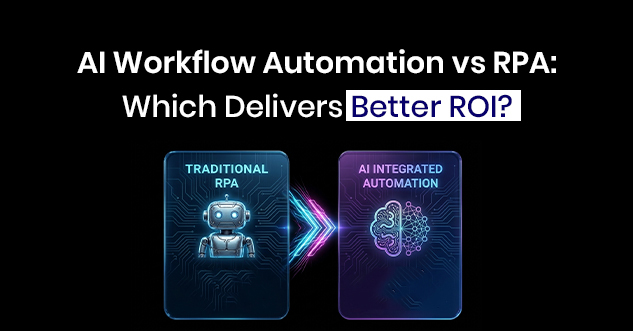
AI Agent Memory 2026
Published by AgamiSoft | Reading time: ~14 minutes
|
Featured Snippet : RPA automates repetitive, rule-based tasks by mimicking clicks and keystrokes. AI workflow automation goes further it uses machine learning, natural language processing, and reasoning to handle unstructured data, adapt to change, and make context-aware decisions. For most operations, AI workflow automation delivers higher long-term ROI, but RPA still wins on cost for narrow, stable, high-volume tasks. |
|
TL;DR : RPA automates repetitive, rule-based tasks using scripted "if-this-then-that" logic. AI workflow automation extends beyond that it handles unstructured data, reasoning, and adaptive decision-making using machine learning and NLP. RPA delivers faster payback on narrow, stable processes; AI workflow automation delivers higher ROI on complex, exception-heavy processes at scale.
|
Why This Comparison Matters Right Now in 2026
The RPA-vs-AI decision has stopped being a technology question and become a budget question, and that shift is the reason this comparison matters now. Deloitte's 2025 survey of 1,854 senior executives found 85% increased AI and automation spending over the past year, and 91% plan to spend more in the next (Deloitte, 2025). That level of investment only makes sense if the return holds up which means the model you choose determines whether that spending compounds or erodes over the next budget cycle.
Here's the mechanism driving the erosion risk. RPA bots are scripted against a specific UI, a specific field layout, a specific sequence of clicks. That specificity is what makes them cheap to build and fast to deploy but it's also what makes them fragile. When a vendor updates a portal, changes a PDF template, or adds a new authentication step, the bot has no way to reason around the change. It simply fails. Someone on your team then has to notice the failure, diagnose it, and rewrite the script. That cycle repeats every time the environment shifts, and the environment shifts constantly in 2026, because vendors ship UI updates faster than automation teams can track them. The result is a cost curve that looks flat on a vendor's pitch deck and looks like a slow leak on your actual P&L.
This is precisely the gap AI workflow automation is built to close. Because it reasons over content rather than following a fixed script, it degrades gracefully instead of breaking outright when conditions change. That difference in failure mode is the real reason 88% of organizations globally now use AI in at least one business function, even though only about a third have scaled it across the enterprise (McKinsey, The State of AI in 2025). The adoption number tells you the technology is proven at the pilot level. The scaling number tells you most companies haven't yet solved the harder problem of deploying it consistently across a full department, not just a single use case. That gap between adoption and scale is exactly where the ROI decision in this article gets made and exactly where most of the failed projects you've heard about actually failed.
For a CIO or operations leader, this reframes the question you should actually be asking your team. It's not "should we use RPA or AI." It's "which of our processes are stable enough for scripted automation to hold its value, and which have already outgrown it." Everything that follows in this article is built to help you answer that question with data instead of vendor talking points.
What Is AI Workflow Automation, Exactly?
To evaluate ROI honestly, you first need a precise definition vague terminology is the single biggest reason executives compare the wrong things. AI workflow automation is the use of machine learning, natural language processing (NLP), and reasoning models to automate business processes that involve judgment, unstructured data, or variable inputs, rather than processes that only require following a fixed rule.
Robotic Process Automation (RPA), by contrast, is scripted automation. A bot records a sequence of clicks and keystrokes and replays them exactly. It has no model of what the data means only what it was told to click, in what order, every time. That's why RPA is fast to deploy: there's nothing to train, only a sequence to record. It's also why RPA is brittle: the bot has zero capacity to interpret anything outside the exact sequence it was given.
AI workflow automation removes that constraint by adding a layer of interpretation before the action is taken. Concretely, that means it can:
-
Read a PDF invoice and extract the right fields even if the vendor changed the layout last week, because it's interpreting the content, not matching pixel coordinates
-
Classify an email by intent and route it without a manually built decision tree, because it's reasoning about meaning, not matching keywords
-
Flag an exception, explain why in plain language, and recommend a next step, because it can articulate the logic behind a decision
-
Learn from human corrections over time instead of failing silently in the same way repeatedly
The distinction that matters for your ROI model is this: RPA executes instructions. AI workflow automation makes decisions. Every dollar of RPA ROI is a function of how stable your process is. Every dollar of AI workflow automation ROI is a function of how well the model's decisions align with what a skilled employee would have decided. Those are two different risk profiles, which is why they need two different evaluation criteria a distinction most vendor comparisons skip entirely, because it's more convenient to sell one technology as a universal replacement for the other than to explain when each one actually applies.
It's also worth being precise about a term you'll hear used loosely: intelligent automation. This isn't a third category competing with the first two it's the umbrella term for combining RPA's execution reliability with AI's reasoning layer in a single workflow. Keeping that distinction clear matters, because much of the confusion executives run into when comparing vendor claims comes from conflating "intelligent automation" (the hybrid approach) with "AI workflow automation" (the reasoning layer specifically).
The Data: What ROI Actually Looks Like for Each Model
Numbers settle arguments that opinions can't, so here's what the current research shows for each model and why the two ROI profiles look so different once you understand the underlying mechanics driving them.
RPA ROI data:
-
RPA implementations typically deliver 30–200% ROI in the first year (UiPath, 2026 industry report)
-
High-performing RPA programs report 300–400% ROI against median adopters, cutting up to 50% of transactional activity costs (RPA Market Statistics, 2026)
-
The global RPA market is valued at $35.27 billion in 2026 (Precedence Research, 2026)
The reason RPA's first-year ROI is both high and fast is structural, not incidental: because the automation only has to replicate a fixed sequence, the build cost is low and the payback period is short. That's the same property that makes it fragile over a multi-year horizon the ROI curve for RPA tends to peak early and then flatten, or even reverse, as maintenance costs accumulate against a process that keeps changing underneath the script. A bot that cost $8,000 to build and paid for itself in four months looks like an unambiguous win in year one. The same bot, requiring monthly fixes by year three because the source system has changed twice, tells a very different story once you total the maintenance line item against the original build cost.
AI workflow automation ROI data:
-
44% of intelligent automation projects deliver ROI in under 12 months (Orbilon Tech, AI Automation Stats, 2026)
-
60% of companies report AI boosts ROI and efficiency (PwC, 2026)
-
AI agents could generate up to $2.9 trillion in annual business value in the US alone (McKinsey)
-
Workers using generative AI save an average of 5.4% of work hours per week about 2.2 hours in a 40-hour week (Federal Reserve Bank of St. Louis)
AI workflow automation's ROI curve behaves differently because the investment isn't just in the script it's in a model that keeps working as the underlying process changes. That's why the payback period is sometimes slower to start (44% inside 12 months, versus RPA's faster typical payback) but the ceiling is materially higher: the same adaptability that costs more upfront is what prevents the value from decaying the way RPA's does. Instead of a curve that peaks early and flattens, you get a curve that starts slower and compounds, because the same deployed model keeps absorbing new variations in the process without requiring a rebuild each time.
The honest caveat, and why it matters more than the headline numbers: Only 29% of executives report seeing significant ROI from generative AI, and just 23% see it from AI agents specifically (Orbilon Tech, 2026). That gap between the technology's proven ceiling and its actual delivered results is not a technology problem it's an execution problem. Companies that redesign the workflow around the AI, rather than inserting AI into an unchanged process, are the ones capturing the $2.9 trillion opportunity McKinsey describes. Companies that treat AI as a drop-in replacement for a single RPA step, without rethinking the surrounding workflow, are the ones showing up in the 71% who don't see significant returns. This is the single most important nuance in the entire ROI conversation, and it's the one most comparison articles leave out because "AI has higher ROI" is a simpler headline than "AI has higher ROI only under specific implementation conditions."
Bottom line on the numbers: RPA gives you a shorter, more predictable payback curve, but that curve is only as durable as the stability of your process. AI workflow automation gives you a wider, more uncertain ROI range on the front end but a much higher ceiling, conditional entirely on how disciplined your implementation is. The choice, in other words, isn't really "which technology performs better." It's "how stable is this process, and how disciplined is our implementation team" and that reframing is what the next section turns into a decision framework.
The Real Cost Comparison: Build, Run, and Maintain
Sticker price is the least useful number in this comparison, because both models carry costs that don't show up until after deployment. A logical ROI comparison has to separate three distinct cost phases, because RPA and AI workflow automation distribute their costs very differently across them.
Build cost. RPA is cheaper here almost every time recording a click sequence and mapping a few fields is inherently less work than training or configuring a reasoning model against your specific documents and edge cases. This is the number vendors lead with, and it's also the number that matters least over a three-year horizon.
Run cost. This is closer to parity than most comparisons suggest. RPA licensing runs roughly $15 per user per month for platform tools like Power Automate, up to $10,000–$20,000 per bot per year for enterprise-grade deployments in regulated industries. AI workflow automation platforms carry similar or somewhat higher run costs, offset by handling a wider range of cases per deployed unit one AI-driven workflow often replaces several narrow RPA bots that would otherwise each need to be built and maintained separately.
Maintenance cost. This is where the real difference shows up, and it's the number executives most often underweight when approving a build. RPA maintenance climbs in direct proportion to how often the underlying systems change every UI update, every new field, every vendor redesign is a support ticket. AI workflow automation maintenance is flatter, because the model's job is specifically to absorb that kind of variation without a manual rebuild. Over a 90-day pilot, this difference is invisible. Over 18–24 months, it's usually the deciding factor in which model actually delivered better ROI, because the maintenance line item is the one that was never on the original business case.
The practical implication: don't evaluate either model on build cost alone. Ask your finance team to model all three cost phases across a 24-month window, not a 90-day pilot window, before comparing the two options. Most of the ROI comparisons that later get labeled "the AI project failed" or "RPA wasn't worth it" turn out, on closer inspection, to have compared build cost only which structurally favors RPA regardless of which technology was actually the better fit for the process.
How to Decide Between AI Workflow Automation and RPA: A 5-Step Framework
Because the ROI comparison above depends entirely on process characteristics rather than the technology in isolation, the right way to choose isn't to pick a favorite platform it's to interrogate the process itself. Work through these steps in order; each one either qualifies or disqualifies a workflow for RPA before you consider AI as the alternative.
-
Map the process variability. If inputs are 100% structured and never change same form, same fields, same system RPA is sufficient, and it's the cheaper option precisely because there's nothing for a reasoning layer to add. Elaborate automation on a process with zero variability is over-engineering, and it inflates your run and maintenance costs without a corresponding gain in reliability.
-
Count the exception rate. This is the number that actually predicts whether RPA will survive contact with reality. If more than 15–20% of cases require judgment, document reading, or routing decisions, RPA will not hold up every exception either breaks the script or gets silently routed to a human, which erodes the "automation" claim entirely. That threshold is your signal to move to AI workflow automation.
-
Calculate the maintenance burden. Ask your team how many hours per month go into fixing broken RPA scripts, and track whether that number is trending up or down. A rising maintenance bill isn't a minor annoyance it's a leading indicator that the process has outgrown scripted automation and is quietly consuming the ROI you thought you'd already banked, exactly as described in the cost comparison above.
-
Pilot on a single high-volume workflow before scaling either model. Choose one process claims intake, invoice processing, ticket triage and measure cycle time, first-pass success rate, and human hours returned across a full 90-day window at minimum. A single well-measured pilot tells you more about real-world ROI than any vendor benchmark, because it's measured against your process, not a generic one.
-
Combine the two models rather than treating the choice as exclusive. The highest-performing operations use APIs where available, RPA for simple, stable micro-tasks, and AI workflow automation for the judgment-heavy, exception-prone steps around them. This hybrid model is now the dominant enterprise pattern, according to SS&C Blue Prism's 2026 trends analysis, precisely because it matches each technology to the part of the process it's actually suited for instead of forcing one tool to cover everything.
What This Looks Like by Function: Three Grounded Examples
Frameworks are easier to apply once you can see the logic play out against a real function, so here's how the five steps above resolve differently depending on the workflow.
Accounts payable. Invoice formats vary by vendor, totals need to be reconciled against purchase orders, and roughly one in five invoices arrives with a missing field or a formatting quirk that a scripted bot can't parse. That exception rate above the 15–20% threshold in Step 2 is exactly why AI workflow automation consistently outperforms RPA here: it can read the invoice regardless of layout, flag the mismatch, and route only the genuinely ambiguous cases to a human. RPA alone, deployed on this workflow, tends to show strong ROI for the first two quarters and then a rising maintenance bill as vendors update their invoice templates the maintenance-spiral pattern described earlier.
IT service desk ticket triage. Ticket categories are relatively stable, the routing rules rarely change, and volume is high and consistent. This is a Step 1 process: low variability, well-suited to RPA or simple rules-based routing, with AI value concentrated narrowly in natural-language ticket classification rather than the full workflow. Over-deploying a full AI agent platform here adds cost without a proportional ROI gain, which is the over-engineering trap described in the framework.
Customer service and claims status inquiries. These processes span multiple portals, involve authentication steps, and increasingly require the system to communicate back to the customer in natural language. This is squarely a Step 2 and Step 5 scenario the exception rate is high, the environment changes often, and the highest-performing deployments combine RPA for the stable data-lookup steps with AI reasoning for exception handling and customer communication. AI handles these interactions at a fraction of the marginal cost of a human agent, which is why customer service consistently ranks as one of the fastest-adopting functions for AI workflow automation.
The pattern across all three examples is the same: the technology choice isn't a preference, it's a direct output of variability and exception rate. That's why Step 1 and Step 2 of the framework do most of the analytical work everything after them is largely execution.
Tools and Tactics: What to Actually Deploy
Once the framework above tells you which category of process you're automating, tool selection follows logically match the platform to the failure mode you're trying to avoid, not to brand reputation.
-
Microsoft Power Automate Best for Microsoft 365-centric workflows: approvals, reporting, desktop tasks. Priced around $15/user/month. Fits Step 1 processes: low variability, tightly scoped.
-
UiPath Market leader in RPA with an estimated 35.8% share; strong for BFSI-grade compliance and reconciliation work, and now layering agentic AI into its platform for the exception-handling gap described in Step 2.
-
Pega Combines RPA with case management and AI decisioning for claims, onboarding, and servicing workflows a native fit for the hybrid model in Step 5.
-
Kofax Document-centric automation with strong OCR; the right choice when the automation problem is really a document-ingestion problem rather than a broader decisioning problem.
-
Purpose-built AI agent platforms Best for portal-heavy, multi-app processes where RPA scripts break weekly due to UI changes, MFA, or CAPTCHA the exact fragility pattern described earlier in this article.
The underlying logic doesn't change across vendors: buying an AI agent platform for a single-app, never-changing task is over-engineering that inflates cost without adding value, and buying RPA for a document-heavy, exception-prone workflow is under-engineering that guarantees the maintenance spiral described in the cost comparison section.
Common Mistakes and Objections
Most objections to switching models come from a reasonable place sunk cost, risk aversion, or a bad first experience but they usually don't survive close scrutiny once you trace the logic through.
"We already invested in RPA switching feels wasteful." This objection assumes the choice is binary, but it isn't. RPA remains the reliable execution layer for stable, rules-based work, and nothing in this article argues for ripping it out. The actual mistake is stretching RPA to cover judgment-based work it was never architected for, and then blaming the technology when it fails the fix is to keep RPA where Step 1 of the framework says it belongs, and layer AI workflow automation only around the exception-heavy edges.
"AI automation is too unpredictable for compliance-heavy processes." This was a fair concern two years ago, when "AI decision" effectively meant "black box." It's less true today because leading platforms now pair AI reasoning with human-in-the-loop review specifically for high-stakes decisions the AI proposes, a human approves, and the audit trail captures both steps. That structure satisfies governance requirements while still capturing speed gains on the routine share of the workload.
"We tried an AI pilot and it didn't show ROI." Trace this back to the execution-versus-technology distinction from the ROI section: most failed pilots share one root cause, which is that teams bolted AI onto an unchanged process instead of redesigning the workflow around it. Orbilon Tech's 2026 research confirms this is the dominant reason generative AI and agent projects underperform. If your pilot failed, the first diagnostic question isn't "is the model good enough" it's "did we actually change the workflow, or just add a tool to the old one."
"RPA bots keep breaking and we don't know why." This is the clearest possible signal, described mechanically earlier in this article: your process has outgrown rule-based automation because the environment around it keeps changing faster than your scripts can be updated. Don't treat the rising maintenance bill as a nuisance to tolerate treat it as the data point that triggers Step 4 of the framework: pilot AI workflow automation on that specific process and measure whether the failure rate actually drops.
"Our team doesn't have AI expertise, so RPA is the safer bet." This conflates deployment complexity with long-term risk. RPA is easier to start, but that same simplicity is what creates the maintenance burden later it's a lower skill requirement traded for a higher ongoing labor cost. Most AI workflow automation platforms today are built for configuration rather than custom model training, which narrows the skill gap considerably. The safer long-term bet is usually the one with a flatter maintenance curve, not the one with the lowest starting skill requirement.
FAQ
What is AI workflow automation? AI workflow automation is the use of machine learning, natural language processing, and reasoning models to automate business processes involving unstructured data or judgment calls. Unlike scripted automation, it adapts to changes in format, layout, and context without requiring a developer to rewrite rules making it suited to complex, variable workflows.
What's the difference between AI and RPA? RPA (Robotic Process Automation) follows fixed, scripted rules to mimic human clicks and keystrokes on stable, structured tasks. AI workflow automation reasons over unstructured data, handles exceptions, and adapts to change using machine learning. RPA executes instructions; AI workflow automation makes context-aware decisions.
Which provides better ROI: AI automation or RPA? It depends on process complexity. RPA delivers faster, more predictable ROI (30–200% in year one) on narrow, stable, rule-based tasks. AI workflow automation delivers higher ceiling ROI on complex, exception-heavy processes, with 60% of companies reporting improved ROI and efficiency from AI but only when implementation redesigns the workflow rather than just adding AI on top.
Conclusion: Match the Model to the Workflow, Not the Trend
The thread running through every section of this article is the same: RPA and AI workflow automation aren't competing technologies, they're tools calibrated to different levels of process complexity, and the ROI data only makes sense once you view it through that lens. RPA wins on cost and speed precisely because it does less it follows a script. AI workflow automation wins on resilience and ceiling ROI precisely because it does more it reasons over exceptions the script was never built to handle. Neither fact makes the other technology obsolete; it just tells you where each one belongs, and the cost-phase breakdown above shows exactly why that placement matters over a multi-year horizon rather than a single quarter.
Your next move: audit your current RPA maintenance costs this quarter, using the exception-rate and maintenance-burden checks from the framework above. Any workflow where that cost is climbing is your best candidate for an AI workflow automation pilot not because AI is trendier, but because the data on that specific process is telling you it has already outgrown scripted automation.
Related reading: For a deeper breakdown of where to start, see our guides on Business Process Automation and AI Consulting Services to scope your first high-ROI pilot.
United States
Salesforce Tower, 415 Mission Street,
San Francisco, CA 94105
Canada
206-15268 100 Avenue,Surrey,
British Columbia, V3R 7V1, Canada
Bangladesh
Sharif Complex (11th floor),
31/1 Purana Paltan, Dhaka - 1000