


Published by AgamiSoft | Reading time: ~14 minutes
|
Featured Snippet / AEO Answer: Schema markup matters more in 2026 than it did in 2019 and for a different reason. After March 2026, Google's AI Mode uses structured data not just to trigger rich results but as a trust signal for entity resolution and claim verification during answer synthesis. Sites with properly implemented structured data are cited in AI responses 3.2 times more often than those without. The rich result value is still real; the AI citation value is now larger.
|
Schema Markup in 2026: Does Structured Data Still Matter?
|
Quick Answer / TL;DR: Yes and the reason why changed in March 2026. Google's AI Mode now uses structured data as a trust signal for claim verification and entity resolution, not just a rich result display trigger. Sites implementing schema markup are cited in AI responses 3.2 times more often than those without (BrightEdge). Rich results still deliver 20–40% CTR lift. 72% of first-page results use schema markup. The answer is not "does it still matter" it's "what are you doing with it now that the rules changed."
|
Why Schema Markup Has Become More Important, Not Less, in 2026
The March 2026 Google core update completed on March 12 and produced the most significant shift in structured data strategy since rich snippets were introduced (Digital Applied, 2026). Before March 2026, schema markup was evaluated primarily as a rich result trigger implement the right schema, earn the right display treatment in search results, capture a higher CTR. After March 2026, the function of structured data expanded: Google's Gemini-powered AI Mode now uses schema markup to verify claims, establish entity relationships, and assess source credibility during the process of synthesizing AI answers (Digital Applied, 2026).
That strategic shift from display trigger to trust signal changes the value proposition of schema markup for every site investing in organic and AI search visibility. Google and Microsoft publicly confirmed in March 2025 that they use schema markup for their generative AI features (Tonic Worldwide, 2026). BrightEdge's "State of Structured Data 2025" found that sites with complete schema markup are cited in AI responses 3.2 times more often than those without. Sites implementing structured data and FAQ blocks saw a 44% increase in AI search citations (BrightEdge, 2026).
The traditional rich result value didn't disappear it compounded. Google AI Overviews now appear on 50–60% of US searches powered by Gemini 3 since January 27, 2026 (GW Content, 2026). 36.6% of searches display at least one rich snippet with information derived from schema markup (Searchmetrics via Search Engine Land). Rich results capture 58% of clicks on search results versus 41% for non-rich results (Tonic Worldwide, 2026). Rotten Tomatoes saw a 25% higher CTR on pages with structured data. Nestlé reported an 82% higher CTR for pages appearing as rich results (Clickforest, 2026).
The question "does schema markup still matter" has a clear answer: yes, for two separate, compounding reasons and the second one (AI citation visibility) is newer and larger than the first.
What Schema Markup Does in 2026
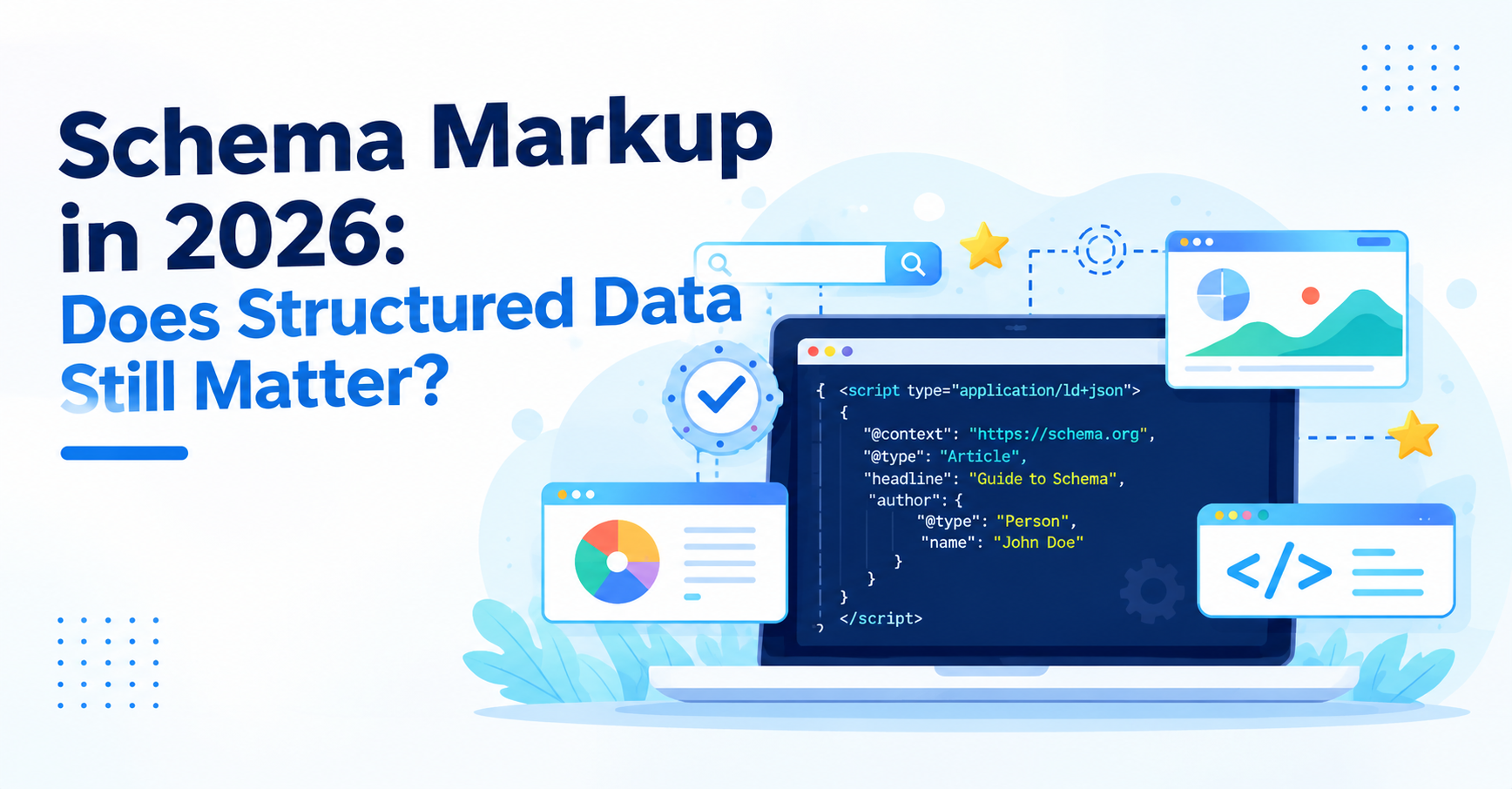
Schema markup is standardized code typically implemented in JSON-LD format, embedded in a webpage's HTML that describes the content and entities on the page in a format that search engines and AI systems can parse without ambiguity. It is not a display instruction. It is a semantic description. The display (rich result, knowledge panel, AI citation) is the downstream benefit of getting the description right.
Structured data and schema markup are often used interchangeably. Technically, structured data refers to any information presented in a standardized format; schema markup is the specific vocabulary defined at Schema.org (currently at version 30.0, updated March 25, 2026, with over 823 schema types as of June 2026). JSON-LD (JavaScript Object Notation for Linked Data) is the format Google recommends for implementing schema markup.
After the March 2026 update, schema markup now performs three distinct functions:
1. Rich result eligibility. The original function. Correct implementation of eligible schema types makes pages eligible for enhanced SERP displays: product price and availability, review stars, FAQ dropdowns, event dates, recipe details, breadcrumbs, how-to steps. Rich results produce 20–40% higher CTR than standard blue-link results. 72% of first-page results now use schema markup, making it competitive table stakes for high-value SERPs (ALMC Corp, 2026).
2. AI Overview and AI Mode source selection. The expanded 2026 function. AI Mode uses structured data to verify claims, establish entity relationships, and assess source credibility during answer synthesis (Digital Applied, 2026). This is the most important strategic shift in structured data since rich snippets launched. A page with accurate schema that matches its content increases AI citation probability independently of whether it earns a traditional rich result display.
3. Knowledge Graph entity recognition. Schema markup that includes Organization, Person, Product, or Place entities with correctly linked same-as properties helps Google add your entities to the Knowledge Graph, enabling knowledge panels and cross-property entity connections that strengthen your brand's presence across AI-powered features.
The key 2026 change in plain terms: Before March 2026, schema markup was evaluated at display time does this page's schema qualify for this rich result type? After March 2026, schema is also evaluated at answer time does this page's schema help AI Mode verify that this page's claims are accurate and trustworthy enough to cite? The first question is about eligibility. The second is about authority.
The Numbers: What Structured Data Actually Delivers in 2026
On AI citation impact:
-
Sites with properly implemented structured data are cited in AI responses 3.2 times more often than those without (BrightEdge, analyzed across 73 websites, 2026)
-
Sites implementing structured data and FAQ blocks saw a 44% increase in AI search citations (BrightEdge State of Structured Data 2026)
-
AI Overviews appear on 50–60% of US searches as of early 2026, powered by Gemini 3 since January 27, 2026 (GW Content, 2026)
-
"How do I…" queries trigger AI Overviews 73% of the time (Medium/Vicki Larson, 2026)
On rich result performance:
-
Rich results capture 58% of clicks versus 41% for non-rich results (Tonic Worldwide, 2026)
-
Pages with rich results experience 20–40% higher CTR than standard listings (ALMC Corp; Tonic Worldwide, 2026)
-
Rotten Tomatoes: 25% higher CTR on pages with structured data (Clickforest, citing Google case study)
-
Nestlé: 82% higher CTR for pages appearing as rich results (Clickforest, citing Google case study)
-
Products with complete schema markup are 4.2x more likely to appear in Google Shopping results (Tonic Worldwide, 2026)
-
72% of first-page results now use schema markup (ALMC Corp, 2026)
On adoption scale:
-
Over 45 million web domains have used schema markup on their pages (Schema.org Wikipedia, 2026)
-
Schema.org reached version 30.0 in March 2026 with 823+ schema types
-
Structured data is described as "the cheapest, highest-leverage technical SEO investment available in 2026" (GW Content, 2026)
What changed specifically in March 2026:
-
How-To rich results disappeared for pages where markup described supplementary rather than primary content
-
FAQ rich results had already been removed from standard display in May 2026 but FAQPage schema remains valuable because AI assistants still draw answers from FAQ content (Clickforest, 2026)
-
AI Mode now reads structured data as a trust signal for entity resolution and claim verification, not solely a display trigger
How to Implement Schema Markup for AI Visibility: A 5-Priority Framework
These five implementation priorities reflect post-March 2026 best practice balancing rich result eligibility with the AI citation trust signal function that now matters equally.
Priority 1: Organization and Person schema your AI identity layer
Organization schema is the foundation of every other schema implementation because it establishes your entity in Google's Knowledge Graph. Include: @type Organization, name, url, logo, sameAs (links to your LinkedIn, Crunchbase, Wikipedia, and social profiles), foundingDate, knowsAbout (a list of your primary topic areas the "knowsAbout" property is the second most impactful entity markup change post-March 2026 according to Digital Applied), and contactPoint. Implement this on every page in the site header, not just the homepage. If your brand appears without an entity foundation in Knowledge Graph, your AI citations will be weaker regardless of how good your other schema is.
Priority 2: Article and BlogPosting schema your content trust layer
Article schema with a complete datePublished, dateModified, author (linked to a Person schema with a URL pointing to a verified author bio page), and about property signals content credibility to AI Mode's claim verification layer. Include headline (matching the H1, not keyword-stuffed), description, image (high-resolution), publisher (linked to Organization schema), and keywords. The author Person schema should include name, url (pointing to the author's about page on your site), and sameAs (LinkedIn, speaker page, or other verified professional presence).
Priority 3: FAQPage schema your AI answer feed
Google removed FAQ rich result display from standard SERPs in May 2026. FAQPage schema still matters because AI assistants extract answers from FAQ content using the schema as a parsing guide (Clickforest, 2026). Implement FAQPage on any page with a genuine FAQ section. Each Question must have the question text in a Question @type and the answer text in an Answer @type. Keep answers in the 40–80 word range this is the length Google's AI Overview extraction prefers. Don't implement FAQPage on pages without a genuine FAQ section; Google has become more precise about penalizing schema that misrepresents page content.
Priority 4: BreadcrumbList your hierarchy signal
BreadcrumbList schema serves three purposes: rich result display of hierarchy in search results, crawler signal for content depth and category structure, and AI citation signal for topical positioning ("this content is part of this topic cluster"). Implement on every content page, product page, and service page. Use the exact same breadcrumb labels as your site navigation inconsistency between schema breadcrumbs and visual breadcrumbs is a markup quality signal that can reduce trust.
Priority 5: HowTo, Product, Review, Event, LocalBusiness (by use case)
These schema types earn the highest-impact rich result displays for their respective page types. HowTo schema on genuinely instructional content earns step-by-step rich results. Product schema with price, availability, and aggregate reviews earns shopping results and product knowledge panels products with complete schema are 4.2x more likely to appear in Google Shopping (Tonic Worldwide, 2026). LocalBusiness schema with verified address, phone, openingHours, and geo coordinates is the primary schema for any business serving a geographic area.
Tools for Implementing and Auditing Schema Markup in 2026
For implementation:
-
Google's Rich Results Test (search.google.com/test/rich-results) The canonical tool for validating schema implementation and previewing which rich result types a page is eligible for. Run every schema-bearing page through this before indexing.
-
Schema.org Markup Validator (validator.schema.org) Validates schema against the Schema.org specification independently of Google's display rules. Useful for catching spec-level errors that Google's tool might miss.
-
Yoast SEO / RankMath (WordPress) Automated schema generation for WordPress sites. Both generate Organization, Article, BreadcrumbList, and FAQPage schema automatically from page content and settings. The fastest implementation path for content-heavy WordPress sites.
For auditing at scale:
-
Screaming Frog SEO Spider Crawls your site and extracts all structured data markup for bulk review. Identifies pages missing schema, pages with invalid markup, and pages where schema type doesn't match content type.
-
Semrush Site Audit / Ahrefs Site Audit Schema markup health reports integrated with broader technical SEO analysis. Surface structured data errors alongside crawl errors, internal linking issues, and page speed problems.
For AI citation monitoring:
-
BrightEdge Generative Parser / AEO Vision Tracks whether schema-bearing pages are being cited in AI Overviews, ChatGPT, and Perplexity. The post-March 2026 measurement that connects structured data implementation to AI citation outcomes.
What Goes Wrong: The 5 Most Expensive Schema Markup Mistakes in 2026
1. Implementing schema that misrepresents the page content.
Google's March 2026 update specifically targeted schema that describes content not prominently featured on the page. How-To schema on a page where the "how-to" steps are buried in a sidebar. FAQPage schema on a page with a single question and a non-substantive answer. Review schema showing aggregate ratings for a product with no visible reviews. Google's position is clear: schema that misrepresents page content is a quality signal violation and AI Mode's claim verification function makes this more detectable, not less, after March 2026.
2. Using outdated schema types after the May 2026 FAQ display deprecation.
FAQ rich result display was removed from standard Google SERPs in May 2026. Teams that haven't updated their schema strategy may be maintaining FAQPage schema expecting a display benefit that no longer exists from the rich result angle. The implementation is still correct FAQPage schema feeds AI answer extraction but the expectation needs to shift from "this will create dropdown FAQ in SERPs" to "this helps AI engines extract answers from my content."
3. Implementing JSON-LD without validating against the Rich Results Test.
Schema that is syntactically valid JSON but semantically incorrect wrong property names, missing required properties, incorrect @type values passes JSON validators and fails Google's Rich Results Test. Every schema implementation must be validated through Google's Rich Results Test before publication. A single missing required property (like "name" for Organization or "url" for a BreadcrumbList item) disqualifies the entire markup from rich result eligibility.
4. Treating schema markup as a one-time setup task.
Schema.org released version 30.0 in March 2026. Google updates its structured data documentation when new schema types become eligible for rich results or when AI Mode citation behavior changes. Schema implemented in 2022 against a prior specification may be missing properties that now directly affect AI citation rates (like knowsAbout for Organization entities, or the dateModified property for Article schema's claim verification signal). Audit schema implementations quarterly, checking against the current Google documentation and Schema.org specification.
5. Ignoring entity markup in favor of content-type markup only.
Most schema implementations focus on content types Article, Product, FAQPage, HowTo. The post-March 2026 AI Mode changes make entity markup Organization, Person, Place, and their sameAs cross-references equally or more important for AI citation. AI Mode's entity resolution uses these markup types to verify that the organization making a claim is who the markup says it is. Organizations without complete entity markup in their schema have weaker AI citation authority signals regardless of how well their content schema is implemented.
FAQ
Does schema markup still matter in 2026?
Yes, and for two compounding reasons. Schema markup still generates 20–40% higher CTR through rich results 72% of first-page results now use it, making it competitive table stakes. More importantly after March 2026, Google's AI Mode uses structured data as a trust signal for entity resolution and claim verification during AI answer synthesis, not just a rich result display trigger. Sites with complete schema markup are cited in AI responses 3.2 times more often than those without (BrightEdge, 2026). The rich result value is real; the AI citation value is now larger.
How does structured data affect AI Overviews?
Structured data affects AI Overviews in two ways. First, schema markup helps AI systems parse content accurately by providing machine-readable descriptions of entities, relationships, and facts reducing ambiguity about what a page claims and who made the claim. Second, accurate schema increases AI citation probability by signaling content credibility to claim verification processes in Google's AI Mode. Sites implementing structured data and FAQ blocks saw a 44% increase in AI search citations (BrightEdge, 2026). FAQPage schema specifically feeds AI answer extraction even after FAQ rich results were removed from standard SERPs in May 2026.
Which schema types should I implement in 2026?
Implement schema in this priority order: Organization (entity foundation and Knowledge Graph presence, including the knowsAbout property); Article or BlogPosting with complete author Person schema (content credibility and claim verification); BreadcrumbList on all content, product, and service pages (hierarchy signal); FAQPage on pages with genuine FAQ sections (AI answer extraction, not rich result display post-May 2026); and HowTo, Product, Review, Event, or LocalBusiness as appropriate for your specific content types. All implementations should be validated through Google's Rich Results Test before indexing, and audited quarterly against current Schema.org and Google documentation.
Conclusion: Schema Markup Is Structural Data and Structure Is What AI Trusts
The evolution of schema markup's role is actually a simplification of its value proposition. Before AI Overviews, schema was "implement this to earn this display feature." After March 2026, schema is "implement this so that AI systems can verify your claims, recognize your entity, and trust your content enough to cite it in answers that 50–60% of searchers now see before they visit any site."
The display benefits still accrue 20–40% CTR lift, rich result eligibility, Google Shopping visibility at 4.2x for compliant products. They are now a side effect of a more important function: making your content machine-readable, your entity verifiable, and your claims trustworthy enough for AI Mode to cite rather than silently skip.
Your immediate action: run your three most important landing pages through Google's Rich Results Test today. Confirm that Organization schema with a complete knowsAbout property is implemented site-wide. For every content page without Article schema including an author Person @type, add it this sprint. Those three changes are the post-March 2026 implementation baseline and the cheapest, highest-leverage technical SEO investment available right now.
Related reading: For the full AI search visibility strategy that schema markup feeds into, see our companion guide on website navigation in the AI era and AI search visibility to build the complete structural and content foundation that AI citation requires.