

Published by AgamiSoft | Reading time: ~14 minutes
|
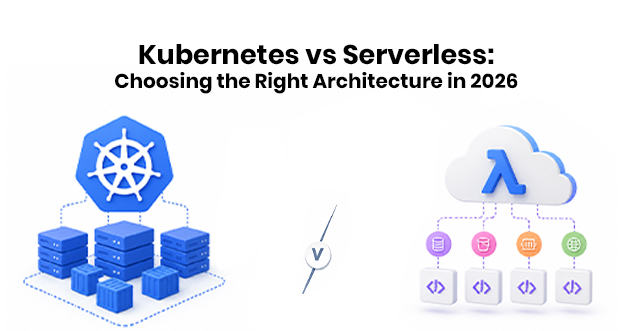
TLDR; Kubernetes vs serverless is the most consequential cloud architecture decision for engineering teams in 2026 and it is not a competition. Kubernetes is the right choice for complex, long-running, stateful workloads requiring fine-grained control over compute, networking, and deployment behavior. Serverless is the right choice for event-driven, stateless, spiky-demand workloads where operational simplicity and per-invocation cost economics are more valuable than architectural control. Organizations that align architecture to workload characteristics rather than standardizing on one model for all workloads consistently achieve the lowest operational complexity and best cost efficiency across their cloud infrastructure. |
Why the Kubernetes vs Serverless Decision Has Higher Stakes for Engineering Teams in 2026
Architecture decisions made in 2026 have a longer tail than they did five years ago. Container orchestration platforms and serverless runtimes are increasingly embedded in the CI/CD pipelines, observability stacks, developer workflows, and cost structures of the teams that use them. Migrating workloads between Kubernetes and serverless after a year of production operation is not a configuration change it is a re-architecture project.
The decision stakes have increased for three specific reasons in 2026:
The maturity gap has closed. Managed Kubernetes AWS EKS, Azure AKS, Google GKE has eliminated the cluster management overhead that previously made Kubernetes prohibitively complex for all but the largest engineering teams. Simultaneously, serverless platforms have addressed the cold start latency problem that previously made them unsuitable for latency-sensitive applications. AWS Lambda SnapStart for Java workloads and Cloudflare Workers with sub-millisecond initialization have expanded the serverless use case envelope significantly. The technical differentiation between the two models is now determined by workload requirements rather than platform limitations.
AI workloads have introduced new architecture requirements. GPU-accelerated AI inference workloads model serving, real-time prediction APIs, embedding generation require persistent container environments, custom hardware, and memory configurations that standard serverless platforms do not support. Simultaneously, AI-powered event processing document classification, image tagging, notification routing maps naturally to serverless execution patterns. The arrival of AI workloads at scale has made the Kubernetes vs serverless decision more nuanced, not simpler.
Cost at scale has diverged significantly. At low invocation volumes, serverless is almost always cheaper zero idle cost, granular per-millisecond billing. At high, sustained utilization volumes (above 60–70% of equivalent compute capacity), Kubernetes on Reserved Instances or Savings Plans consistently costs 40–60% less than equivalent serverless execution. Engineering teams that default to serverless for all workloads without modeling steady-state compute costs are consistently surprised by their cloud bills at scale.
What Is Kubernetes vs Serverless, Exactly and What Does Each Architecture Actually Provide?
Kubernetes the open-source container orchestration platform originally developed by Google, now maintained by the Cloud Native Computing Foundation (CNCF) manages the deployment, scaling, networking, and lifecycle of containerized applications across a cluster of compute nodes. It provides:
-
Declarative workload specification through Kubernetes manifests (Deployments, StatefulSets, DaemonSets)
-
Automatic pod scheduling across nodes based on resource requests and affinity rules
-
Horizontal and vertical pod autoscaling based on CPU, memory, or custom metrics
-
Service discovery and load balancing through Kubernetes Services and Ingress controllers
-
Persistent storage management through Persistent Volumes and StorageClasses
-
Rolling deployments, canary releases, and blue-green deployment patterns
Serverless computing the execution model in which cloud providers (AWS, Azure, Google Cloud, Cloudflare) execute application code in ephemeral, fully managed compute environments triggered by events provides:
-
Zero infrastructure management: no servers, clusters, or operating systems to configure or maintain
-
Automatic scaling from zero to thousands of concurrent executions within seconds
-
Per-invocation billing: charges only when code is executing, not for idle capacity
-
Event-driven execution triggered by HTTP requests, queue messages, database changes, scheduled events, or storage events
-
Stateless execution model: no persistent memory between invocations
The architectural distinction is most clearly stated as a management model difference:
-
Kubernetes: you manage the runtime environment (cluster, nodes, networking), the platform manages the container lifecycle
-
Serverless: the provider manages everything below your function code; you provide code and configuration
Container orchestration the broader category that includes Kubernetes and alternatives like Amazon ECS and HashiCorp Nomad is distinct from Kubernetes specifically, but Kubernetes has become the de facto industry standard for container orchestration at scale, with 84% of container deployments in enterprise environments using Kubernetes as the orchestration layer (CNCF Annual Survey, 2025).
Four workload characteristics determine architecture alignment:
-
Execution pattern: continuous/long-running → Kubernetes; event-driven/short-duration → serverless
-
State requirements: stateful → Kubernetes; stateless → serverless
-
Compute profile: custom hardware, GPU, high memory → Kubernetes; standard CPU, low memory → serverless
-
Traffic pattern: steady baseline → Kubernetes (with autoscaling); highly variable/spiky → serverless
The Performance and Cost Numbers That Define the Kubernetes vs Serverless Decision
Kubernetes vs Serverless: Direct Architecture Comparison
|
Dimension |
Kubernetes (Managed EKS/AKS/GKE) |
Serverless (AWS Lambda/Azure Functions) |
|
Infrastructure management overhead |
Low (managed control plane) + node management |
Near-zero |
|
Cold start latency |
None (pods pre-warm) |
100ms–2s (language and package dependent) |
|
Minimum idle cost |
Node cost even at zero traffic (~$50–$300/month per node) |
Zero (no invocations = no cost) |
|
Cost at sustained high load |
Low with Reserved Instances (30–45% discount) |
High (per-invocation accumulates) |
|
Maximum execution duration |
Unlimited |
15 minutes (AWS Lambda), 10 minutes (Azure Functions) |
|
Memory limit |
Up to node capacity (hundreds of GB) |
10GB (AWS Lambda), 14GB (Azure Functions) |
|
Custom runtime support |
Any container image |
Limited to supported runtimes |
|
Networking complexity |
High (Services, Ingress, NetworkPolicies) |
Low (managed by provider) |
|
Observability depth |
High (full container metrics, logs, traces) |
Medium (function-level, limited intra-execution) |
|
Deployment complexity |
Medium (Helm, Kustomize, GitOps) |
Low (ZIP upload, container image) |
Sources: CNCF Annual Survey 2025; AWS Lambda Pricing vs EC2 Reserved Instance Analysis 2025; Datadog State of Serverless 2025.
Cost Crossover Analysis
The cost crossover point where Kubernetes becomes cheaper than equivalent serverless occurs at approximately 60–70% sustained utilization of equivalent compute capacity. For a workload requiring 1 vCPU and 2GB memory continuously:
-
Serverless cost (AWS Lambda): 1 vCPU ≈ 1,769MB memory setting; 60 million invocations × 1,000ms average duration = approximately $10,500/month
-
Kubernetes equivalent (t3.medium Reserved Instance): $12.41/month for the instance a 99.9% cost reduction for the same continuous workload
That extreme example illustrates the cost crossover at maximum utilization. At more typical enterprise workload profiles:
-
Below 30% utilization: serverless almost always cheaper (no idle cost)
-
30–60% utilization: cost-comparable, with operational simplicity favoring serverless
-
Above 60% utilization: Kubernetes with Reserved Instances consistently 40–60% cheaper (Flexera, 2025)
Operational Complexity and Team Productivity
-
Engineering teams managing Kubernetes-only architectures spend an average of 30% of platform engineering capacity on cluster operations, upgrades, and node management (CNCF, 2025)
-
Teams adopting managed Kubernetes (EKS, AKS, GKE) reduce that overhead to 15–20% with control plane management eliminated but node and networking management remaining
-
Serverless teams spend less than 5% of engineering capacity on infrastructure operations redirecting that capacity to application development
-
Organizations using Kubernetes for core services and serverless for event-driven integrations report the lowest combined operational overhead: 10–15% of platform engineering capacity (Datadog, 2025)
How to Choose Between Kubernetes and Serverless: A 5-Step Decision Framework
Step 1: Classify Every Workload by Execution Pattern and State Requirements
The Kubernetes vs serverless decision is made at the workload level, not the organization level. Begin by classifying every workload in your current or planned architecture:
Kubernetes indicators (any of these characteristics):
-
Runs continuously regardless of incoming traffic
-
Requires persistent in-memory state between requests
-
Uses custom runtime, GPU, or hardware acceleration
-
Executes for more than 15 minutes per task
-
Requires fine-grained networking (service mesh, custom routing, mTLS)
-
Is a stateful database, message broker, or ML model server
Serverless indicators (any of these characteristics):
-
Triggered by events: HTTP requests, queue messages, file uploads, scheduled jobs
-
Stateless between invocations
-
Execution duration under 15 minutes
-
Demand highly variable zero traffic for hours, then traffic spikes
-
Standard runtime (Node.js, Python, Java, Go, .NET)
-
Operational simplicity is more valuable than architectural control
Step 2: Model Total Cost of Ownership at Your Expected Scale
Never make a Kubernetes vs serverless decision based on small-scale cost estimates. The cost relationship inverts at scale. Model TCO at three utilization scenarios:
-
Current state your actual present invocation volume or compute utilization
-
6-month projection where you expect to be in two product development cycles
-
Peak scenario your maximum expected load for capacity planning
For Kubernetes: include node costs (EC2 instances or VM SKUs), Reserved Instance discount potential at your baseline utilization, load balancer costs, persistent storage costs, and platform engineering staff time (0.5–1.5 FTE/cluster depending on complexity).
For serverless: include invocation costs, duration costs at your expected memory allocation, provisioned concurrency costs if cold start latency is unacceptable, and data transfer costs.
Step 3: Assess Your Team's Kubernetes Operational Maturity
Kubernetes delivers its full value portability, control, cost efficiency at scale only when operated by a team with sufficient Kubernetes expertise to configure and maintain it correctly. Misconfigured Kubernetes generates more operational complexity than serverless at equivalent scale.
Evaluate your team honestly against these capability requirements:
-
Can your team configure Kubernetes RBAC, NetworkPolicies, and ResourceQuotas without external consulting?
-
Do you have documented runbooks for cluster upgrades, node scaling events, and pod eviction scenarios?
-
Is your CI/CD pipeline capable of GitOps-based Kubernetes deployment with automated rollback?
-
Do you have an observability stack configured for pod-level metrics, container logs, and distributed tracing?
If three or more of these requirements are unmet, serverless or managed serverless platforms will produce better operational outcomes than Kubernetes regardless of the theoretical cost advantage at scale.
Step 4: Evaluate the Hybrid Architecture Option
For most enterprise architectures, the optimal answer to Kubernetes vs serverless is not either/or it is a deliberate hybrid where each workload category runs on the architecture it is best suited for:
-
Kubernetes tier: long-running services (API servers, databases, ML model endpoints, message brokers), stateful applications, GPU-accelerated workloads
-
Serverless tier: event-driven integrations, webhook handlers, scheduled jobs, data transformation pipelines, notification workflows, low-traffic microservices
The operational overhead of running both tiers is lower than it appears when both are managed through a unified CI/CD pipeline, unified observability platform, and shared identity and networking architecture. AWS, Azure, and GCP all support hybrid architectures where Lambda functions and EKS pods share VPC networking, IAM identity, and CloudWatch/Azure Monitor observability reducing the integration complexity of the hybrid model significantly.
Step 5: Define Your Migration Path Before Committing to Either Architecture
The hardest part of the Kubernetes vs serverless decision is not the initial choice it is the migration if the initial choice turns out to be wrong. Define your migration path before committing:
-
If you choose Kubernetes today and discover in 12 months that operational overhead exceeds benefit: can your applications be refactored to serverless without significant rewrite? Stateless, short-duration services usually can. Stateful or GPU-dependent workloads usually cannot.
-
If you choose serverless today and discover in 12 months that cost or cold start performance requires Kubernetes: are your functions containerized already (AWS Lambda container images)? Container-based serverless functions migrate to Kubernetes with significantly lower effort than ZIP-based deployments.
Containerizing serverless functions from day one using Lambda container images rather than ZIP packages preserves migration optionality at near-zero additional cost.
Which Kubernetes and Serverless Tools Deliver Best for Enterprise Architectures in 2026?
Managed Kubernetes Platforms
AWS EKS (Elastic Kubernetes Service) The most widely deployed managed Kubernetes platform globally 84% of Kubernetes deployments on AWS use EKS (CNCF, 2025). EKS manages the Kubernetes control plane, provides native integration with AWS IAM, VPC networking, and ALB Ingress, and supports both EC2-backed node groups and AWS Fargate (serverless pods). EKS Fargate running Kubernetes pods without managing EC2 nodes provides a middle ground between full Kubernetes control and serverless simplicity for teams that need Kubernetes APIs without node management. Best for: AWS-primary organizations requiring full Kubernetes capabilities with managed control plane.
Azure AKS (Azure Kubernetes Service) AKS provides managed Kubernetes with native Azure Active Directory integration, Azure Monitor observability, and Azure CNI networking. AKS's Virtual Nodes running Kubernetes pods on Azure Container Instances without provisioning node VMs provides the same Fargate-equivalent capability for Azure workloads. Best for: Microsoft-ecosystem organizations requiring Kubernetes with native Azure identity and monitoring integration.
Google GKE (Google Kubernetes Engine) GKE Autopilot Google's fully managed Kubernetes mode manages node provisioning, scaling, and upgrades automatically, reducing Kubernetes operational overhead to near-serverless levels while retaining full Kubernetes API compatibility. GKE remains the Kubernetes platform with the deepest native integration for ML workloads (Vertex AI, TPU support). Best for: organizations prioritizing Kubernetes operational simplicity (Autopilot) or ML/AI workloads requiring Google Cloud TPU or Vertex AI integration.
Serverless Platforms
AWS Lambda The serverless market leader with the most extensive event source integrations (200+ native triggers), the widest language runtime support, and the most mature ecosystem of tooling (SAM, CDK, Serverless Framework). AWS Lambda SnapStart for Java reduces cold start latency by up to 90% for Java workloads significantly expanding the use case envelope. Best for: AWS-primary organizations building event-driven applications, API backends, and data processing pipelines.
Cloudflare Workers Cloudflare Workers execute at 300+ global edge locations with sub-millisecond cold starts the lowest latency serverless platform available. Workers' V8 isolate model (rather than full VM spin-up per invocation) eliminates cold start overhead entirely for JavaScript/TypeScript and WebAssembly workloads. Best for: globally distributed applications requiring sub-10ms function execution latency at edge, including API middleware, authentication, and real-time personalization.
Google Cloud Run Cloud Run occupies the middle ground between Kubernetes and serverless running containerized workloads (any language, any binary) with serverless scaling (scale to zero, automatic scale-up) and per-request billing. Container portability plus serverless economics makes Cloud Run the closest available implementation of "serverless Kubernetes" for teams that want both. Best for: teams wanting serverless operational simplicity without giving up container portability or runtime flexibility.
Knative on Kubernetes For organizations committed to Kubernetes but wanting serverless-style scaling behavior, Knative provides serverless workload management on top of Kubernetes scale-to-zero for idle services, request-based autoscaling, and event-driven workload invocation through a Kubernetes-native API. Best for: platform engineering teams building internal developer platforms that expose serverless abstractions to application teams while maintaining Kubernetes control at the infrastructure layer.
Explore our Cloud-Native Development and DevOps Engineering capabilities for engineering teams designing hybrid Kubernetes and serverless architectures aligned to their specific workload portfolio.
What Goes Wrong With Kubernetes vs Serverless Architecture Decisions and How to Prevent Each Failure
Failure 1: Choosing Kubernetes for Organizational Status Rather Than Workload Requirements
Kubernetes carries technical prestige that can bias architecture decisions. Engineering teams that choose Kubernetes because it signals technical sophistication rather than because their workloads require the control and capabilities Kubernetes provides consistently create operational overhead that exceeds the value delivered. A serverless API handling 100,000 requests/day that works reliably and costs $50/month is not an inferior architecture to a Kubernetes deployment handling the same load at $400/month with three times the operational maintenance. Architecture fitness is measured by workload outcome, not platform sophistication.
Failure 2: Defaulting to Serverless Without Modeling Steady-State Cost at Scale
Serverless pricing is almost universally cheaper at low invocation volumes and almost universally more expensive at sustained high utilization compared to equivalent Kubernetes on Reserved Instances. Engineering teams that choose serverless at small scale without projecting cost at 10x and 100x invocation volume consistently discover cost cliffs that require emergency re-architecture at the worst possible moment when the product is growing and engineering capacity is most constrained. Model cost at your 12-month projected scale before committing to serverless as your primary compute architecture.
Failure 3: Running Kubernetes Without a Platform Engineering Model
Kubernetes is a platform that requires a platform team to operate. Organizations that deploy Kubernetes as individual application teams managing their own cluster configurations without a central platform engineering function providing shared cluster infrastructure, deployment standards, security policies, and observability produce fragmented, inconsistently secured, and operationally brittle Kubernetes environments. The savings from managed Kubernetes are realized only when a coherent operational model governs the clusters. Deploy the operational model before deploying the workloads.
Failure 4: Treating the Architecture Decision as Permanent
Serverless platforms and Kubernetes platforms are both evolving rapidly. Cloudflare Workers and AWS Lambda container images have significantly closed the gap between serverless and Kubernetes on capability. Kubernetes Autopilot (GKE) and EKS Fargate have significantly closed the gap on operational simplicity. The Kubernetes vs serverless decision made in 2026 should be revisited annually not because instability is good, but because the landscape is changing fast enough that the correct decision for a specific workload may shift over an 18-month period.
Frequently Asked Questions
Is Kubernetes Cheaper Than Serverless?
The cost comparison between Kubernetes and serverless depends entirely on workload utilization patterns. Serverless is cheaper for low-traffic, event-driven, or spiky-demand workloads because there is no idle compute cost you pay only when code is executing. Kubernetes on Reserved Instances is cheaper for sustained, high-utilization workloads typically 40–60% cheaper than equivalent Lambda execution at above 60–70% sustained utilization. For most enterprise architectures, the cost-optimal approach uses serverless for event-driven and variable-demand workloads and Kubernetes for high-utilization, continuous services reducing total infrastructure cost compared to standardizing on either architecture alone.
Which Architecture Scales Better Kubernetes or Serverless?
Both architectures scale effectively, but through different mechanisms and within different constraints. Serverless scales from zero to thousands of concurrent executions within seconds with no pre-configuration required making it better suited for applications with unpredictable or highly variable demand spikes. Kubernetes scales through Horizontal Pod Autoscaler (HPA) and Cluster Autoscaler adding pods and nodes based on defined metrics which is slower to scale out (typically 1–3 minutes for new node provisioning) but supports significantly larger memory requirements, persistent state, and custom hardware like GPUs. For applications that need to handle sudden 100x traffic spikes with zero preparation, serverless scales more reliably. For applications requiring sustained performance at massive scale with complex resource requirements, Kubernetes scales more cost-effectively.
When Should Enterprises Choose Kubernetes Over Serverless?
Enterprises should choose Kubernetes over serverless when one or more of the following conditions apply: workloads require more than 10GB of memory or GPU compute (exceeding serverless platform limits); services run continuously with high baseline utilization where Reserved Instance pricing makes Kubernetes 40–60% cheaper; applications require persistent in-memory state between requests; execution duration exceeds 15 minutes; workloads need custom runtime environments or binary dependencies not supported by serverless platforms; or the organization requires workload portability across cloud providers without vendor lock-in on a proprietary serverless runtime. In practice, most enterprises with more than 50 engineers and $500K+ annual cloud spend benefit from Kubernetes for their core platform services alongside serverless for their event-driven workloads.
Match the Architecture to the Workload. Model the Cost at Scale. Preserve Migration Optionality.
The Kubernetes vs serverless decision is not an organizational identity choice it is an engineering discipline applied to each workload based on its execution pattern, state requirements, performance profile, and cost economics at expected scale.
The engineering organizations making the best architecture decisions in 2026 follow three principles consistently: they classify workloads by technical characteristics before selecting platforms, they model total cost at projected scale rather than current scale, and they preserve migration optionality by containerizing workloads from day one regardless of where they deploy.
Classify your current and planned workloads against the Kubernetes and serverless indicators in this guide. Identify the three highest-cost workloads in your architecture and model their cost under both architectures at your 12-month projected scale. For any workload currently on serverless, verify it uses container image packaging. For any workload currently on Kubernetes, verify your platform engineering model shared infrastructure, deployment standards, observability is in place before the next workload is added to the cluster.
To design a cloud architecture that aligns Kubernetes and serverless to your specific workload portfolio, engineering team capabilities, and cost targets, explore our Cloud-Native Development and DevOps Engineering capabilities structured for CTOs and engineering managers who need architecture decisions backed by workload analysis, not platform preferences.