

Reading time: ~14 minutes
|
TLDR ; Edge computing integration places compute, storage, and intelligence at or near the point of data generation reducing latency by up to 80% for real-time applications while offloading bandwidth and processing costs from centralized cloud infrastructure. When integrated with cloud-native systems through Kubernetes-based orchestration, service mesh networking, and unified observability, edge deployments achieve the latency performance of local processing with the governance, scalability, and security of cloud-native architecture. The organizations generating the highest ROI from edge-cloud integration in 2026 are those that defined their data sovereignty requirements, latency SLAs, and bandwidth constraints before selecting their edge platform. |
Why Edge Computing Integration Has Become Architecturally Critical for Enterprise Systems in 2026
Cloud-only architectures have a physics problem. The speed of light limits how fast data can travel between a sensor on a factory floor in Riyadh, a patient monitor in a Doha hospital, or an autonomous vehicle in a Dubai logistics corridor and a cloud data center in Frankfurt, Virginia, or Singapore. For applications where processing latency above 10–50 milliseconds produces incorrect decisions, customer experience failures, or safety risk, routing all data to the cloud is not a viable architecture regardless of cloud provider performance.
The global edge computing market reached $87.3 billion in 2025 and is projected to hit $232.4 billion by 2030 at a 21.6% CAGR (Grand View Research, 2025). That growth rate reflects genuine deployment velocity not speculative investment. IDC's 2025 data shows that 45% of all enterprise data will be created and processed outside centralized data centers by 2026, up from 10% in 2018. The shift from cloud-centric to distributed compute architectures is structural and accelerating.
Three 2026-specific developments have moved edge computing integration from architectural experiment to production standard:
Kubernetes at the edge has matured. Projects like K3s (lightweight Kubernetes), KubeEdge, and AWS EKS Anywhere have made it practical to run the same container orchestration model at edge nodes that cloud-native teams operate in AWS, Azure, and GCP enabling a unified deployment, monitoring, and governance model across the full distributed infrastructure.
5G private networks are operational. The deployment of enterprise 5G networks providing 1ms latency, 10 Gbps throughput, and network slicing for application-specific QoS has eliminated the connectivity bottleneck that previously limited edge computing to fixed-infrastructure environments. Manufacturing, logistics, and healthcare organizations are deploying private 5G as the transport layer for edge-cloud integration at scale.
Data sovereignty regulations have made edge mandatory. GDPR, Saudi Arabia's NDMO data localization requirements, UAE Health Data Law, and sector-specific data residency mandates require that certain categories of data patient records, financial transactions, citizen data are processed within defined geographic boundaries. Edge computing integration provides the architecture for processing regulated data locally while sending only non-regulated metadata and aggregates to centralized cloud infrastructure.
What Is Edge Computing Integration, Exactly and How Does It Differ From Traditional Cloud Architecture?
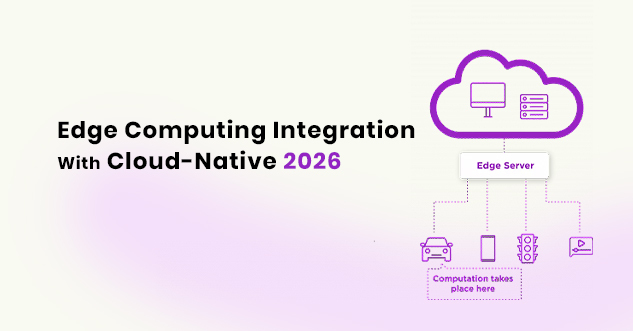
Edge computing is the practice of processing data at or near its point of generation on devices, gateways, or local servers within a facility or geographic area rather than transmitting all raw data to centralized cloud infrastructure for processing.
Edge computing integration the specific architectural practice this guide addresses is the design and implementation of systems that coordinate edge processing with cloud-native platforms through unified orchestration, bidirectional data pipelines, and shared governance controls.
It is not a standalone deployment model. Edge nodes operating without cloud integration become isolated silos capable of local processing but unable to share intelligence across distributed locations, receive centralized model updates, or participate in enterprise-wide analytics. The value of edge computing integration comes from the combination: local processing speed plus cloud-scale intelligence.
Four architectural models define the edge computing integration spectrum:
Model 1 Cloud-centric with edge offload The primary processing logic runs in the cloud. Edge nodes handle only latency-sensitive preprocessing filtering sensor noise, compressing video, buffering data during connectivity loss before forwarding processed data to the cloud. Lowest edge complexity, moderate latency reduction. Appropriate for: analytics applications where real-time action is not required within milliseconds.
Model 2 Edge-primary with cloud synchronization The primary processing and decision logic runs at the edge. Cloud receives aggregated results, model updates, and exception events rather than raw data streams. Highest latency reduction, highest edge complexity. Appropriate for: manufacturing quality control, autonomous vehicle systems, real-time medical monitoring.
Model 3 Federated edge-cloud processing Processing is distributed across edge and cloud based on data classification regulated or latency-sensitive data processed at edge, non-regulated or analytical data processed in cloud. Highest governance flexibility. Appropriate for: healthcare, financial services, and public sector organizations with data residency obligations.
Model 4 Multi-tier edge hierarchy Three-tier architecture: device edge (on the sensor or IoT device itself), near edge (local gateway or micro data center), and far edge (regional data center or telecom edge node) with cloud at the top of the hierarchy for global aggregation and governance. Appropriate for: large-scale IoT deployments across multiple facilities or geographic regions.
Multi-access edge computing (MEC) the ETSI standard for deploying compute capabilities at mobile network base stations is the telco-driven implementation of near edge processing, enabling ultra-low latency applications for mobile devices and IoT endpoints connected through 4G and 5G networks.
Fog computing an alternative term for the intermediate processing tier between IoT devices and cloud, popularized by Cisco is functionally equivalent to near edge processing in most enterprise deployment contexts.
The Performance and Business Case Numbers Behind Edge Computing Integration
Edge computing reduces latency by up to 80% for real-time applications and the business impact of that latency reduction is measurable across the enterprise use cases driving adoption.
Edge vs Cloud-Only Processing: Latency and Performance Comparison
|
Application Type |
Cloud-Only Latency |
Edge-Integrated Latency |
Reduction |
Business Impact |
|
Industrial quality control (vision AI) |
150–300ms |
10–30ms |
80–90% |
Defect detection before production line advance |
|
Patient vital sign alerting |
200–400ms |
15–40ms |
80–90% |
Clinical response within safe intervention window |
|
Retail checkout and inventory |
100–250ms |
20–50ms |
70–80% |
Real-time stock accuracy and frictionless checkout |
|
Autonomous vehicle decision |
80–150ms |
5–15ms |
85–90% |
Safe navigation within reaction time requirements |
|
Financial fraud detection |
50–120ms |
5–20ms |
75–85% |
Transaction blocking before authorization completes |
|
Smart building energy management |
100–300ms |
20–60ms |
70–80% |
Real-time HVAC and lighting optimization |
Sources: Eclipse Foundation IoT and Edge Developer Survey 2025; Gartner Edge Computing Market Guide 2025; IDC Edge Spending Guide 2025.
Bandwidth and Cost Reduction
-
Edge preprocessing reduces data transmission to cloud by 60–90% for high-bandwidth IoT workloads video streams, vibration sensor arrays, industrial telemetry by filtering, compressing, and aggregating at the edge before cloud transmission (IDC, 2025)
-
A manufacturing facility generating 10TB/day of raw sensor data that transmits only 500GB of processed results to cloud reduces annual data egress costs by $180,000–$360,000 at current AWS and Azure egress pricing
-
Edge computing integration reduces cloud compute cost for real-time inference workloads by 40–65% by processing time-sensitive inference at edge nodes and reserving cloud GPU capacity for model training and batch analytics (Forrester, 2025)
Enterprise Deployment Velocity
-
67% of enterprise IoT deployments in 2025 include at least one edge processing tier between devices and cloud up from 31% in 2022 (Eclipse Foundation, 2025)
-
The average enterprise edge-cloud integration program takes 6–18 months from architecture design to production deployment across the first 3–5 edge locations
-
Organizations using managed edge platforms (AWS Outposts, Azure Stack Edge, Google Distributed Cloud) deploy their first production edge workload 40% faster than those building on bare-metal edge infrastructure (IDC, 2025)
How to Architect and Deploy Edge Computing Integration: A 6-Step Framework
Step 1: Define Your Latency SLA, Data Sovereignty Requirements, and Bandwidth Constraints
Edge computing integration architecture is determined by three constraints that must be documented before any platform selection:
-
Latency SLA: What is the maximum acceptable time between data generation and action? Below 10ms requires device-edge processing. 10–50ms is achievable with near-edge. 50–200ms can be addressed with far-edge or regional cloud. Above 200ms may not require edge at all.
-
Data sovereignty requirements: Which data categories must be processed within specific geographic boundaries? Patient health records in UAE must not leave UAE data centers under the Health Data Law. Manufacturing process data in Saudi Arabia may be subject to NDMO classification requirements. Define the data residency obligation before deciding which processing occurs at edge vs cloud.
-
Bandwidth constraints: What is the available connectivity between edge locations and cloud? A manufacturing facility with 100 Mbps internet uplink cannot stream 4K video from 50 cameras to cloud for processing it must process video at edge and transmit only metadata. Map your bandwidth envelope before assuming cloud connectivity is sufficient.
Step 2: Select Your Edge Platform and Cloud Integration Model
Match your edge platform to your existing cloud investment and operational model:
-
AWS Outposts AWS-managed hardware running native AWS services (EC2, EKS, RDS, S3) on-premises or at edge locations, with unified AWS console management. Best for: AWS-primary organizations requiring native AWS services at edge.
-
Azure Stack Edge Azure-managed hardware running Azure IoT Edge and AKS edge clusters with Azure Arc governance. Best for: Microsoft-ecosystem organizations with Azure IoT Hub investments.
-
Google Distributed Cloud Google-managed hardware running GKE at edge, connected to Google Cloud for centralized management. Best for: Kubernetes-native organizations with Google Cloud primary deployments.
-
Open-source edge platforms K3s, KubeEdge, or OpenYurt on commodity hardware maximum flexibility, maximum operational overhead. Best for: organizations with strong Kubernetes expertise and specific customization requirements that managed platforms cannot satisfy.
Step 3: Deploy Kubernetes-Based Edge Orchestration
Kubernetes is the unifying orchestration layer that makes edge-cloud integration operationally manageable at scale. Without Kubernetes at the edge, each edge location becomes a bespoke deployment requiring location-specific management eliminating the operational efficiency that makes distributed edge deployment viable.
Implement the following Kubernetes architecture at each edge node:
-
K3s or KubeEdge as the lightweight edge Kubernetes distribution (full Kubernetes has a resource footprint too large for constrained edge hardware)
-
GitOps deployment model using Argo CD or Flux edge workloads deployed from the same Git repository as cloud workloads, with edge-specific configuration overlays via Helm values
-
Edge-specific resource limits enforced through Kubernetes ResourceQuotas preventing any single workload from consuming hardware resources needed for real-time processing
-
Local persistent storage configured through local-path-provisioner for data that must remain at edge before cloud synchronization
Step 4: Implement Bidirectional Data Pipelines Between Edge and Cloud
Edge-cloud data integration requires separate pipelines for different data flow directions and time sensitivities:
Edge-to-cloud pipelines (upward data flow):
-
Real-time alerts and exceptions MQTT or HTTP/2 to AWS IoT Core, Azure IoT Hub, or Google Cloud IoT sub-second latency for critical events
-
Aggregated time-series telemetry Apache Kafka or AWS Kinesis data streams for buffered, high-throughput sensor data
-
Batch analytics data periodic synchronization of edge-processed results to cloud data lake (S3, ADLS, GCS) for historical analytics and ML training
Cloud-to-edge pipelines (downward data flow):
-
Model updates ML model artifacts pushed to edge nodes on a defined update schedule through OTA (over-the-air) update mechanisms
-
Configuration updates policy changes, threshold adjustments, and workload configuration updates deployed through GitOps pipelines
-
Synchronization data reference data (product catalogs, patient records, inventory master data) cached at edge for offline operation during connectivity loss
Step 5: Implement Unified Observability Across Edge and Cloud
Operating edge nodes without unified observability creates the most common operational failure in edge-cloud deployments: engineers who can see their cloud workloads clearly but are blind to edge node health, workload performance, and data pipeline status until a downstream system fails.
Deploy a unified observability stack that covers both edge and cloud:
-
Metrics: Prometheus agents on every edge node, federated to a central Prometheus or Grafana Cloud instance with edge-specific dashboards showing node health, workload resource utilization, and data pipeline throughput
-
Logs: Fluent Bit log agents at edge (lightweight, designed for constrained environments) shipping to a central log aggregation system (Loki, Elasticsearch, or cloud-native log services) with edge location and node ID as standard log fields
-
Distributed tracing: OpenTelemetry instrumentation on edge workloads, with traces propagated to cloud-based tracing backends (Jaeger, Tempo, or cloud-native APM) for end-to-end request visibility across the edge-cloud boundary
Step 6: Implement Edge Security Controls Aligned to Cloud Security Policy
Edge nodes are physically accessible in ways that cloud infrastructure is not creating security risks that cloud-native security controls alone cannot address. Implement edge-specific security controls:
-
Hardware security: Trusted Platform Module (TPM) for hardware-attested node identity and encrypted storage at rest
-
Network security: mutual TLS (mTLS) for all edge-to-cloud communication enforced through a service mesh (Istio or Linkerd) spanning both edge and cloud workloads
-
Zero trust edge access: ZTNA controls preventing unauthorized access to edge management interfaces no direct SSH access to edge nodes without time-limited, identity-verified session establishment
-
Supply chain security: signed container images verified through admission controllers before deployment to edge nodes preventing unauthorized workload injection through compromised update channels
Which Edge Computing Integration Tools and Platforms Deliver Best in 2026?
For managed edge infrastructure: AWS Outposts Servers (1U and 2U form factors for space-constrained edge locations) deliver native AWS services at edge with the same APIs, tools, and console your cloud team already uses eliminating the operational context-switching that makes unmanaged edge deployments expensive to operate. Azure Stack Edge Pro provides GPU-accelerated inference at edge for organizations running Azure ML workloads that require sub-50ms inference latency.
For Kubernetes at the edge: K3s (Rancher/SUSE) is the lightweight Kubernetes distribution optimized for edge 40MB binary, single-binary installation, ARM64 support for lower-power edge hardware. It has become the default edge Kubernetes runtime for organizations not committed to a managed cloud edge platform. KubeEdge adds cloud-edge synchronization capabilities on top of K3s useful for large-scale edge deployments requiring automated workload distribution from cloud to thousands of edge nodes.
For edge-cloud data integration: AWS IoT Greengrass enables Lambda functions and ML models to run at edge with automatic synchronization to AWS IoT Core the most mature managed edge runtime for AWS-primary organizations. Azure IoT Edge provides the equivalent capability for Azure-connected edge deployments, with strong integration with Azure Stream Analytics for real-time edge analytics. Eclipse Mosquitto and EMQX are the leading open-source MQTT brokers for IoT-to-edge message routing.
For edge ML inference: NVIDIA Jetson modules (Jetson Orin for high-performance inference, Jetson Nano for cost-constrained deployments) are the hardware standard for GPU-accelerated ML inference at edge enabling real-time computer vision, NLP inference, and sensor fusion that CPU-only edge nodes cannot support. TensorFlow Lite and ONNX Runtime provide the model serving frameworks for deploying cloud-trained models to resource-constrained edge hardware.
For unified edge-cloud observability: Grafana Agent (lightweight Prometheus-compatible metrics agent) and Fluent Bit (lightweight log forwarder) are the standard telemetry collection agents for edge nodes designed for constrained hardware where full Prometheus and Fluentd deployments exceed available resources. Both integrate with centralized Grafana Cloud or Grafana Enterprise for unified edge-cloud dashboards.
Explore our Cloud Infrastructure Solutions and IoT Development Services capabilities for organizations designing edge-cloud integration architectures that connect distributed edge deployments to centralized cloud governance.
What Goes Wrong With Edge Computing Integration Programs and How to Prevent Each Failure
Failure 1: Treating Edge Nodes as Mini Data Centers
Organizations that deploy edge nodes expecting to run the same workloads they run in cloud data centers consistently discover that edge hardware constrained on CPU, RAM, storage, and power cannot support the resource footprint of cloud-native workloads designed without resource constraints. A Kubernetes pod that runs comfortably on a cloud node with 32 cores and 128GB RAM will fail to schedule on an edge node with 4 cores and 16GB RAM. Design edge workloads for constrained hardware from the start using lightweight container images, resource limits, and application profiles optimized for edge execution rather than cloud execution.
Failure 2: Building Edge Deployments Without Offline Operation Capability
Edge nodes frequently lose cloud connectivity network outages, maintenance windows, WAN failures. Applications that assume continuous cloud connectivity and fail when that connectivity is lost create operational disruptions in exactly the environments manufacturing, healthcare, logistics where downtime is most costly. Every edge application must define its offline operation mode: what functionality continues during connectivity loss, how data is buffered locally until connectivity resumes, and how synchronization conflicts are resolved when the connection is restored. Design for offline-first operation at every edge location.
Failure 3: Deploying Edge Security as an Afterthought
Edge nodes located in manufacturing facilities, retail locations, hospitals, and logistics warehouses are physically accessible to anyone with physical access to the location unlike cloud infrastructure in locked, guarded data centers. Organizations that deploy edge nodes without hardware security (TPM-based attestation, encrypted storage), physical security (tamper detection, locked enclosures), and network security (mTLS for all cloud communication, zero trust access to management interfaces) create security vulnerabilities that no cloud-side control can compensate for. Physical accessibility to edge hardware is the primary security differential from cloud and it must be addressed in the architecture, not in the incident response plan.
Failure 4: Operating Edge and Cloud as Separate Observability Domains
Engineering teams that can see their cloud workloads clearly but have blind spots in edge node health, data pipeline throughput, and edge workload performance consistently experience incidents that are slow to diagnose and slow to resolve because the failure signal originates at edge but is only visible downstream in cloud systems minutes or hours later. Unified observability across edge and cloud is not an operational convenience it is the technical prerequisite for managing a distributed system as a single operational entity rather than two separate systems with different visibility tools, different alert routing, and different incident response processes.
Frequently Asked Questions
What Is Edge Computing?
Edge computing is the practice of processing data at or near the point of generation on devices, gateways, or local servers at the network edge rather than transmitting all data to centralized cloud data centers for processing. By bringing computation physically closer to data sources, edge computing reduces the round-trip latency between data generation and processing from 100–300 milliseconds (cloud-only) to 5–50 milliseconds (edge-processed) for applications where that latency difference determines whether real-time decisions can be made safely, accurately, and within the available time window. Edge computing does not replace cloud infrastructure it extends it to distributed locations.
How Does Edge Computing Integrate With Cloud-Native Architecture?
Edge computing integrates with cloud-native architecture through three technical mechanisms. First, Kubernetes-based orchestration running K3s or KubeEdge at edge nodes enables the same container deployment, scaling, and lifecycle management model used in cloud to operate at edge, with GitOps pipelines pushing workload updates from cloud to edge automatically. Second, bidirectional data pipelines connect edge-processed results to cloud analytics through MQTT, Kafka, or managed IoT services (AWS IoT Core, Azure IoT Hub) while cloud pushes ML model updates, configuration changes, and reference data to edge. Third, unified observability Prometheus metrics, Fluent Bit logs, and OpenTelemetry traces provides single-pane visibility across edge and cloud in centralized dashboards.
Which Industries Benefit Most From Edge Computing Integration?
The industries generating the highest measurable ROI from edge computing integration in 2026 are manufacturing (real-time quality control using computer vision AI at production line speed 10–30ms inference at edge versus 150–300ms cloud round-trip), healthcare (patient vital sign monitoring with sub-40ms alert latency enabling clinical intervention before deterioration, and health data sovereignty keeping patient records within national borders), autonomous systems (vehicles, drones, and robotics requiring sub-15ms sensor-to-decision latency that cloud architectures physically cannot achieve), retail (real-time inventory tracking, frictionless checkout, and loss prevention using edge computer vision), and energy and utilities (predictive maintenance on industrial equipment generating terabytes of vibration, thermal, and acoustic sensor data that cannot be cost-effectively transmitted to cloud at raw volume).
Define Your Latency SLA First. Everything Else Follows From That Number.
Edge computing integration architecture is not primarily a technology decision it is a physics decision. The latency requirement of your application, the data sovereignty requirement of your jurisdiction, and the bandwidth constraint of your edge location collectively determine which processing occurs at edge and which occurs in cloud. Those three constraints must be defined before any platform is selected, any hardware is procured, or any Kubernetes distribution is deployed.
The solution architects and CTOs generating the strongest edge-cloud integration outcomes in 2026 made one sequencing decision correctly: they defined their latency SLA, sovereignty requirements, and bandwidth envelope before their first vendor conversation. That sequencing produced architecture decisions aligned to actual operational constraints rather than platform capabilities and it produced edge deployments that work in production rather than in proof-of-concept environments with assumed connectivity and unlimited hardware resources.
Define your lowest acceptable latency requirement across your highest-priority edge use case. Map which data categories must remain within your jurisdiction under applicable data sovereignty laws. Measure your actual WAN bandwidth between your target edge location and your cloud region. Then select your edge platform and orchestration model against those specific, documented constraints.
To design an edge-cloud integration architecture matched to your specific latency, sovereignty, and connectivity requirements, explore our Cloud Infrastructure Solutions and IoT Development Services capabilities structured for solution architects and enterprise CTOs building distributed systems that process data where it is generated and govern it where it belongs.