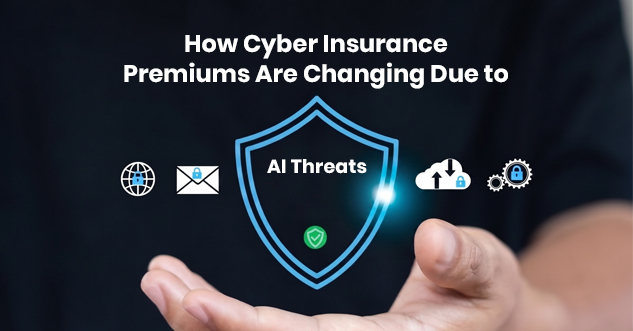


How Cyber Insurance Premiums Are Changing Due to AI Threats in 2026
TL;DR
Cyber insurance AI threats have shifted underwriting from a historical-claims-based model to a forward-looking security posture assessment, because AI-generated phishing, deepfake-enabled business email compromise, and AI-assisted vulnerability discovery have measurably increased both attack frequency and success rate. Insurers are tightening requirements around AI-aware security controls phishing-resistant MFA, deepfake verification procedures, and AI usage governance and pricing coverage accordingly. Organizations that can demonstrate these specific controls are securing materially lower premiums than those relying on pre-AI-era security baselines.
Why AI Threats Are Reshaping Cyber Insurance Underwriting Right Now
Cyber insurers price risk based on loss probability and severity and both variables have shifted measurably since AI tools became broadly accessible to threat actors. The underwriting models insurers built on 2018–2022 breach data no longer accurately price 2026 risk, because the attack techniques generating claims have changed in ways that older security baselines don't address.
AI-generated phishing is the clearest driver. Phishing emails generated by large language models are now functionally indistinguishable from legitimate business correspondence eliminating the grammatical and stylistic tells that trained employees and email security filters historically relied on for detection. Proofpoint's 2025 State of the Phish report found that AI-generated phishing emails achieve a 31% higher click-through rate than templated phishing kits from 2022, directly translating into more successful initial access events the starting point for the ransomware and business email compromise claims that drive insurer losses.
Deepfake-enabled fraud has moved from novelty to documented claims volume. Voice and video deepfakes impersonating executives to authorize fraudulent wire transfers the modern evolution of business email compromise generated claims significant enough that several major cyber insurers introduced deepfake-specific underwriting questions and, in some cases, sub-limits or exclusions for losses where the organization had no deepfake verification procedure in place.
AI-assisted vulnerability discovery has compressed the exploitation timeline insurers must price against. Threat actors using AI tools to identify and weaponize vulnerabilities faster than defenders can patch them has shortened the window between vulnerability disclosure and active exploitation directly affecting the loss severity insurers model for any given security gap.
For CFOs and risk managers, this means the cyber insurance renewal conversation in 2026 looks different than it did even two years ago: insurers are asking specific, AI-threat-aware questions, and organizations without specific, demonstrable answers are facing higher premiums, reduced coverage limits, or declined renewal.
What Does "Cyber Insurance AI Threats" Actually Mean and How Has Underwriting Changed?
Cyber insurance AI threats refers to the category of cyber risk arising specifically from AI-powered attack techniques AI-generated phishing and social engineering, deepfake-enabled fraud, and AI-assisted vulnerability discovery and exploitation and the corresponding shift in how cyber insurers assess, price, and underwrite policies in response to that risk category.
Underwriting has changed across three dimensions:
Dimension 1 Application questionnaire depth
Pre-2023 cyber insurance applications asked largely generic security questions: do you have MFA, do you have backups, do you have an incident response plan. 2026 applications from major carriers (Chubb, Beazley, Coalition, AIG) now include specific questions about phishing-resistant authentication methods, deepfake verification procedures for financial transactions, and increasingly questions about the organization's own AI tool usage and governance, since unsanctioned AI tool usage by employees is itself an emerging claims category.
Dimension 2 Security control verification, not just attestation
Several carriers, led by Coalition and other "active insurance" providers, now perform external attack surface scanning as part of underwriting independently verifying security posture claims rather than relying solely on self-reported questionnaire answers. This shift means an organization's actual, externally observable security posture directly affects pricing, not just what it states on an application.
Dimension 3 AI-specific exclusions, sub-limits, and required controls
Some carriers have introduced policy language specifically addressing deepfake-enabled fraud either as a defined sub-limit (lower coverage cap than the main policy) or as an exclusion unless specific verification controls are documented as being in place. This mirrors how social engineering fraud coverage evolved a decade earlier, moving from full inclusion to sub-limited or condition-dependent coverage as claims volume increased.
Phishing-resistant MFA authentication methods (FIDO2/WebAuthn hardware keys, platform authenticators) that cannot be defeated by the real-time phishing relay attacks AI has made easier to execute at scale has become a specific underwriting differentiator, distinct from simply having "MFA" in a generic sense, because SMS and push-notification MFA remain vulnerable to AI-enhanced phishing kits that traditional MFA was not originally designed to resist.
The Numbers Behind AI-Driven Cyber Insurance Premium Changes
| Metric | Pre-AI Baseline (2022) | 2026 Status / Target | Impact / Change Change |
| Phishing email click-through rate (AI-generated vs templated) | Baseline | 31% higher | Significant increase in successful initial access events. |
| Business email compromise claims involving deepfake/voice cloning | Negligible / unclassified | 17% of BEC claims | New, rapidly growing claims category complicating fraud payouts. |
| Average premium increase for organizations without phishing-resistant MFA | Baseline | 22–35% higher | Direct underwriting financial penalty applied at renewal. |
| Average premium reduction for organizations with deepfake verification | N/A | 8–15% reduction | New custom pricing lever and risk offset credit available. |
| % of carriers performing external attack surface verification | <10% | 45%+ of carriers | Major fundamental shift in active underwriting methodology. |
Claims Severity and Frequency Trends
- Ransomware claims involving AI-assisted initial access (phishing or vulnerability exploitation) showed 18% higher average claim severity than non-AI-assisted ransomware incidents, attributed to faster, more targeted initial compromise leading to broader lateral movement before detection (Coalition, 2025).
- Business email compromise claims involving deepfake voice or video impersonation grew from a negligible, unclassified category in 2022 to 17% of all BEC claims by carrier classification in 2025 (Marsh McLennan, 2025).
- Organizations demonstrating phishing-resistant MFA across privileged accounts and financial approval workflows show 60% lower successful BEC claim rates than organizations using SMS or push-based MFA alone (Beazley, 2025).
Premium and Coverage Impact
- Cyber insurance premiums overall rose 8–12% industry-wide in 2025, with the increase concentrated disproportionately among applicants unable to demonstrate AI-threat-specific controls organizations with strong baseline security but no AI-specific updates saw renewal increases at the lower end of that range or below, while organizations with security postures unchanged since 2022 saw increases at the higher end or beyond (Marsh McLennan, 2025).
- 23% of carriers now offer explicit premium credits for documented deepfake verification procedures and phishing-resistant authentication a pricing lever that did not exist in most policies before 2024 (Marsh McLennan, 2025).
How to Reduce Cyber Insurance Premiums Despite Rising AI Threats: A 5-Step Framework
Before your next renewal, inventory which systems and accounts use SMS or push-notification MFA versus phishing-resistant methods (FIDO2/WebAuthn hardware keys or platform authenticators built into modern devices).
- Prioritize phishing-resistant MFA deployment for privileged accounts (domain administrators, financial system access, executive accounts) first.
- Extend to financial approval workflows specifically wire transfer authorization, vendor payment approval given the direct link to deepfake-enabled fraud claims.
- Document the deployment with specifics (which accounts, which method, what percentage of privileged accounts covered).
Given that 17% of BEC claims now involve deepfake impersonation, implement a specific, documented verification procedure for any financial transaction request received via voice, video call, or urgent written communication appearing to come from an executive:
- Require out-of-band verification a callback to a known, previously verified phone number, not a number provided in the suspicious communication itself for any transaction request above a defined threshold.
- Establish a verification codeword or secondary confirmation channel for executive-level transaction approvals specifically.
- Document this procedure formally, since several carriers now explicitly ask about deepfake verification procedures in underwriting questionnaires and offer premium credits for documented implementation.
Traditional phishing filters trained on stylistic and grammatical anomalies are measurably less effective against AI-generated phishing that lacks those tells:
- Deploy email security tools with behavioral and contextual analysis (sender behavior patterns, domain reputation, link destination analysis).
- Implement DMARC, DKIM, and SPF enforcement at the strictest policy level your email infrastructure supports, closing domain spoofing vectors.
- Update employee security awareness training specifically to address AI-generated phishing characteristics.
With 45%+ of carriers now performing independent attack surface scanning as part of underwriting, proactively identify what an external scan would reveal before your insurer does:
- Run your own external attack surface assessment to identify exposed services, expired certificates, or misconfigurations visible from the internet.
- Remediate identified issues before renewal, since carriers performing this verification will price discovered issues into your premium regardless of questionnaire answers.
- Maintain this as an ongoing practice, not a pre-renewal exercise.
As insurers begin asking about organizational AI tool usage and governance specifically, prepare documentation showing:
- A formal AI usage policy specifying sanctioned tools and prohibited data handling practices.
- Evidence of AI application visibility (CASB or equivalent monitoring) demonstrating the organization can detect shadow AI usage.
- Data loss prevention controls specifically covering AI application data submission.
Which Tools and Approaches Help Organizations Manage Cyber Insurance AI Risk in 2026?
- For phishing-resistant authentication: YubiKey (Yubico) and Microsoft Authenticator with passkey support provide FIDO2/WebAuthn-compliant phishing-resistant authentication. Okta and Microsoft Entra ID both support enforcing phishing-resistant authentication methods specifically for privileged account tiers.
- For AI-aware email security: Abnormal Security and Mimecast provide behavioral and contextual email security analysis specifically designed to detect AI-generated phishing and business email compromise patterns. Proofpoint offers comparable AI-threat-aware detection.
- For external attack surface management: Censys and Shodan provide external attack surface visibility tools that approximate what carrier-side scanning will reveal. CrowdStrike Falcon Surface and Palo Alto Cortex Xpanse provide managed external attack surface management.
- For deepfake detection and verification: Pindrop and Reality Defender provide emerging voice and video deepfake detection capability for organizations with high-value transaction approval workflows.
- For cyber insurance brokerage and risk assessment: Working with a broker experienced specifically in the current AI-threat underwriting landscape Marsh McLennan, Aon, or Gallagher at the enterprise tier provides access to carrier-specific intelligence.
What Goes Wrong When Organizations Respond to AI-Driven Insurance Changes
Failure 1: Treating Generic MFA as Sufficient Without Verifying the Specific Method
Organizations that report "we have MFA" on renewal applications without distinguishing between SMS-based, push-notification, and phishing-resistant methods consistently receive less favorable pricing.
Failure 2: Addressing Phishing-Resistant MFA Only for Standard User Accounts
Organizations that roll out phishing-resistant authentication broadly for standard user logins while leaving privileged accounts on weaker MFA methods are protecting the lower-value targets while leaving the highest-value accounts exposed.
Failure 3: Implementing Deepfake Verification Procedures Without Documentation
An organization that has informally agreed "we'll call back to verify big transfers" without a documented, formal procedure cannot demonstrate that control to an underwriter in a way that affects pricing.
Failure 4: Waiting for Carrier Scanning to Discover Attack Surface Issues
Organizations that take a passive approach waiting to see what a carrier's external scan reveals rather than proactively assessing and remediating their own attack surface consistently receive less favorable renewal terms.
Frequently Asked Questions
How Does AI Affect Cyber Insurance?
What Controls Do Insurers Require for Cyber Insurance Coverage?
Document Your Specific Controls Now. Generic Security Claims No Longer Move Your Premium.
Cyber insurance AI threats have shifted underwriting from broad questionnaire attestation to specific, often externally verified security posture assessment and the organizations securing the most favorable premiums in 2026 are those that can document phishing-resistant authentication, deepfake verification procedures, and AI governance with the same specificity carriers now use to price risk.
The CFOs and risk managers achieving the strongest renewal outcomes share one practice: they stopped answering underwriting questionnaires with generic security claims and started documenting the specific methods, coverage percentages, and procedures that current carrier pricing models actually weigh.
Partner with AGAMISOFT
To strengthen your security posture against the specific controls cyber insurers now price into AI-driven risk, explore our Cyber Risk Management Services and Security Compliance Framework capabilities structured for CFOs and risk managers who need premium outcomes tied to documented, verifiable security controls.