

Published by AgamiSoft | Reading time: ~14 minutes
|
Featured Snippet / AEO Answer : Build vs buy app development is the strategic decision of whether to develop a custom mobile application from scratch (build), purchase or license an existing software product (buy), or engage an external development partner to build a custom solution (outsource). The right choice depends on whether the app represents a competitive differentiator, what the realistic 5-year total cost of ownership is for each option, how quickly the app is needed, and whether internal engineering capability exists to build and maintain it.
|
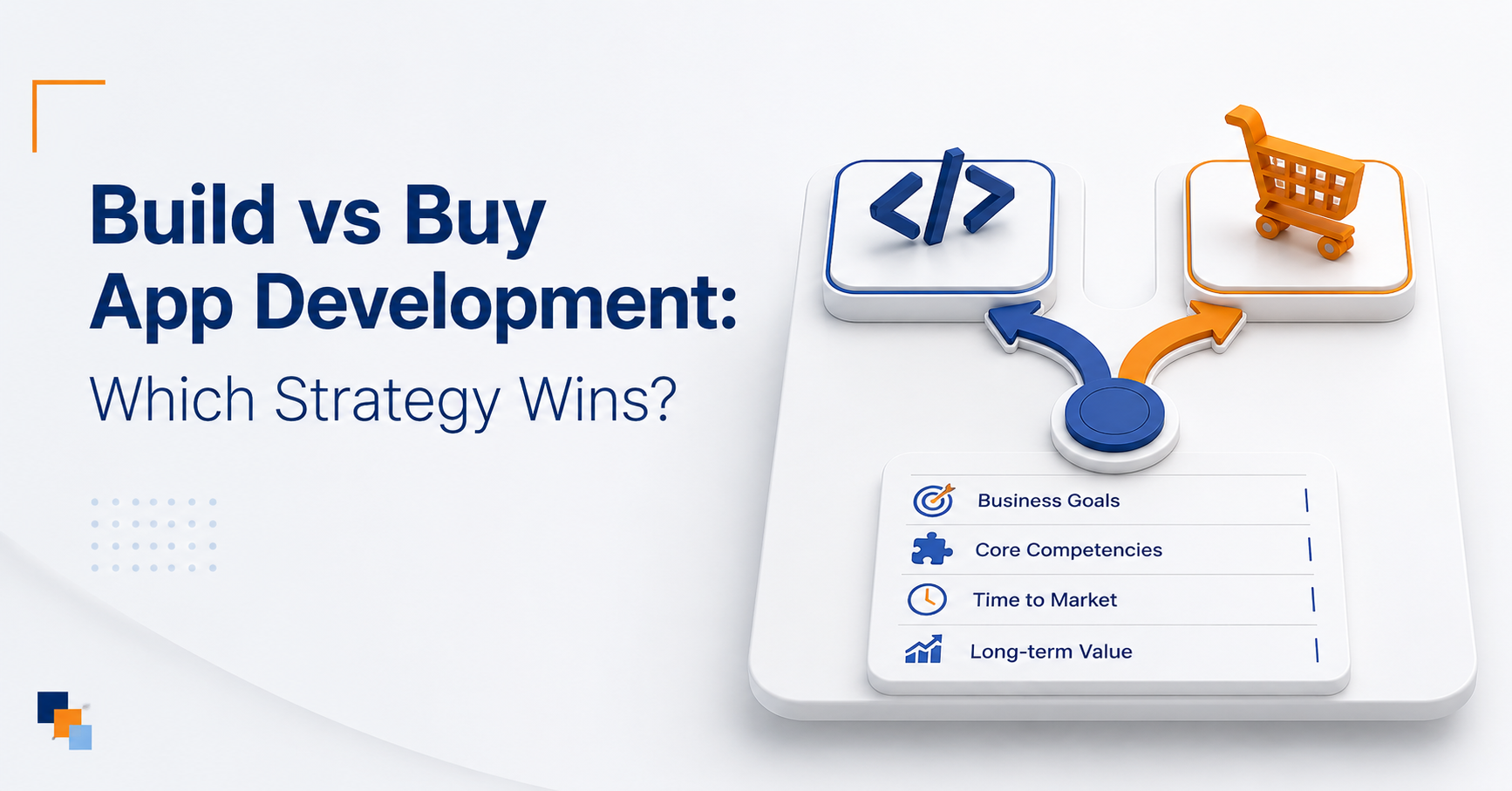
Build vs Buy App Development: Which Strategy Is Right for Your Mobile App in 2026?
|
Quick Answer / TL;DR The build vs buy app development decision determines whether your organization develops a custom mobile application, purchases an existing solution, or engages an external partner to build something custom. Getting this decision wrong is expensive in both directions: building custom software for a commodity function wastes engineering investment that should be directed elsewhere; buying a SaaS solution for a differentiating function forces you to compete on the same terms as every competitor using the same software. The framework for making this decision correctly is straightforward but requires honest answers to questions most organizations skip.
|
Why the Build vs Buy App Development Decision Has Higher Stakes Than It Appears
Every organization making a mobile app decision believes their situation is straightforward: "we need an app, should we build it or buy it?" The decision appears binary. In practice, it has a third option (outsource) and several sub-options within each that meaningfully change the cost, timeline, and strategic outcome.
The stakes are higher than most decision-makers realize at the moment of the decision, because the choice has multi-year compounding consequences:
Build commits your engineering capacity. An in-house mobile app competes for engineering time with every other initiative. If the app isn't your core product, it draws from the same pool of engineering capacity that should be building your core competitive advantage.
Buy creates long-term dependency. A SaaS platform or white-label app that becomes deeply integrated into your operations is extraordinarily difficult to replace. The switching cost migrating data, retraining users, rebuilding integrations grows every year the platform is in use.
Outsource creates knowledge transfer risk. A custom app built by an external team is a custom app whose architecture, code, and institutional knowledge may be concentrated outside your organization.
Three developments in 2026 have made this decision more nuanced:
The quality of off-the-shelf and white-label mobile solutions has improved substantially. In 2020, buying a pre-built mobile solution often meant accepting significant capability compromises. In 2026, the SaaS and white-label app market has matured to the point where commodity functions e-commerce storefronts, appointment scheduling, loyalty programs, delivery tracking have commercial solutions that match or exceed what a custom build would deliver in the first two years.
Outsourced app development quality has become more verifiable and more variable simultaneously. The market for outsourced app development has expanded globally providing access to high-quality development at competitive rates through established agencies in Eastern Europe, Southeast Asia, and Latin America while simultaneously producing a long tail of low-quality providers who position well but deliver poorly. Verifying outsource quality before commitment is more important and more feasible than ever.
AI-assisted development has shifted the build cost curve. The same MVP that required 4–6 months and $150,000 in 2022 can be built in 2–4 months at $80,000–$120,000 in 2026 with AI-assisted development tools changing the build vs buy comparison in cases where the 2022 build cost was prohibitive but the 2026 build cost is justifiable.
What Are the Three App Development Strategies, Exactly and What Does Each Involve?
Strategy 1 Build (Custom In-House Development)
Your engineering team designs and builds the mobile app using your organization's own resources producing software you own completely, can modify freely, and are entirely responsible for maintaining.
Best for: apps that are your core product or a core competitive differentiator; apps with highly specific requirements that no commercial solution satisfies; apps where the competitive advantage comes from the specific way the app functions, not just from having an app.
Key considerations: requires engineering capacity and mobile expertise; highest upfront cost; highest long-term control and flexibility; no vendor dependency; requires ongoing maintenance investment.
Strategy 2 Buy (Commercial Software, SaaS, or White-Label)
Purchase or license an existing mobile application or platform configuring and customizing within the product's available options rather than building from scratch.
Sub-types:
-
SaaS mobile product: subscribe to an existing mobile-first SaaS platform that serves your use case (e.g., a delivery tracking app, an appointment booking app, a loyalty program)
-
White-label app: license a mobile app built by another company, rebrand it with your identity, and configure it for your specific use case without building the underlying application
-
App marketplace templates: purchase a code template or starter kit that provides the foundational structure, customized and deployed by your team or a development partner
Best for: commodity functions where the competitive advantage is not in how the function is performed but in the business value it enables; situations where time-to-market is critical and the function is well-served by existing commercial solutions.
Key considerations: lower upfront cost; faster deployment; vendor dependency and switching cost; limited customization to the vendor's roadmap and feature set; ongoing subscription cost that scales with usage.
Strategy 3 Outsource (Custom Development by External Partner)
Engage an external development agency or team to build a custom mobile app to your specifications combining the customization of building with external development capacity.
Sub-types:
-
Fixed-scope project: external agency builds a defined scope for a defined price on a defined timeline
-
Dedicated team: external agency provides a dedicated team that functions as an extension of your engineering organization, working on an ongoing basis
-
Staff augmentation: external engineers join your team and work under your technical leadership
Best for: custom app requirements without the internal engineering capacity or mobile expertise to build them; situations where development speed requires a team larger than internal hiring can produce in the available timeline; organizations that want custom ownership without building a permanent mobile engineering team.
Key considerations: requires careful vendor selection; knowledge transfer and documentation risk; higher hourly rate than equivalent internal employees but lower total cost than building internal capacity for temporary needs; quality varies significantly by partner.
The Data Behind Each Strategy's Real Cost and Performance
5-Year Total Cost of Ownership Comparison (Illustrative, Medium Complexity App)
|
Strategy |
Year 1 Cost |
Year 3 Cumulative |
Year 5 Cumulative |
Control |
Speed to Launch |
|
Build (in-house) |
$200,000–$400,000 |
$350,000–$650,000 |
$500,000–$900,000 |
Full |
Slowest (4–9 months) |
|
Buy (SaaS/white-label) |
$20,000–$80,000 |
$80,000–$240,000 |
$150,000–$450,000 |
Limited |
Fastest (days–weeks) |
|
Outsource (custom) |
$80,000–$250,000 |
$150,000–$400,000 |
$200,000–$550,000 |
Full |
Medium (3–6 months) |
Sources: Clutch App Development Cost Report 2025; Gartner Make vs Buy Analysis Framework 2025; Andreessen Horowitz Software Cost Research 2025. Illustrative ranges actual costs depend significantly on app complexity, team location, and specific vendors.
Where Each Strategy Wins on TCO
-
Buy wins on 5-year TCO for commodity functions at moderate usage scale accounting, HR administration, standard e-commerce, basic CRM where the commercial solution is sufficiently configurable and switching costs remain manageable
-
Build or outsource wins on 5-year TCO for differentiating functions at scale proprietary customer experience, unique business logic, high transaction volumes that make per-seat or usage-based SaaS pricing exceed build economics
-
The TCO crossover point where cumulative build cost becomes lower than cumulative buy cost for a given usage scale typically occurs between years 2–4 for medium-complexity apps with significant per-unit SaaS pricing
How to Make the Build vs Buy App Development Decision: A 5-Step Framework
Step 1: Determine Whether the App Is a Competitive Differentiator
This single question eliminates most of the decision space:
-
Ask: is the way our app functions the reason customers choose us over competitors, or is having an app the baseline and the competitive advantage comes from something else?
-
If the app's specific functionality is differentiating: build or outsource buying forces you to offer the same experience as every competitor who buys the same product. The competitive advantage is in the custom implementation, not in having an app.
-
If having an app is the baseline and the differentiation is elsewhere: buy the commercial solution delivers the baseline at lower cost and faster timeline, preserving engineering investment for the differentiating capabilities.
A startup whose core product is a mobile app is always build or outsource. A restaurant that needs an ordering app to keep pace with competitors is almost always buy.
Step 2: Model the 5-Year Total Cost of Ownership for Each Option
Year-one cost comparisons consistently mislead the build vs buy decision. A SaaS solution at $500/month looks far cheaper than a $150,000 custom build in year one. At year three with 10,000 users at $5/user/month, the same comparison looks different.
Buy TCO components:
-
Subscription or license fee × 5 years (apply expected annual price increases of 5–15%)
-
Implementation, configuration, and integration cost (typically 50–200% of first-year license for commercial enterprise apps)
-
Ongoing customization cost for platform-specific work
-
Estimated switching/migration cost if you exit the platform
Build/outsource TCO components:
-
Initial development cost
-
Annual maintenance (15–25% of development cost per year)
-
Infrastructure/hosting cost
-
Team cost for ongoing feature development
Model the crossover year when cumulative build cost falls below cumulative buy cost. If the crossover is beyond year 5, buy is likely the correct answer for a non-differentiating function.
Step 3: Assess Internal Capability for Build Options
The build option's TCO model is only valid if the organization can execute the build at the projected quality:
-
Mobile engineering expertise: does your team have iOS/Android or React Native/Flutter experience, or would the build require hiring or training?
-
Ongoing maintenance capacity: after the initial build, who maintains it? What's the opportunity cost of that maintenance work against other priorities?
-
Outsource capability: if internal build isn't feasible, can you identify and manage an outsource partner effectively? Do you have the project management capacity to run an outsourced development engagement?
If internal build is not feasible and outsource management capacity is limited, buy may be the correct answer even for moderately differentiating functions because a build that your organization cannot execute reliably is not a real option.
Step 4: Evaluate Vendor Lock-In and Data Portability for Buy Options
For any buy option that survives the TCO analysis:
-
Data portability: can you export all your data from the platform in a standard format a replacement system could consume?
-
Integration reversibility: how deeply will this platform integrate with other systems, and how reversible are those integrations if you decide to switch?
-
Pricing leverage: at what usage level does the vendor gain significant pricing power over you?
For platforms where data portability is limited or integration reversibility is low, increase your buy-option TCO by 30–50% to account for realistic switching cost.
Step 5: Apply Business Stage to Calibrate Risk Tolerance
The build vs buy answer shifts by business stage:
Pre-product-market fit (seed/early Series A): buy everything except the core product. Speed to validation is the primary priority. Custom infrastructure that hasn't been validated to be necessary wastes capital.
Scaling (Series B–C): audit your commercial software stack. Replace tools that have become pricing bottlenecks or capability constraints with custom builds or outsourced alternatives starting with the highest-cost, highest-friction commercial solutions.
Established: actively manage the build/buy portfolio annually reviewing which functions have scaled to the point where custom economics are justified.
Which Approach Should You Choose for Specific Mobile App Types?
Almost always buy:
-
Employee HR and payroll mobile apps (Rippling, Gusto)
-
Standard e-commerce storefronts (Shopify Mobile, WooCommerce app)
-
Appointment scheduling for service businesses (Calendly, Acuity mobile)
-
Field service management for small teams (ServiceTitan, Jobber)
-
Basic loyalty programs (Stamp Me, Loopy Loyalty)
Almost always build or outsource:
-
The core product of a software company
-
Apps with proprietary matching, pricing, or recommendation logic
-
Apps integrating deeply with proprietary internal systems
-
Apps where the user experience is the competitive differentiator
Evaluate explicitly:
-
Customer-facing apps for mid-market businesses where brand experience matters but underlying functionality is standard
-
Internal operations apps where the workflow is partially standard and partially organization-specific
-
Apps in categories where white-label solutions exist but customization requirements may exceed what white-label allows
Frequently Asked Questions
When Should a Company Build a Custom App Instead of Buying?
A company should build a custom app when: the app's specific functionality is a source of competitive differentiation (custom experience is why customers choose you), the requirements are too specific for any commercial solution to satisfy without prohibitive customization, the projected 5-year usage scale makes commercial subscription pricing exceed build economics, or data sovereignty requirements prevent using a managed third-party platform. Conversely, buy when the function is standard, the commercial solution is configurable to your requirements, the time-to-launch advantage of buying is significant relative to the competitive situation, and the 5-year TCO of the commercial option is lower than the build option at projected usage scale.
Is Outsourcing App Development Better Than Building In-House?
Outsourcing app development is better than building in-house when: the organization lacks mobile engineering expertise internally and the timeline doesn't accommodate hiring and onboarding; the development need is scoped and finite rather than ongoing (a defined project rather than a permanent capability); or the development investment is contingent on market validation (building internally before validation commits ongoing engineering overhead to an unvalidated product). In-house development is better when: the app is the core product and requires continuous, rapid iteration; data sensitivity makes external development inappropriate; or the organization has existing mobile engineering capacity that can absorb the project without opportunity cost.
How Do You Decide Between Build vs Buy vs Outsource for a Mobile App?
Apply the framework in five steps: first, determine whether the app is a competitive differentiator (if yes, build or outsource; if no, evaluate buy seriously). Second, model the 5-year TCO for each option at projected usage scale buy may look cheap in year one and expensive in year four. Third, assess your organization's ability to build or manage an outsourced build a build that your team cannot execute is not a real option. Fourth, evaluate data portability and lock-in risk for any buy option that survives TCO analysis. Fifth, apply your business stage pre-PMF startups should bias toward buy for non-core functions; scaling companies should audit their buy decisions for functions that have reached custom-development TCO crossover.
Determine Differentiator Status First. Model 5-Year TCO, Not Year-One Cost. Assess Execution Capability Before Committing to Build.
The build vs buy app development decision produces its best long-term outcome when it's made function-by-function against honest answers to three questions: is this app a source of competitive differentiation, what is the realistic 5-year total cost of each option at projected scale, and does our organization have the capability to execute the build option if that's what the analysis recommends?
The founders and product leaders making the best build vs buy decisions in 2026 shared one discipline: they modeled 5-year TCO before making any commitment calculating the crossover year, accounting for vendor price increases, and estimating switching costs rather than comparing year-one price tags that consistently favor buy and year-five ownership economics that frequently favor build.
Apply the five-step framework to your current app decision this week. Calculate the 5-year TCO crossover for your top buy option at your projected usage scale. Identify whether your app's core functionality is a competitive differentiator or a baseline capability that competitors offer equivalently.
To build a custom mobile app that delivers the competitive differentiation your business requires, or to evaluate whether outsourcing or a commercial solution is the right fit for your specific situation, connect with our team for app development strategy and implementation support.