

Published by AgamiSoft | Reading time: ~14 minutes
|
Featured Snippet / AEO Answer : AI vendor risk management evaluates the security, privacy, compliance, reliability, data practices, model governance, and business continuity risks associated with third-party AI providers before deployment through structured assessment and after deployment through continuous monitoring. Third-party AI providers can introduce risks involving data privacy, model security, regulatory compliance, availability, intellectual property, and vendor dependency that standard software vendor risk frameworks were not designed to assess, requiring AI-specific evaluation criteria applied to every provider that processes organizational data or influences organizational decisions.
|
AI Vendor Risk Management: How to Assess Third-Party AI Providers in 2026
|
Quick Answer / TL;DR : AI vendor risk management is the structured practice of evaluating, selecting, and continuously monitoring third-party AI providers against the specific risk dimensions that AI systems introduce data privacy, model security, regulatory compliance, service reliability, intellectual property, and vendor lock-in dimensions that standard IT vendor risk frameworks address incompletely or not at all. Every enterprise that calls an LLM API, deploys an AI-powered SaaS tool, or integrates a third-party AI model is taking on the risk profile of that provider alongside the capability, and most organizations are doing so without the structured assessment that the risk warrants.
|
Why AI Vendor Risk Management Requires a Different Framework Than Standard IT Vendor Risk
Standard IT vendor risk management evaluating cloud infrastructure providers, SaaS tools, and software vendors against security certifications, SLAs, and data handling practices is a mature discipline with established frameworks (SOC 2, ISO 27001, NIST CSF). These frameworks capture most of the risk that traditional software vendors introduce.
AI vendors introduce risk categories that these frameworks were not designed to address:
Model behavior risk. A traditional software vendor delivers deterministic code that behaves predictably within its specifications. An AI vendor delivers a probabilistic model whose outputs vary, whose behavior can change with model updates, and whose performance on your specific use case may differ from benchmarks. No SOC 2 audit captures whether the AI model has systematic biases, failure modes on your data distribution, or behavior that violates your policies.
Training data provenance risk. The AI model you're deploying was trained on data whose sources, licenses, and content you may know nothing about. If that training data included copyrighted material used without license, personal data collected without consent, or data from prohibited sources, your organization inherits the legal and reputational risk associated with that training data by deploying the model.
Indirect regulatory scope. Deploying an AI vendor for consumer-facing or decision-making applications may bring your organization within scope of AI-specific regulations EU AI Act, EEOC AI hiring guidance, CFPB AI credit guidance regardless of the vendor's own compliance posture. Your vendor's compliance certifications may be irrelevant to the regulatory obligations your use of their AI creates.
Three developments have elevated AI vendor risk management to a 2026 compliance imperative:
EU AI Act obligations extend to deployers, not just developers. Under the EU AI Act, organizations that deploy high-risk AI systems including AI from third-party vendors have obligations for transparency, human oversight, and compliance documentation. "We bought it from a vendor" is not a defense against EU AI Act obligations for the deployment-stage requirements that apply to the organization using the AI.
AI supply chain attacks have moved from theoretical to documented. Attacks targeting AI model supply chains including poisoned models distributed through public repositories, backdoored model weights, and training data poisoning have been documented in the security literature and are actively referenced in threat intelligence. The AI model you deploy from a third-party vendor may have integrity issues that standard software supply chain security checks don't catch.
AI vendor concentration risk has emerged as a systemic concern. Financial regulators including the Bank of England and the Federal Reserve have identified AI vendor concentration the risk that a small number of AI providers serving the majority of the financial sector creates systemic fragility as an emerging macro-prudential concern. Individual enterprise AI vendor risk assessments should include single-vendor dependency risk as a specific assessment dimension.
What Is AI Vendor Risk Management, Exactly and What Are the Seven Risk Dimensions?
AI vendor risk management is the structured process of evaluating third-party AI providers against AI-specific risk criteria before procurement, as a condition of contract negotiation, and through ongoing monitoring after deployment addressing risk dimensions that standard IT vendor risk frameworks don't cover.
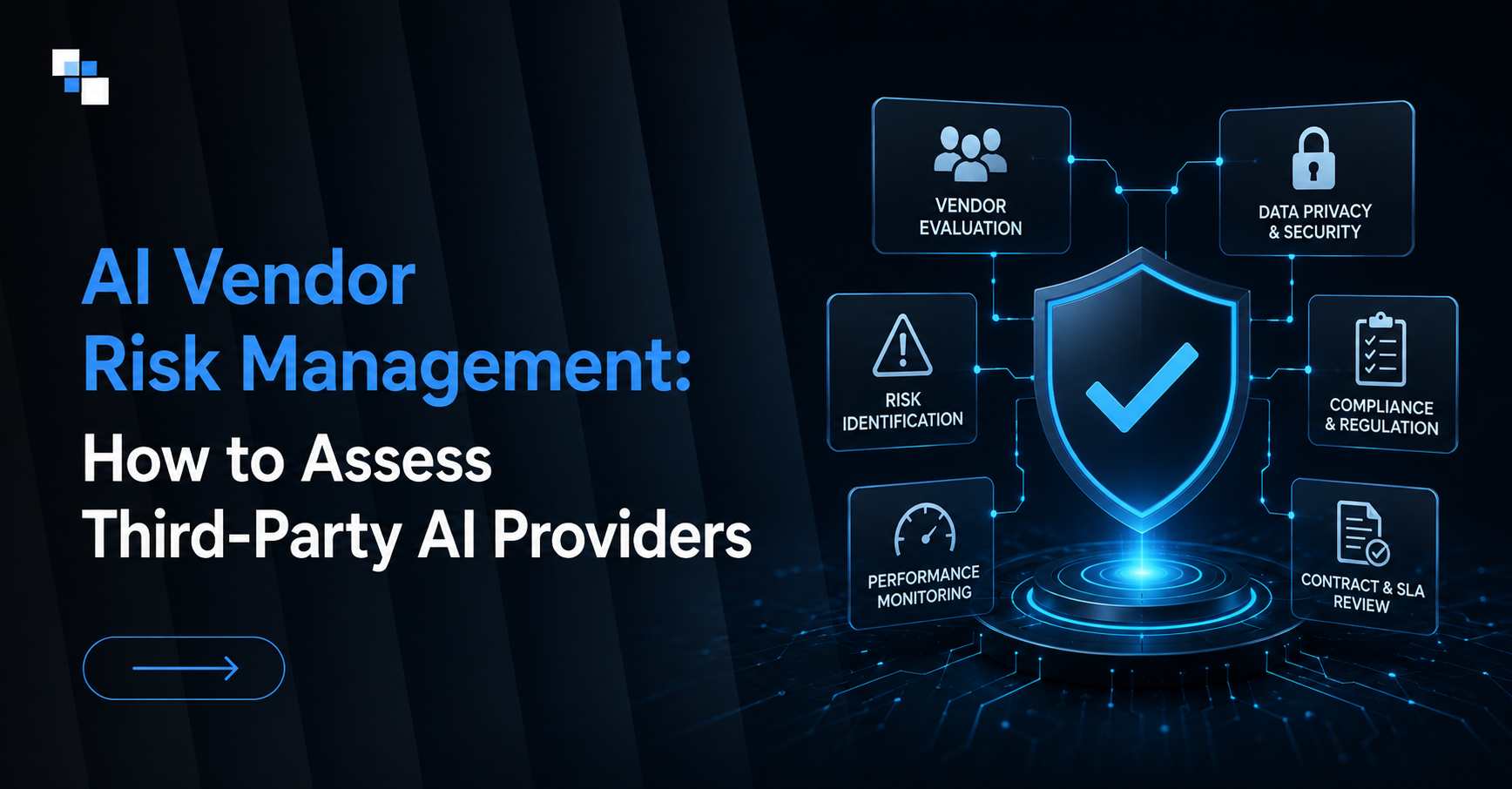
Seven risk dimensions require specific assessment for AI vendors:
Dimension 1 Data privacy and processing risk
What data does the vendor's AI system process, where is that data stored, who can access it, and is it used to train or improve the vendor's models? This dimension determines whether deploying the vendor creates GDPR Article 28 data processor obligations, whether data sovereignty requirements are satisfied, and whether confidential organizational data sent to the AI is protected from disclosure to the vendor's other customers or model training processes.
Dimension 2 Model security risk
What are the security properties of the AI model itself is it vulnerable to prompt injection, adversarial inputs, or model inversion attacks? How does the vendor protect the model serving infrastructure from unauthorized access? Has the vendor conducted adversarial robustness testing? Model security risk is not covered by standard application security assessments.
Dimension 3 Regulatory compliance risk
Does your use of this AI vendor's product create regulatory obligations under EU AI Act, EEOC AI guidance, CFPB AI credit guidance, healthcare AI regulations, or sector-specific requirements? Is the vendor's own regulatory compliance posture sufficient to support your use case's compliance requirements? Many AI vendors have general-purpose compliance postures that don't address sector-specific regulatory requirements.
Dimension 4 Training data and intellectual property risk
What is the provenance of the training data used to train the vendor's AI model? Does the vendor have licenses for all training data sources, or does training data include copyrighted content that may create IP liability for organizations that deploy the resulting model? Has the vendor indemnified customers against training data IP claims?
Dimension 5 Availability and reliability risk
What SLAs does the vendor provide for AI service availability, and what is the vendor's actual performance against those SLAs historically? What is the vendor's disaster recovery capability? What is the contractual remediation for SLA failures and is that remediation proportional to the business impact of AI service unavailability on your production applications?
Dimension 6 Vendor dependency and lock-in risk
How deeply would your organization's AI applications depend on this specific vendor's API, model format, or proprietary features? What is the data portability story if you need to migrate to an alternative? What is the migration path if the vendor changes pricing, discontinues a model, or becomes unavailable? Vendor dependency risk compounds as integration depth increases.
Dimension 7 Model governance and change management risk
Does the vendor notify customers before making material changes to the AI model that could affect application behavior? What is the vendor's model versioning policy can you pin to a specific model version, or are you subject to automatic updates? How does the vendor validate that model updates don't degrade performance on your specific use cases?
The Risk Data That Makes the Assessment Case
-
Third-party AI providers can introduce risks involving data privacy, model security, regulatory compliance, availability, intellectual property, and vendor dependency and most enterprises have not assessed these risks systematically: 61% of enterprises deploying third-party AI tools have not conducted an AI-specific vendor risk assessment for those tools, relying on standard IT vendor assessments that don't address AI-specific risk dimensions (Gartner AI Risk Survey, 2025)
-
OpenAI's March 2023 data breach exposed customer conversation data demonstrating that AI API providers have the same infrastructure security vulnerabilities as other cloud providers, and that conversation data sent to AI APIs can be exposed in provider-side breaches (OpenAI disclosure, March 2023)
-
The Adobe Firefly copyright litigation, the Getty Images lawsuit against Stability AI, and similar training data IP cases have created active legal uncertainty about the IP status of AI models trained on copyrighted data uncertainty that extends to organizations deploying those models (ongoing litigation, multiple jurisdictions, 2024–2025)
-
Model behavior changes in AI provider updates have caused measurable production AI application failures organizations that didn't pin to specific model versions have experienced output format changes, capability regressions, and behavioral shifts that required emergency application updates (Anthropic and OpenAI model update histories, documented by enterprise users, 2024–2025)
How to Conduct AI Vendor Risk Assessment: A 5-Step Framework
Step 1: Classify the AI Vendor by Risk Tier Before Starting Assessment
Not every AI vendor warrants the same assessment depth. Tier the assessment by the risk profile of the specific use case:
Tier 1 High risk: AI vendor processing regulated data (PII, PHI, financial customer data), AI vendor whose output influences high-stakes decisions (credit, hiring, medical), AI vendor deployed in consumer-facing applications subject to AI regulations. Requires full seven-dimension assessment, legal review, and executive sign-off.
Tier 2 Moderate risk: AI vendor processing internal business data without regulated categories, AI vendor providing productivity tools for employee use, AI vendor used for internal decision support without automated decision-making. Requires focused assessment on data handling, security, and reliability dimensions.
Tier 3 Lower risk: AI vendor used for development tooling without production data access, AI vendor processing only publicly available or synthetic data, AI vendor with no direct integration to organizational systems. Standard IT vendor review supplemented with AI-specific data handling questions.
Step 2: Issue a Structured AI Vendor Security Questionnaire
Standard vendor security questionnaires address application security and infrastructure controls. The AI vendor assessment requires additional questionnaire sections:
Data and model training section:
-
Does the vendor use customer data submitted through the API or application to train or improve its AI models? Under what terms, with what opt-out mechanism?
-
Where is customer data processed and stored? What jurisdictions? What data retention period?
-
What third-party sub-processors have access to customer data submitted to the AI system?
-
What is the provenance of the training data used to train the vendor's AI models? Does the vendor have documented licenses for all training data sources?
Model security and robustness section:
-
Has the vendor conducted adversarial robustness testing against prompt injection, jailbreaking, and model inversion attacks? Are results available?
-
What controls exist to prevent one customer's data from appearing in another customer's AI outputs?
-
What is the vendor's vulnerability disclosure policy for AI-specific vulnerabilities?
Model governance and change management section:
-
Does the vendor provide the ability to pin to a specific model version in production?
-
What is the vendor's advance notice period for material model behavior changes?
-
Does the vendor provide API versioning that allows customers to continue using a prior model version after a new version is released?
Regulatory compliance section:
-
What AI-specific regulatory frameworks has the vendor assessed their product against (EU AI Act, NIST AI RMF)?
-
Does the vendor offer Data Processing Agreements (DPAs) appropriate for GDPR Article 28 compliance?
-
Does the vendor support the data subject rights (access, deletion, portability) applicable to data processed through their AI system?
Step 3: Conduct Technical Security and Performance Validation
Beyond questionnaire responses, validate technical security and performance directly:
-
Penetration testing and security review: for Tier 1 vendors, require evidence of recent third-party penetration testing results (not just the SOC 2 report's scope, but AI-specific attack surface testing) or conduct your own application-layer security review of the AI vendor integration
-
Model behavior testing on your data: before production deployment, test the vendor's AI model on a representative sample of your actual production data not the vendor's benchmark tasks. Evaluate outputs for quality, consistency, policy compliance, and edge case behavior on inputs representative of real production variance
-
SLA performance validation: review the vendor's historical uptime and latency performance from independent monitoring sources or customer references not vendor-reported metrics alone. For Tier 1 applications, conduct load testing to validate latency under realistic production request patterns
Step 4: Review and Negotiate the AI Vendor Contract
Standard SaaS contracts don't address AI-specific obligations. Review vendor contracts specifically for:
-
Data processing and training terms: explicit prohibition on using customer data for model training without consent; clear data retention and deletion terms; sub-processor disclosure requirements; and the right to audit data handling practices
-
IP indemnification: vendor indemnification against intellectual property claims arising from the vendor's AI model training data this is a specific provision not present in most standard SaaS contracts that shifts training data IP risk back to the vendor
-
Model stability commitments: contractual commitments to provide advance notice before material model behavior changes; the ability to pin to a specific model version for a defined period; and rollback rights if model updates cause production degradation
-
SLA remediation proportionality: SLA credits that reflect actual business impact of AI service unavailability a standard "service credit of 10% of monthly fees" for a production AI application that generates $1M/month in business value is not proportional remediation
-
Regulatory cooperation: vendor commitment to cooperate in regulatory examinations or investigations related to the AI system, provide documentation required for regulatory compliance, and notify you of regulatory actions against the vendor that could affect your use
Step 5: Implement Continuous Post-Deployment Monitoring
AI vendor risk assessment is not a one-time pre-deployment activity the risk profile changes as the vendor evolves, the regulatory landscape changes, and your organization's use of the vendor deepens:
-
Monitor for vendor changes that trigger reassessment: ownership changes, regulatory actions against the vendor, significant incident disclosures, material changes to data handling terms, model update announcements, and pricing changes that indicate financial stress or strategy shifts
-
Monitor AI model behavior continuously: track key performance metrics (output quality, format compliance, error rates) for each AI vendor integration in production degradation from baseline triggers a change management review to determine whether a model update or vendor-side change is responsible
-
Conduct annual AI vendor risk reviews: reassess each Tier 1 AI vendor annually against the full seven-dimension framework updating the risk assessment as the vendor's posture, regulatory requirements, and your organization's use case evolve
AI Security Questions to Ask Every AI Provider
The most revealing security questions to ask third-party AI providers, and what strong answers look like:
"Is our data used to train your models?"
Strong answer: "No customer data submitted through our API is used for model training without explicit opt-in. Our default is zero data retention for API calls." Weak answer: "We use aggregate, anonymized data to improve our models." The distinction matters for GDPR and for competitive sensitivity.
"What is your incident response process for AI-specific security events?"
Strong answer: documented incident response procedures specifically for AI model compromise, prompt injection attacks at scale, and data exposure through AI outputs, with defined customer notification timelines. Weak answer: standard security incident response procedures without AI-specific components.
"Can we pin to a specific model version in production?"
Strong answer: versioned model APIs with defined EOL timelines and a minimum 6-month advance notice before version deprecation. Weak answer: "We recommend always using the latest model version."
"What is your data breach notification commitment?"
Strong answer: contractual commitment to notify within 24–72 hours of discovery for any breach affecting customer data. Weak answer: "We comply with applicable data breach notification laws" which in some jurisdictions allows up to 72 hours but is not a contractual commitment.
What Should an AI Vendor Contract Include?
A complete AI vendor contract for a Tier 1 deployment should include:
Data handling provisions:
-
Explicit prohibition on training data use without consent
-
Data processing agreement (DPA) for GDPR Article 28 compliance
-
Data retention period and deletion process
-
Sub-processor disclosure and approval rights
Model governance provisions:
-
Model versioning and pinning capability
-
Advance notice period for material model changes (minimum 30 days, 90 days preferred)
-
Model rollback rights for performance degradation
-
Transparency about model training data provenance
IP and indemnification provisions:
-
Vendor indemnification for IP claims arising from training data
-
Clear IP ownership of outputs generated using the vendor's AI
Reliability and SLA provisions:
-
Uptime SLA with financial remediation proportional to business impact
-
Latency SLA for API response times
-
Disaster recovery and business continuity commitments
Regulatory and compliance provisions:
-
Regulatory cooperation commitment
-
Notification obligations for regulatory actions affecting the vendor
-
Audit rights for compliance verification
Frequently Asked Questions
What Is AI Vendor Risk Management?
AI vendor risk management is the structured process of evaluating third-party AI providers against AI-specific risk dimensions data privacy, model security, regulatory compliance, availability, intellectual property, model governance, and vendor dependency before procurement and through continuous post-deployment monitoring. It extends standard IT vendor risk management with the AI-specific risk categories that standard frameworks don't address: model behavior risk, training data provenance, AI regulatory scope, and model governance. Enterprises should assess AI vendors before deployment and continuously monitor them after implementation because the risk profile of an AI vendor changes as the vendor's model, data practices, and regulatory environment evolve.
How Should Enterprises Evaluate AI Vendors?
Enterprises should evaluate AI vendors through a five-step process: first, classify the vendor by risk tier based on the sensitivity of data processed and the stakes of decisions influenced. Second, issue a structured AI-specific vendor security questionnaire covering data training practices, model security, model governance, and regulatory compliance. Third, conduct technical validation model behavior testing on your own data and SLA performance verification from independent sources. Fourth, review and negotiate the contract specifically for AI-specific provisions (data training prohibition, IP indemnification, model versioning, proportional SLAs). Fifth, implement continuous post-deployment monitoring for vendor changes, model behavior drift, and regulatory developments that affect the risk assessment. The depth of assessment should be proportional to the risk tier Tier 1 vendors warrant full legal review and technical validation; Tier 3 vendors warrant focused data handling review.
What Security Questions Should Companies Ask AI Providers?
The most critical security questions for AI providers address four areas. Data handling: "Is our data used to train your models, and under what terms?" Model security: "Have you conducted adversarial robustness testing against prompt injection and jailbreaking, and can you share results?" Model governance: "Can we pin to a specific model version, and what advance notice do you provide before material model updates?" Data breach: "What is your contractual commitment for breach notification timing?" Regulatory compliance: "What AI-specific regulatory frameworks have you assessed your product against, and do you offer GDPR-compliant data processing agreements?" Weak answers to these questions vague commitments, redirection to standard security certifications that don't address AI-specific questions, or missing contractual provisions are the most reliable indicators that an AI vendor has not matured its enterprise risk management posture.
What Should an AI Vendor Contract Include?
An enterprise AI vendor contract for a high-risk deployment should include six categories of provisions beyond standard SaaS contract terms. Data handling: explicit prohibition on training use without consent, DPA for GDPR Article 28, data retention and deletion terms, sub-processor disclosure. Model governance: model versioning with pinning capability, advance notice for model changes, rollback rights, training data provenance disclosure. IP protection: vendor indemnification for training data IP claims. SLA and reliability: uptime and latency SLAs with remediation proportional to business impact, disaster recovery commitments. Regulatory cooperation: commitment to cooperate in regulatory examinations, notification of regulatory actions affecting the vendor. Security: penetration testing evidence, incident response commitments, data breach notification timelines.
Tier the Assessment by Use Case Risk. Negotiate AI-Specific Contract Provisions Before Signing. Monitor Continuously Vendor Risk Doesn't End at Deployment.
AI vendor risk management delivers its protection against data exposure, regulatory non-compliance, model behavior failures, and vendor dependency when it is applied as a continuous program that starts before vendor selection and continues through the vendor relationship, rather than as a one-time pre-procurement checklist that doesn't account for how AI vendor risk profiles change after deployment.
The CIOs, CISOs, and compliance leaders building the strongest AI vendor risk management programs in 2026 share one contracting discipline: they negotiated AI-specific provisions data training prohibition, IP indemnification, model versioning rights, proportional SLAs before signing, rather than discovering the absence of these provisions during a post-deployment incident or regulatory examination.
Tier your current AI vendor inventory against the three risk tiers in this guide this quarter. Issue AI-specific security questionnaires to every Tier 1 AI vendor before their next contract renewal. Review your highest-risk AI vendor contracts for the six provision categories in this guide, and negotiate updates where provisions are missing.
To build an AI vendor risk management program that assesses and monitors third-party AI providers across all seven risk dimensions with the AI-specific contract protections your use cases require, explore our How to Evaluate an AI Development Vendor: A 2026 Checklist and AI Governance Under the EU AI Act guides structured for CIOs, CISOs, and compliance leaders who need AI vendor risk management delivered as a complete program, not an updated security questionnaire.