

Published by AgamiSoft | Reading time: ~14 minutes
|
Featured Snippet / AEO Answer : Account based marketing (ABM) is a B2B marketing strategy that concentrates sales and marketing resources on a defined list of high-value target accounts treating each account as a market of one with personalized content, messaging, and outreach rather than casting a wide net across a broad audience and nurturing individual leads. ABM consistently produces higher win rates, larger deal sizes, and shorter sales cycles than traditional demand generation for enterprise B2B, with leading ABM practitioners reporting 2–3x pipeline efficiency improvement compared to traditional inbound approaches.
|
Account Based Marketing: The Complete Guide to Targeting High-Value B2B Buyers in 2026
|
Quick Answer / TL;DR : Account based marketing is the strategic alignment of sales and marketing effort around a specific list of target accounts investing personalized content, advertising, outreach, and sales engagement into the accounts most likely to become high-value, long-term customers rather than distributing that effort across all inbound leads regardless of fit. The fundamental premise is that 20% of prospective accounts generate 80% of enterprise revenue and that concentrating resources on that 20% with account-specific personalization produces better pipeline and revenue outcomes than volume-based demand generation that treats all leads equally.
|
Why Account Based Marketing Has Become the Default Enterprise B2B Strategy in 2026
Demand generation's economics have been under pressure for several years: rising cost-per-click across digital advertising platforms, declining email open rates, increasingly automated noise filtering in buyers' inboxes, and growing buyer committees that mean the average B2B enterprise deal now involves 6–10 stakeholders across multiple functions (Gartner, 2025).
These dynamics have made volume-based demand generation progressively less efficient for enterprise B2B generating more leads at higher cost, with lower conversion rates, to reach the same revenue outcome. Account based marketing addresses this inefficiency directly by inverting the funnel: instead of generating volume and filtering for quality, ABM starts with quality and generates volume of engagement within that quality-defined account set.
Three developments have made ABM the dominant 2026 approach for enterprise B2B:
Intent data has made ABM targeting dramatically more precise. Third-party intent data platforms Bombora, G2 Intent, TechTarget now provide account-level signals indicating which companies are actively researching topics related to your product category. ABM programs built on intent data target accounts that are in active buying mode rather than target accounts based solely on firmographic fit, producing measurably higher engagement and conversion rates.
AI has made personalization at ABM scale operationally feasible. Genuinely personalized account-specific content customized landing pages, personalized email sequences, account-specific case studies previously required manual effort that limited ABM to 20–50 named accounts for most organizations. AI-generated personalization that adapts content to account-specific context (industry, company size, known technology stack, recent news) has made account-specific personalization feasible at 500–2,000 account scale.
B2B buyer behavior has shifted decisively toward self-directed research. Gartner's research consistently shows that B2B buyers complete 57–80% of their purchase decision research before engaging with a sales representative (Gartner, 2025). ABM's approach being present with relevant, account-specific content across the channels where target accounts are researching is specifically designed for this buyer behavior, while outbound SDR-heavy models that interrupt buyers before they're ready to engage have declining effectiveness.
What Is Account Based Marketing, Exactly and How Does It Differ From Traditional Demand Generation?
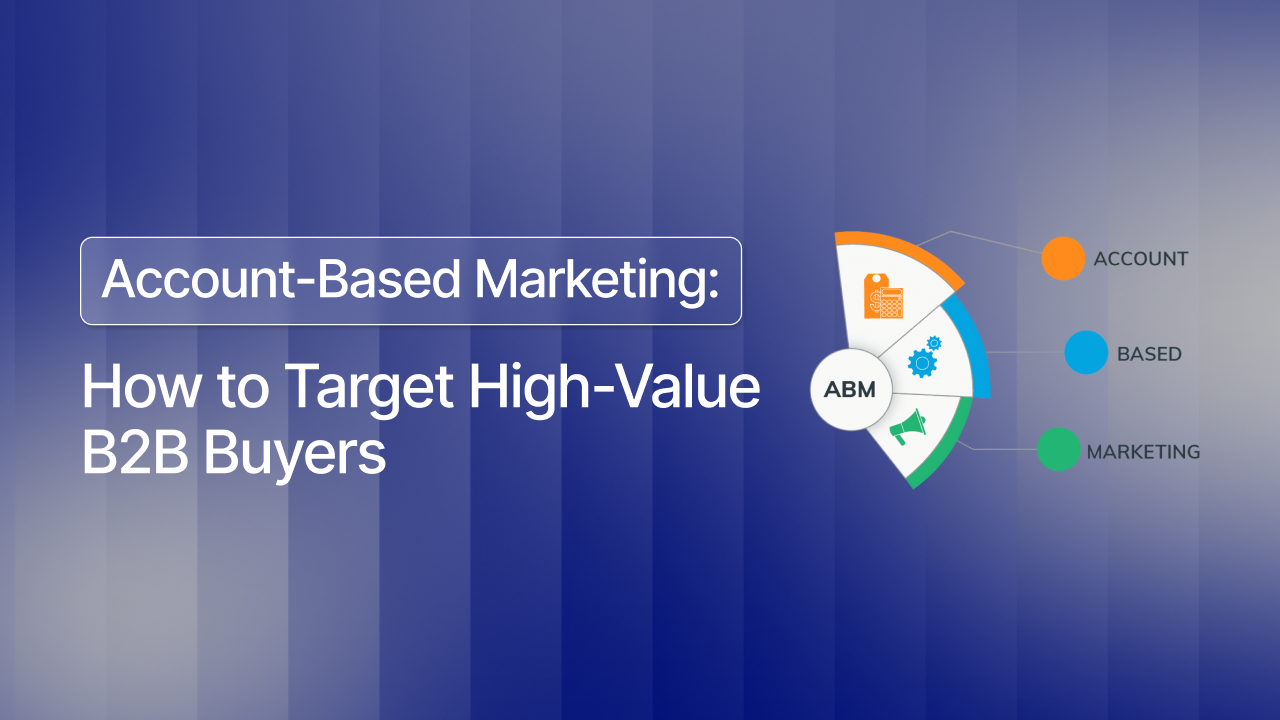
Account based marketing (ABM) is a B2B marketing strategy that identifies a specific list of target accounts companies that match the ideal customer profile for high-value, high-fit customers and coordinates sales and marketing activities specifically around engaging, nurturing, and converting those accounts, treating each account as a distinct market with specific stakeholders, specific pain points, and specific content requirements.
The fundamental structural difference from traditional demand generation:
Traditional demand generation generates volume publishing content, running paid ads, building email lists and filters the resulting leads for quality using lead scoring and qualification processes. Marketing is measured by MQL volume; sales is responsible for converting MQLs to pipeline.
Account based marketing starts with quality defining which accounts are worth pursuing before generating any content or advertising and generates volume of engagement within that quality-defined account set. Marketing and sales are jointly measured by account pipeline and revenue from the target account list.
Three ABM model types exist, each appropriate for different account list sizes and resource levels:
One-to-One ABM (Strategic ABM): deeply personalized programs for the 5–20 highest-value target accounts. Each account gets a bespoke campaign custom content, dedicated sales engineering time, personalized events. Resource-intensive; appropriate for accounts representing $1M+ potential ACV.
One-to-Few ABM (ABM Lite): moderately personalized programs for a cluster of 20–200 target accounts with strong firmographic and pain-point similarities. Content is personalized to industry vertical and company size tier rather than to individual accounts. The most common ABM model for mid-market B2B organizations.
One-to-Many ABM (Programmatic ABM): technology-driven personalization at scale for 200–2,000 target accounts. Personalization is driven by account data and intent signals fed into advertising platforms and content systems. More efficient than One-to-One at scale; less personalized but more accountable than traditional demand generation.
The Performance Data That Makes the ABM Case
ABM vs Traditional Demand Generation: Key Metrics
|
Metric |
Traditional Demand Generation |
ABM (Mature Program) |
Improvement |
|
Average deal size |
Baseline |
25–50% larger |
Larger deals from better-fit accounts |
|
Win rate |
Baseline |
15–30% higher |
More engaged, better-fit prospects |
|
Sales cycle length |
Baseline |
10–20% shorter |
Earlier multi-stakeholder engagement |
|
Marketing ROI |
Baseline |
2–3x higher |
Concentrated spend on convertible accounts |
|
Marketing-sales alignment score |
Low |
Significantly higher |
Shared account list and metrics |
Sources: ITSMA ABM Benchmark Study 2025; Demandbase State of ABM 2025; Forrester B2B Marketing Benchmark 2025.
The Intent Data Advantage
-
ABM programs using third-party intent data to prioritize active-research accounts achieve 30–40% higher engagement rates compared to ABM programs targeting based on firmographics alone because intent signals identify accounts in active buying mode rather than accounts that simply match the ICP profile (Bombora Intent Data Benchmark, 2025)
-
Organizations using coordinated ABM (aligned sales and marketing on the same account list with shared pipeline metrics) report 2–3x improvement in pipeline efficiency more pipeline value per dollar of sales and marketing investment compared to organizations running disconnected sales outreach and marketing demand generation (ITSMA, 2025)
How to Build an ABM Program: A 5-Step Framework
Step 1: Build Your Ideal Customer Profile and Target Account List
Every ABM program starts with the same question: which accounts, if won, would create the most value? The answer comes from analyzing your existing customer base:
-
Analyze your best customers: identify the 20–30 customers with the highest ACV, lowest churn rate, highest expansion revenue, and shortest sales cycles the customers who got the most value from your product fastest with the least friction
-
Extract the firmographic patterns: what industries, company sizes, geographies, and tech stacks are over-represented among your best customers? These patterns define your ICP.
-
Extract the behavioral patterns: what buying signals, organizational triggers (new funding, leadership change, compliance deadline, M&A), and pain points were present at the time your best customers began their buying process?
-
Build the target account list: identify companies that match the ICP firmographic and behavioral patterns typically using a combination of your CRM data, LinkedIn Sales Navigator, ZoomInfo, or Clearbit prioritized by fit score and intent signal strength
A well-constructed target account list for a One-to-Few ABM program contains 100–500 accounts; a Programmatic ABM list typically contains 500–2,000 accounts, all within the ICP and filtered for minimum fit score.
Step 2: Map Stakeholders and Define Engagement Strategy Per Account
B2B enterprise deals involve multiple stakeholders each with different priorities, different information needs, and different roles in the purchase decision. ABM effectiveness depends on engaging the full stakeholder committee, not just the most accessible contact:
-
Map the buying committee for your ICP accounts: identify the typical decision-maker (economic buyer), champion (internal advocate), user (day-to-day user of your product), technical evaluator, and blocker (legal, security, procurement) for accounts in your target segment
-
Define the content and message for each stakeholder role: the CFO cares about ROI and cost; the CISO cares about security and compliance; the end user cares about ease of use and workflow integration. Each needs different content to move through their individual evaluation journey.
-
Define the engagement channel mix for each stakeholder: executives engage through LinkedIn thought leadership, executive events, and personalized executive outreach; technical evaluators engage through documentation, technical blog content, and demos; end users engage through product trials, tutorials, and peer reviews on G2 or Gartner Peer Insights
Step 3: Create Account-Specific Content and Personalization
ABM content is fundamentally different from demand generation content it is specific rather than general, demonstrating that you understand the target account's specific context:
-
Industry-specific content: case studies from the target account's industry, content that uses industry-specific language and references industry-specific regulatory or competitive context
-
Company-specific personalization: personalized landing pages that reference the target account by name, their industry, and their specific challenges (achievable through tools like Mutiny or Clearbit Reveal)
-
Trigger-based content: content responding to specific account signals if intent data shows the account is researching a competitor, deploy competitive differentiation content; if the account announced a new CISO, deploy security and compliance content; if the account raised funding, deploy growth and scaling content
Step 4: Orchestrate Multi-Channel Account Engagement
ABM works through coordinated, multi-channel account presence not through any single channel. The account must encounter your brand, your content, and your value proposition across multiple touchpoints in a coordinated sequence:
ABM channel stack:
-
LinkedIn advertising (account-matched): target your account list with role-specific LinkedIn ads most B2B ABM programs anchor on LinkedIn for executive and decision-maker reach
-
Display advertising (IP-matched): serve display ads to website visitors from target account IP ranges through platforms like Demandbase or 6sense
-
Email sequences (personalized): multi-touch email sequences personalized to account context and stakeholder role, triggered by engagement signals
-
Direct mail (high-value accounts): for One-to-One ABM, physical personalized outreach (branded gifts, personalized books, event invitations) cuts through digital noise for the highest-value accounts
-
SDR/BDR outreach (sales-coordinated): sales outreach that is coordinated with marketing engagement the SDR calls when marketing has warmed the account with content and advertising, not in isolation
Step 5: Measure ABM With Account-Level Metrics, Not Lead-Level Metrics
ABM measurement requires a fundamentally different metrics framework from demand generation measurement:
Account-level engagement metrics:
-
Account engagement score (multi-channel touchpoints per account per quarter)
-
Stakeholder coverage (percentage of target accounts with 2+ stakeholders engaged)
-
Intent signal change rate (percentage of target accounts showing increasing research activity)
Pipeline and revenue metrics:
-
Pipeline from target account list (vs pipeline from non-target accounts)
-
Win rate on target accounts vs non-target accounts
-
Average deal size from target accounts
-
Sales cycle length on target accounts
Program efficiency metrics:
-
Cost per engaged account
-
Cost per pipeline dollar from target accounts
-
Pipeline ROI from ABM investment
Which Tools Support ABM Program Execution in 2026?
For account intelligence and intent data:
Bombora provides the most widely used third-party intent data for B2B ABM topic-level intent signals at the account level indicating which companies are actively researching relevant categories. 6sense provides integrated intent data, predictive account scoring, and multi-channel advertising activation in a single ABM orchestration platform. ZoomInfo provides contact data, technographic data, and intent signals with the broadest B2B contact database coverage.
For ABM advertising:
LinkedIn Campaign Manager with Matched Audiences and Account Targeting provides the most precise B2B account-level advertising reach for executive and decision-maker audiences. Demandbase and Terminus provide programmatic display advertising with IP-based account targeting for serving ads to website visitors from target account offices.
For website personalization:
Mutiny provides the most widely used ABM website personalization platform serving account-specific homepage variants, messaging, and case studies to visitors from target accounts identified by IP and firmographic matching. Clearbit Reveal provides the underlying account identification that enables personalization.
For ABM orchestration:
HubSpot ABM tools (for HubSpot users) and Salesforce Account Engagement (Pardot) with account-based reporting provide CRM-integrated ABM orchestration aligning sales and marketing activity on the same account list with shared pipeline metrics.
Explore our AI Development Services capabilities for B2B technology companies building AI-powered ABM personalization and account intelligence systems.
What Goes Wrong With ABM Programs and How to Prevent Each Failure
Failure 1: Building the Target Account List From Firmographics Without Fit Analysis
ABM programs that define target accounts as "companies with 500+ employees in X industries" without analyzing which existing customers generated the most value consistently produce target lists full of accounts that match the right size but not the right fit. Build the ICP from analysis of your best existing customers not from assumptions about which companies should be your best customers.
Failure 2: Running ABM as a Marketing Program Without Sales Alignment
ABM programs where marketing builds the account list, creates the content, and runs the advertising without sales participating in account selection and engagement strategy consistently produce marketing activity that doesn't translate to sales pipeline because sales is still working their own account list with their own outreach, disconnected from the marketing engagement. ABM is a joint sales-and-marketing program or it isn't ABM it's targeted marketing.
Failure 3: Measuring ABM With Lead Metrics Instead of Account Metrics
Marketing leaders who measure ABM success with MQL volume metrics consistently report that ABM "isn't working" because MQL volume is lower than from demand generation not understanding that ABM's value is in pipeline quality and revenue from target accounts, not in lead volume. Switch to account engagement coverage, pipeline from target accounts, and win rate on target accounts as the primary ABM metrics before running the first campaign.
Frequently Asked Questions
What Is Account Based Marketing?
Account based marketing (ABM) is a B2B marketing strategy that concentrates sales and marketing resources on a predefined list of high-value target accounts companies that match the ideal customer profile rather than distributing effort across all inbound leads regardless of fit. Each target account is treated as a market of one, receiving personalized content, advertising, and sales outreach specific to their industry, company context, and known pain points. ABM aligns marketing and sales around shared account-level metrics (pipeline from target accounts, win rate on target accounts) rather than the traditional split of marketing measured by MQL volume and sales measured by pipeline generated.
How Do You Build an ABM Strategy?
Building an ABM strategy requires five sequential steps: ICP and target account list construction (analyze your best existing customers to define firmographic and behavioral patterns, then identify external accounts matching those patterns); stakeholder mapping (identify the full buying committee and define content and engagement strategy for each role); account-specific content creation (industry-specific case studies, company-specific landing pages, trigger-based content responding to account signals); multi-channel orchestration (coordinated LinkedIn advertising, display advertising, personalized email sequences, SDR outreach, and for high-value accounts, direct mail, aligned to move accounts through the buying journey); and account-level measurement (engagement coverage, pipeline from target accounts, win rate and deal size on target accounts, not lead volume metrics). Sales alignment is a prerequisite at every step ABM that marketing runs independently of sales participation produces marketing activity without sales pipeline.
How Do You Measure ABM ROI?
ABM ROI is measured at the account level, not the lead level: percentage of target accounts engaged (multi-channel touchpoints received), pipeline generated from target accounts versus non-target accounts, win rate on target accounts compared to the company's overall win rate, average deal size from target accounts, and marketing and sales investment per pipeline dollar from target accounts. The correct comparison for ABM ROI is not ABM versus demand generation on lead metrics it's ABM versus demand generation on pipeline value and revenue from equivalent investment, where ABM consistently produces 2–3x pipeline efficiency improvement for enterprise B2B programs with mature ICP definitions and sales-marketing alignment.
Build the Target Account List From Your Best Customers, Not From Firmographic Assumptions. Align Sales on the Account List Before Running the First Campaign. Measure Pipeline From Target Accounts, Not MQL Volume.
Account based marketing delivers its 2–3x pipeline efficiency improvement larger deals, higher win rates, shorter sales cycles when it is built on a target account list derived from rigorous ICP analysis, coordinated between sales and marketing on shared account-level metrics, and measured against revenue outcomes rather than lead volume.
The B2B marketing and sales leaders achieving the strongest ABM results in 2026 share one program design discipline: they defined the target account list collaboratively with sales before running any advertising or outreach and they agreed on account-level pipeline as the primary success metric before the first campaign launched. That alignment produced ABM programs where marketing activity directly supported sales engagement rather than generating marketing activity disconnected from the accounts sales was actually pursuing.
Run your ICP analysis this quarter pull your 20 best customers by ACV and 90-day churn rate and extract the firmographic and behavioral patterns. Build your target account list from those patterns, filtered by intent data for accounts currently in active research mode. Bring the account list to your sales leadership for validation before activating any advertising or outreach.
To build an account based marketing program that generates measurable pipeline from high-value B2B target accounts, connect with our team for ABM strategy, content, and technology implementation support.